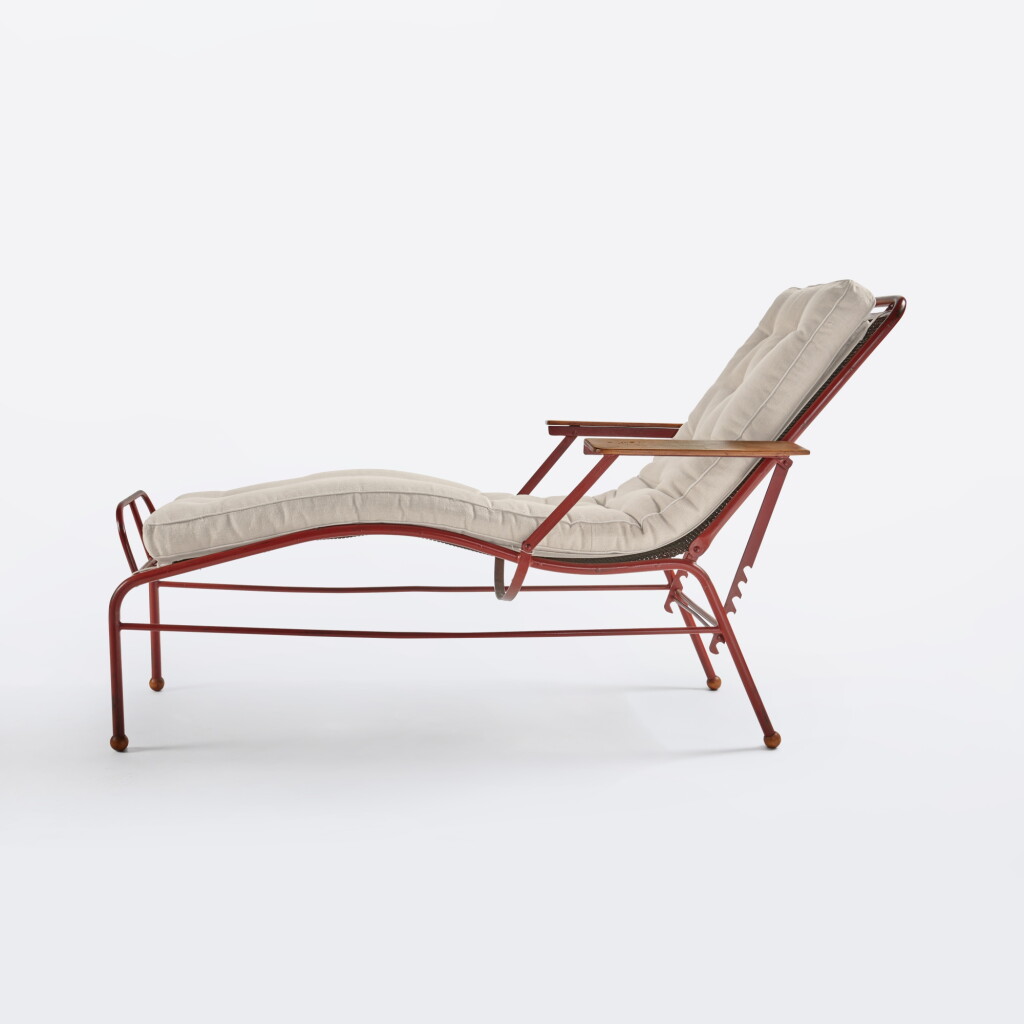
Property from The Stuart Cary Welch Collection
Jules Leleu
Chaise Longue
Lot Closed
October 19, 04:07 PM GMT
Estimate
8,000 - 12,000 USD
Lot Details
Description
Property from The Stuart Cary Welch Collection
Jules Leleu
Chaise Longue
circa 1934-1936
produced by Ateliers Jean Prouvé, Nancy, France
for the sanatorium Martel de Janville, Assy, France
lacquered metal, oak, fabric upholstery
39 ¾ x 32 x 68 in. (101 x 81.3 x 172.7 cm)
Galerie Downtown, Paris
Acquired from the above by the present owner, circa 1998
Modern Quotidian: Furniture by Prouvé, Perriand, Le Corbusier, Rietveld, Fogg Art Museum, Harvard University Art Museums, October 5, 2002–March 30, 2003
Emmanuel Bréon and Michèle LeFrancois, Le Musée des Années 30, Paris, 1998, p. 111
Leleu: 50 ans de mobilier et de décoration, 1920-1970, exh. cat., Musée d'Art et d'Industrie André-Diligent, Paris, 2007, p. 101
Françoise Siriex, The House of Leleu: Classic French Style for a Modern World 1920-1973, New York, 2008, p. 178 (for a discussion of the furniture designed for the sanatorium Martel de Janville)
Modernist designers often sought unexplored avenues in the development of their craft— combining existing techniques with new artistic sensibilities, and blurring the lines between luxury and mass production. An unlikely opportunity was found in sanatoriums, specialized hospitals for convalescing that began to appear around France at the end of the 19th century. These often state-funded facilities embraced modernism from the start, incorporating minimalist structural design and sculptural elements throughout. In 1932, architects Pol Abraham and Jacques Henri Le Même constructed the Martel de Janville Sanatorium in Plateau d’Assy, France. The asymmetrical building was designed for military personnel, offering them an aseptic environment for long term care and treatment. When the French Air Force offered 1,700 francs per room for the sanatorium’s furnishing, Jules Leleu and Jean Prouvé won the contract. The partnership was a dream pairing as Prouvé’s interest in new materials and techniques such as steel, aluminum and welding met Leleu’s proclivity for marquetry and neoclassical styles. In line with his preferred mode of crafting, Leleu first produced the prototypes in wood and once finalized, the models were mass produced by Prouvé in a painted sheet metal of bright, Venetian red hue, mirroring accents on the exterior of the sanatorium. Through the project, the two saw an unique opportunity to blend design with function, working within the formal constraints of a medical facility.
You May Also Like