Property of a Gentleman | 士紳收藏
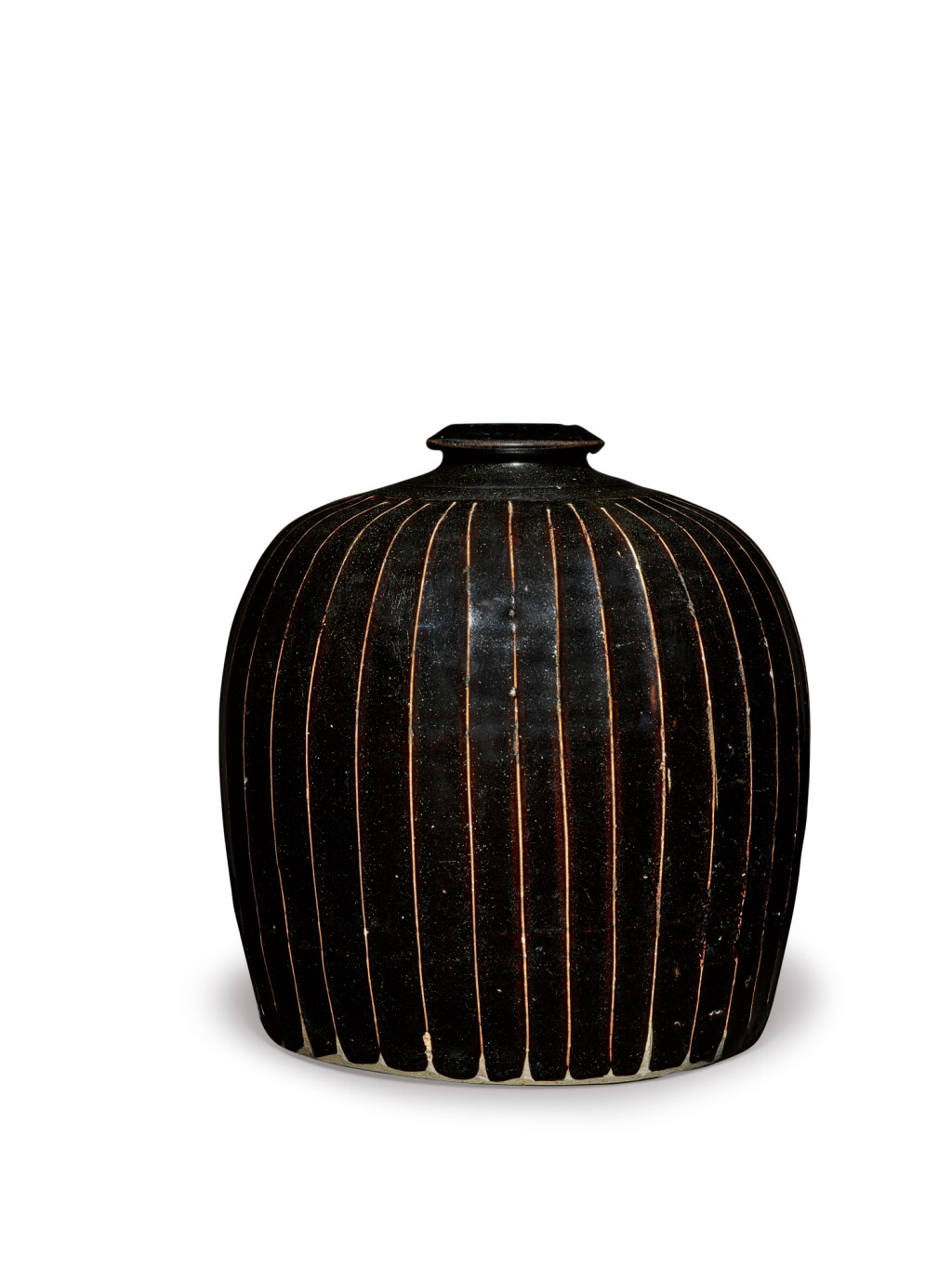
A black-glazed ribbed vase, tuluping, Northern Song - Jin dynasty | 北宋至金 黑釉棱線吐魯瓶
Auction Closed
November 26, 08:41 AM GMT
Estimate
400,000 - 800,000 HKD
Lot Details
Description
Property of a Gentleman
A black-glazed ribbed vase, tuluping,
Northern Song - Jin dynasty
士紳收藏
北宋至金 黑釉棱線吐魯瓶
h. 22 cm
The present vase is one of the finest examples of black wares with ribbed decoration. The seemingly easy, yet highly effective method of decorating a black jar with parallel white lines was adopted by many northern kilns during the Song dynasty. Qualities, shapes and details of the execution, however, vary considerably. Extant dark vessels with bright lines are mostly adorned in a relatively spontaneous manner. It is extremely rare to find an example with a finish as refined as that on present piece. The fine and straight white ribs, running in parallel all the way from the top to the bottom, point to the skilful control craftsmen were able to exert over the medium at the time.
However popular vessels of this design were, they usually came in the form of wide-mouthed jars with or without handles; pieces of the present form are extremely rare. This impressive shape, with a small mouth, broad shoulders and wide base, is known as tuluping, or truncated meiping, and was used for storing wine. Usually consumed at a warm temperature, alcohol would have been transferred to an ewer or smaller bottle for pouring into the cup.
White-ribbed dark wares were mostly produced in the 12th and 13th centuries, at numerous kilns in Henan, Hebei, and Shandong provinces. Robert D. Mowry discusses this type of ware in detail in the catalogue of the exhibition Hare’s Fur, Tortoiseshell, and Partridge Feathers: Chinese Brown-and Black-Glazed Ceramics, 400-1400, Harvard University Art Museum, Cambridge, 1996. He suggests that ribs of white slip were first decoratively used during the Tang dynasty, on ceramics imitating lacquer or silver, mainly to segment the interiors of open-form vessels (p. 176). In the 10th and 11th centuries, they were sparingly added to the exteriors of vessels, before emerging as an important decorative scheme in their own right by the twelfth century. Although the kilns were mainly located in north China, the limited evidence from the various sites still does not permit conclusive attribution of individual pieces to any particular kiln group.
Compare examples of similar design and form, but with a taller, waisted neck, including one now in the Asia Society, New York (accession no. 1979.143), included in the Harvard exhibition, ibid., cat. no. 62; another sold at Christie’s New York, 13th September 2018, lot 810; and a smaller vessel sold at Christie’s Hong Kong, 30th November 2016, lot 3386.
You May Also Like