
Property from the De An Tang Collection | 德安堂藏玉
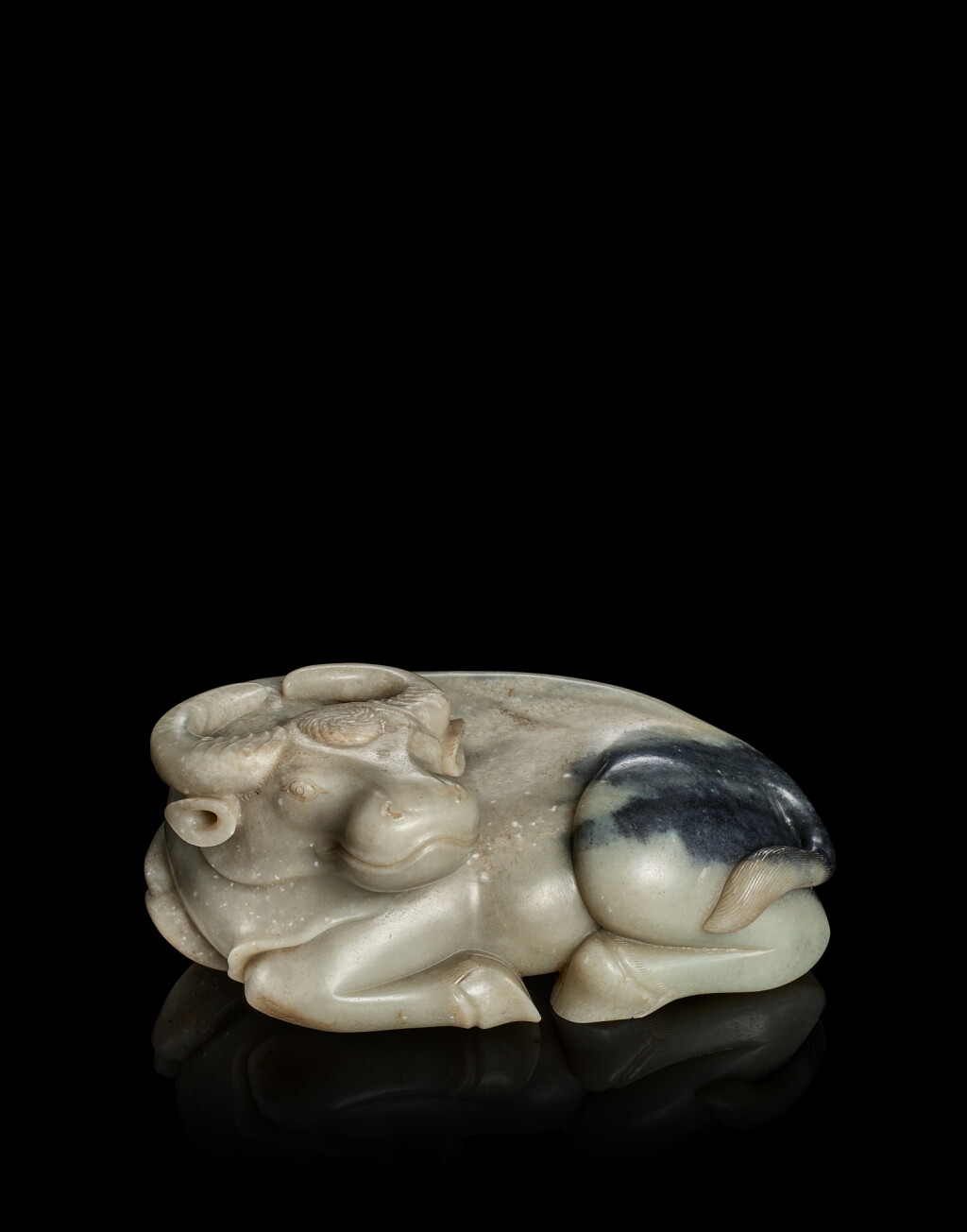
A large greyish-green and black jade water buffalo, Late Ming - early Qing dynasty | 明末至清初 青灰玉大臥牛
Auction Closed
November 26, 08:41 AM GMT
Estimate
2,000,000 - 3,000,000 HKD
Lot Details
Description
Property from the De An Tang Collection
A large greyish-green and black jade water buffalo,
Late Ming - early Qing dynasty
德安堂藏玉
明末至清初 青灰玉大臥牛
wood stand
29 cm
Hall Family Collection, England, acquired circa 1950s.
Sotheby’s Hong Kong, 8th April 2010, lot 1909.
霍爾家族收藏,英格蘭,約1950年代入藏
香港蘇富比2010年4月8日,編號1909
The imposing recumbent beast conveys at once both strength and tranquillity. Buffalos were emblematic of agriculture and as such, in imperial China, where agriculture was considered by Confucian authority to be the main source of tax revenue, the buffalo underpinned rice production and the rural economy represented prosperity and dedication to hard work.
Buffalos were also employed in Chinese literati paintings. Its bucolic aspect evokes the simple and true life in the countryside, and as the reputed mount of the philosopher Laozi, the buffalo also has strong Daoist connotations. Animal sculptures, however, created for pleasure rather than for ritual or burial, are extremely rare in China in any medium.
The present carved buffalo is among the most impressive pieces produced in China since prehistoric times. Exactly when these - in jade terms - 'monumental' animal sculptures were made, is still a matter of debate. The almost eccentric choice of material for this and similar buffalos, distinctly coloured and veined, might fit in best with a late Ming (1368-1644) date, while the masculine strength, elegance and simplicity of the sculpting are in tune with stylistic principles of the Kangxi reign (1662-1722).
Comparable figures are known from several fabled collections of the past, many of which are said to have come from the Summer Palace in Beijing. The present piece is perhaps the most 'life-like' of this small group, the unusual colouring of the stone in different tones of buff and grey being reminiscent of the actual animals' skin. The Jacob Goldschmidt buffalo was exhibited at the influential Ausstellung Chinesischer Kunst, Gesellschaft für Ostasiatische Kunst and Preußische Akademie der Künste, Berlin, 1929, cat.no.1085; the Lord Gladwyn buffalo, sold in these rooms, 1st November 1966, lot 47, and now in the collection of Sir Joseph Hotung, was included in the exhibition Chinese Jade from the Neolithic to the Qing, the British Museum, London, 1995, cat.no.26: 19; the Oscar Raphael buffalo, now in the Fitzwilliam Museum, Cambridge, formed part of the Oriental Ceramic Society exhibition Chinese Jade Throughout the Ages, Victoria and Albert Museum, London, 1975, together with two other jade buffalos, cat.nos.395-7, one from the collection of Somerset de Chair; the Baron Lionel de Rothschild buffalo, later in the Eckstein collection, was sold twice in these rooms, 19th April 1937, lot 47, and 9th December 1948, lot 111; the Alexander Ionides buffalo, later in the Hotchkis collection, was also sold in these rooms, 20th May 1954, lot 101; and the Bulgari buffalo 11th June 1996, lot 190. Another buffalo from the Somerset de Chair Collection that sold twice in our London rooms, 18th July 1952, lot 50 and again 9th June 2004, lot 151.
You May Also Like


