Arnulf Rainer
Kreuz (Cross)
Lot closes
November 12, 01:11 PM GMT
Estimate
50,000 - 70,000 EUR
Starting Bid
50,000 EUR
We may charge or debit your saved payment method subject to the terms set out in our Conditions of Business for Buyers.
Read more.Lot Details
Description
Arnulf Rainer
1929-2025
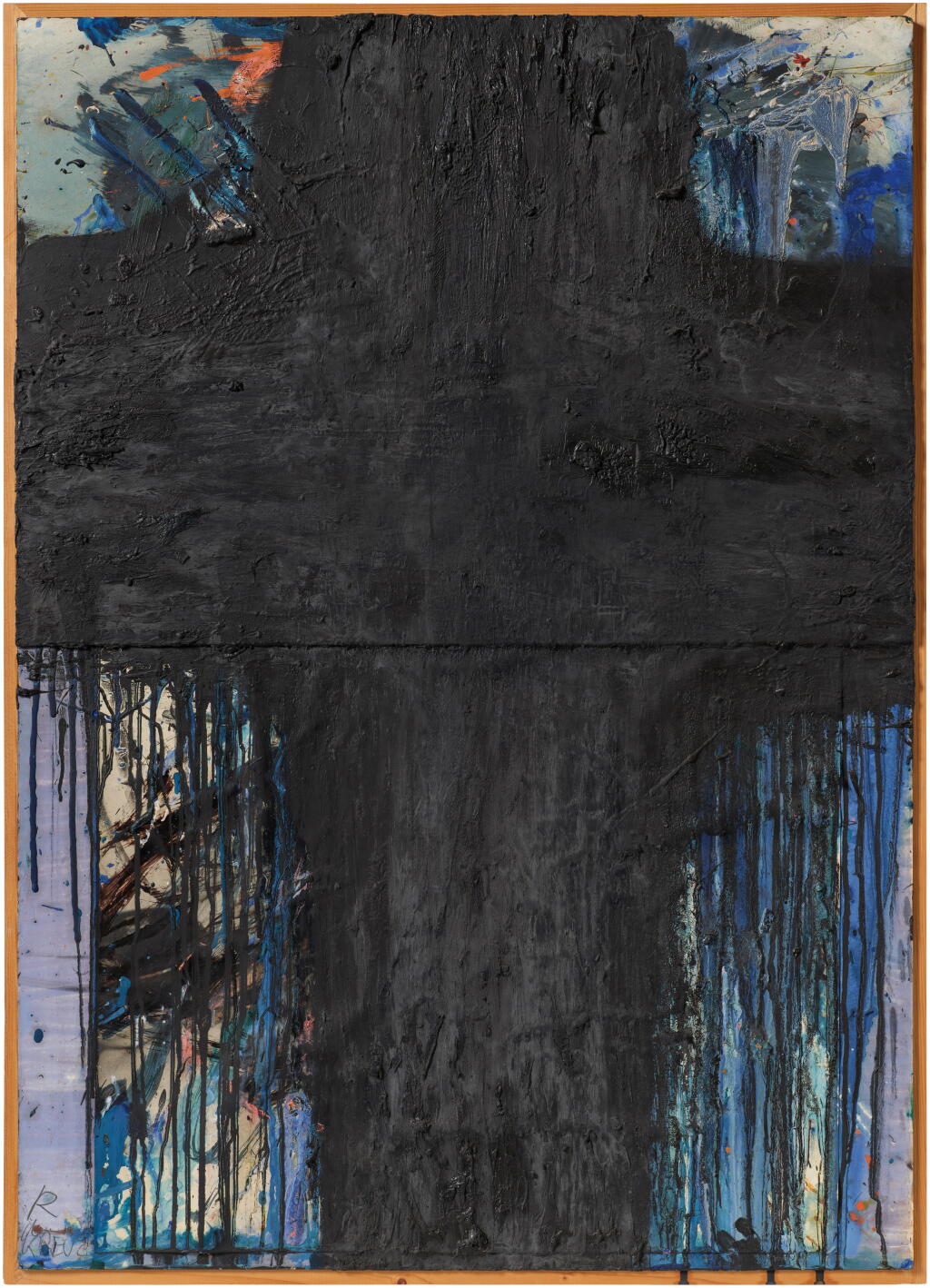
Kreuz (Cross)
signed with the artist's initials and titled (lower left); signed and dated 82 (on the reverse)
oil on board and paper laid down on board, in artist’s frame
104.8 by 75.6 cm.
41¼ by 29¾ in.
Executed in 1982.
Galerie Heike Curtze, Düsseldorf
Private Collection, Europe (acquired from the above in 1988)
Thence by descent to the present owner
Düsseldorf, Galerie Heike Curtze, Arnulf Rainer. Kreuze 1980-1984, 1984, p. 24, illustrated
It started as a black figural structure. I attempted to make a crucified figure. At the start it was a kind of cubic stretch-figure. But it wasn’t successful. It was a stylistic platitude. So, I went on painting and the figure of Christ became a cross. And finally, this cross became veiled by a dark cloud. But I am quite satisfied that something is still perceptible. It doesn’t even have to be consciously perceptible. He [Christ] withdraws when we attempt to represent him. Perhaps he is there in an intimation, in an extinguished, fragmentary way. In certain signs. And yet he even withdraws there. As soon as one thoughtlessly repeats it.
(Arnulf Rainer, quoted in P. Friedhelm Mennekes, Rainer Michael Mason, Arnulf Rainer: Arnulf Rainer. Cross 1956-2009, Nürnberg, 2010, p. 27).
Executed in 1982, Kreuz (Cross) belongs to one of the most significant and enduring motifs within Arnulf Rainer's oeuvre. Since the mid-1950s, the artist repeatedly returned to the image of the cross, employing it not only as a symbol rooted in Christian tradition but also as a means of exploring the limits of representation itself. As Rainer described, his crosses emerged from attempts to depict the figure of Christ, only to become increasingly obscured through the process of painting. The motif thus occupies a space between revelation and concealment, presence and absence.
The present work exemplifies Rainer's engagement with materiality and surface. Executed in oil on paper laid down on board, the work derives its visual strength from the interplay between its elements. The layered construction reinforces the vertical and horizontal axes of the composition, lending the cruciform structure a physical presence. Across this framework, Rainer applies dense passages of black pigment in vigorous gestures, activating the surface while preserving the clarity of the motif. Traces of the artist's intervention remain visible throughout, imbuing the work with a sense of energy and immediacy.
Situated within Rainer's celebrated body of Kreuz paintings and related Übermalungen (Overpaintings), the present work reflects the artist's sustained engagement with the motif of the Cross and its relationship to the figure of Christ. Rather than abandoning figuration altogether, Rainer subjects the image to a process of transformation, shifting the emphasis from representation to the physical act of painting itself. The cross remains legible, its structural presence reinforced by the layered support, while the expressive application of paint introduces movement, tension and ambiguity. Through this interplay of image, material and gesture, the work achieves both a powerful spiritual resonance and the striking material presence that characterises the artist's most accomplished works.
Widely regarded as one of the most important European artists of the post-war era, Arnulf Rainer developed a highly individual visual language in which religious imagery, gestural abstraction and the physical act of painting converge. His international importance has been affirmed through major retrospectives at the Centre Georges Pompidou, Paris, the Solomon R. Guggenheim Museum, New York, and the Stedelijk Museum, Amsterdam. In the present work, these concerns coalesce with particular clarity, making Kreuz a compelling example of the artist's enduring engagement with the themes of revelation, concealment and transcendence.
You May Also Like