
PROPERTY FROM A PRIVATE JAPANESE COLLECTION
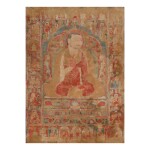
A THANGKA DEPICTING PHAGMODRUPA, TIBET, CIRCA 13TH CENTURY
Auction Closed
September 22, 07:46 PM GMT
Estimate
60,000 - 80,000 USD
Lot Details
Description
PROPERTY FROM A PRIVATE JAPANESE COLLECTION
A THANGKA DEPICTING PHAGMODRUPA
TIBET, CIRCA 13TH CENTURY
26 by 18 ⅝ in. (66 by 47 cm)
the master with closed cropped black hair, hands held in vitakra mudra with chakras painted in gold on the inner palms of the hands, dressed in a red patchwork robe and cloak of golden floral patterned cloth, seated on a multi-colored lotus supported by a tiered throne draped with a floral patterned altar cloth, the green throne back against a torana flanked by green elephants supporting viyalas, the upper border portraying the lineage of the Kagyu masters, the side and lower borders showing scenes from the previous lives and recent life of the master
Himalayan Art Resources item no. 13727.
Private Collection, Japan
Rossi & Rossi, Selection 1994, exh. cat., London, 1994, p. 23, cat. no. 9
Steven Kossak, Painted Images of Enlightenment, Marg Publications, 2010, p. 78, fig. 52
David P. Jackson, Mirror of the Buddha, Rubin Museum publication, 2011, p. 142, fig 5.7
Beginning in central Tibet in the second half of the twelfth century, representations of living gurus became visually synonymous with depictions of buddhas. These thangkas portraying gurus were primarily meant to act as the “‘living’ presences” of the teacher and provided the main means of spiritual worship for followers at the time (S. Kossak, Painted Images of Enlightenment, Mumbai, 2010, p. 41). This movement, tied to the rise of guru worship in the twelfth century, became largely associated with the portrait of Phagmodrupa (1110-11700), and there remain several close examples of his portrait, including this present work. (D. Jackson, Mirror of the Buddha: Early Portraits from Tibet, New York, 2011, pp. 133-134).
The founder of the Pagdru Kagyu School, Phagmodrupa attracted meditators and followers to his hut in Phagmodru, a juniper forest that would later become the celebrated site of Densatil Monastery. His teaching, said to be profound, encouraged monks to come from afar to study with the great master, and his reputation among students gave him an elevated status that likened him to that of a deity.
By placing Phagmodrupa at the center of the painting in a large proportion, he holds the position typically associated with a deity. The ornamented lotus seat on which he sits and the embellished throne back flanked by two viyalas, all painted with richly textural details, is majestic and ceremonial. His hands gently twist in the elegant gesture of the vitarka mudra, the gesture of exposition, marking the great power of his teachings. The delicately painted golden wheels on his hands and feet represent the physical attributes of an enlightened being.
While he maintains venerated status in the painting, he also possesses details that capture the likeness of his individualized features. In all the extant examples, Phagmodrupa is portrayed with his hair closely cropped in an identical manner, a light shading of facial hair, a wide face, a rounded nose and his mouth open showing his teeth (Jackson, p.138). Certain facial features make him instantly recognizable, but at the same time his body and the styling of his robes take on a more generic type, a format that can be linked visually to other portraits of Taklung masters. There is a play between the individualized features and the more naturalistic approach that Kossak discusses, and this contrast would have personalized the presence of the guru for the student while at the same time upholding his deified status (Kossack, 84).
In the borders of the painting are representations of spiritual adepts and included to link the teacher within the continuity of a spiritual lineage. They “proclaim the teachers’ historic role as links in the unbroken chain of received mysteries emanating from India that made them repositories of supernatural religious power and prestige.” (ibid.) Phagmodrupa was a disciple of Gampopa and student of the long lineage of Karma Kagyu masters, including Tilopa, Naropa, Marpa and Milarepa, represented here in the upper border. Only one other portrait of Phagmodrupa portraying the Kagyu lineage remains in the Tamashige Collection (The World of Mandala- Tamashige Tibet Collection, Okura Museum of Art, Japan, 2005, cat. no. 17), making this thangka a rare and masterful example of the Taklung portraiture style.