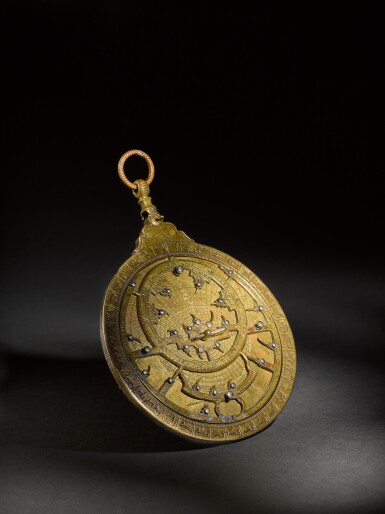
A brass astrolabe, attributable to the workshop of al-Hasan ibn Ahmad al-Battuti, Morocco, late 17th/early 18th century
Auction Closed
October 25, 04:59 PM GMT
Estimate
80,000 - 120,000 GBP
Lot Details
Description
cast brass, hammered and engraved, rete with curved hook-like pointers with silver studs, comprising three plates with the localities for Mecca, Medina, Fes, Marrakesh, Egypt, and all latitudes, a replacement plate for Ouazzane, the interior of the mater with inscriptions in Andalusian Kufic with latitudes, longitudes and climates for 32 localities, reverse with shadow square, with shackle and loop, alidade, pin and a replacement horse
16.9cm. height including shackle
The Maghrib was the scene of major activity in mathematical astronomy and astrology from the tenth to the fifteenth century, and an interest in traditional astronomy continued there until the early-twentieth century. In particular, the construction of instruments continued into the late nineteenth century.
Hasan ibn Ahmad and his brother Muhammad ibn Ahmad al-Battuti were prolific astrolabe makers of the late seventeeh/early eighteenth century and together they represent the last generation of serious and distinguished makers in the Maghrib. Examples of Muhammad ibn Ahmad al-Battuti’s scientific instruments far outnumber those of his brother, with David King recording only three by the maker; one in the National Museum of American History, Washington D.C., dated 1103 AH (acc. no.215454)' another in the Museum of Islamic Art, Cairo, dated 1106 AH, and a final one in a private collection, dated 1097 AH (King 2005, p.1014).
The present astrolabe shares many features typical of astrolabe production in the Maghrib. The form of the rete and the hooked star pointers rising from a cluster of three roundels is a typical feature. See, for example, an astrolabe by Muhammad ibn Ahmad al-Battuti in the Royal Museum, Greenwich (inv. no.AST0532). The example in the National Museum of American Art, Washington, which is signed by Hasan ibn Ahmad al-Battuti and dated 1691 AD, shares many features with the present example. The workmanship of the throne and rete is comparable, both similarly formed with the throne left plain aside from a narrow engraved line to frame the outline. The similarities suggest that the instrument was produced by a maker with knowledge of Hasan ibn Ahmad al-Battuti’s production, most likely a student in his workshop.
You May Also Like