
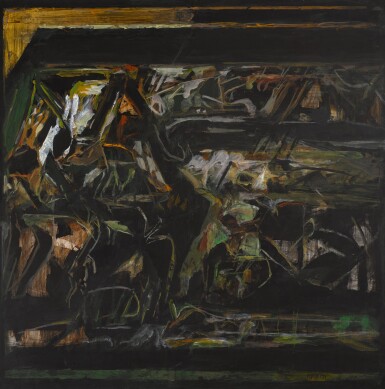
PROPERTY FROM A PRIVATE NORWEGIAN COLLECTION
SAYED HAIDER RAZA | UNTITLED
Auction Closed
September 29, 03:32 PM GMT
Estimate
20,000 - 30,000 GBP
Lot Details
Description
PROPERTY FROM A PRIVATE NORWEGIAN COLLECTION
SAYED HAIDER RAZA
1922 - 2016
UNTITLED
Acrylic on paper
Signed and dated 'RAZA ' 81' lower right and further signed, dated and inscribed 'RAZA / 1981 / 80X80cms / Acrylic on paper _' on reverse
79.6 x 79.6 cm. (31 ¼ x 31 ¼ in.)
Painted in 1981
Acquired from Galleri Koloritten, Stavanger, circa 1980s
This work will be included in SH RAZA, Catalogue Raisonné, 1972 – 1989 (Volume II) by Anne Macklin on behalf of The Raza Foundation, New Delhi (Image ref SR3418)
During his childhood, Sayed Haider Raza formed a close connection with the natural world. His father was a forest warden stationed in the thick jungles of central India in the 1930s, and this is said to have profoundly influenced the artist. “The most tenacious memory of my childhood is the fear and fascination of Indian forests. We lived near the source of the Narmada river in the centre of the dense forests of Madhya Pradesh. Nights in the forest were hallucinating; sometimes the only humanizing influence was the dancing of the Gond tribes. Daybreak brought back a sentiment of security and well-being. On market-day, under the radiant sun, the village was a fairyland of colours. And then, the night again. Even today I find that these two aspects of my life dominate me and are an integral part of my paintings” (S. H. Raza quoted in Y. Dalmia, The Making of Modern Indian Art: The Progressives, Oxford University Press, New Delhi, 2001, p. 155)
The present work captures the delirium of the dark and dense Madhya Pradesh forests, and the mystical power of nature, more generally, through Raza’s bold use of colour. The artist considered black to be ‘the mother of all colours and the one from which all others were born. It was also the void from which sprang the manifest universe [...] Some of the most haunting works of this period are those which evoke the night [...] where the liminal sheaths of black are illuminated by sparks of white light [...] As with Mark Rothko, black is one of the richest colours in Raza’s palette and signifies a state of fulsomeness. However, for both painters, colours plumb the depths and are not simply used for their own sake.’ (Y. Dalmia, ‘The Subliminal World of Raza’, A Life in Art: S.H. Raza, Art Alive, New Delhi, 2007, p. 197) In the current painting, Raza paints energetic lines and fluid shapes in bright white and vivid greens, yellows and oranges, against a backdrop of impending darkness. His loose brushstrokes evidence the influence of Abstract Expressionism on the artist, and express a sense of chaos. Raza’s use of gestural paintwork was soon to disappear from his painting, to be replaced by a more rigid and formal geometry.
‘In the thickness of his matter, a whole network of coloured veins circulated; flashing reds and yellows pierced deep blacks. Effects of tension and nervous agitation upset shadowy zones. The composition itself was affected by this, and in a given work, the compressed pulsations of the forms, the character of which could be defined as anguishing, were in opposition to immense, light and calm surfaces. Thus, ever faithful to his deep sentiments, Raza sought to free himself of the oppression of the night and to glorify the serenity rediscovered in the light of dawn.’ (J. Lassaigne quoted in Raza: A Retrospective, Saffronart, New York, 2007, p. 76)