
Christian Daniel Rauch
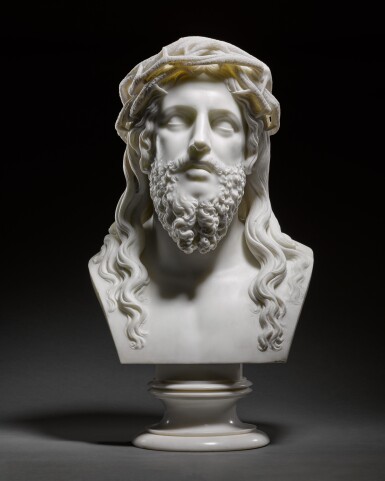
Bust of Christ with the Crown of Thorns
Lot Closed
July 2, 03:01 PM GMT
Estimate
15,000 - 20,000 GBP
Lot Details
Description
Circle of Christian Daniel Rauch (1777-1857)
German, first half 19th century
Bust of Christ with the Crown of Thorns
white marble, on a white marble socle
62cm., 24 3/8 in. overall
Whilst this beautiful Bust of Christ with the Crown of Thorns defies a definite attribution at present, its excellent carving of the crown and fine detail in the hair and beard distinguish it as a work by a master sculptor. The bust relates closely to the work of one of Germany’s foremost 19th century sculptors, Christian Daniel Rauch (1777-1857), and particularly to his marble relief portrait of Christ with the Crown of Thorns on the Tomb of Georg Niebuhr (1776-1831) in the Old Cemetery in Bonn. The parallel treatment of the subject, similar style and technique indicates that the present sculptor was intimately familiar with Rauch’s oeuvre.
During the course of his prestigious career, the King of Prussia, Friedrich Wilhelm III, recognised Rauch's talents and awarded him a stipend to travel to Italy in 1805. In Rome, Rauch befriended the prolific Neoclassical sculptors Antonio Canova and Bertel Thorvaldsen, and developed his own personal style, oscillating between Neoclassicism and the prevailing Romantic movement. The stylistic features in the present bust resonate with Rauch’s unique sensitivity in carving marble portraits; the unincised eyes and idealised face suggest a Neoclassical influence, while the subject, and expression imbued with subtle pathos is reminiscent of German Romanticism. A bronze portrait relief of Christ wearing the Crown of Thorns, by Christian Friedrich Tieck (1776-1851), a follower of the Romantic movement in Berlin, demonstrates a similar expression with lips slightly parted, and with an equally elaborate crown of thorns (Schinkel Pavillon, Berlin, inv. no. Ks III/131).
The finely textured and expertly undercut crown of thorns compares closely to Rauch’s marble portrait of Agnes in the Alte Nationalgalerie, Berlin (inv. no. B II 167), which includes a similarly cut ivy wreath. Further stylistic parallels can be drawn to the figures in Rauch’s plaster Vendee candelabra in the Nationalgalerie, Berlin (inv. no. RM 213), which include a similar modelling of the waving tresses of hair falling onto the shoulders. Another feature recalling one of Rauch’s hallmarks is the skilfully carved and highly polished socle with a fine double rim at the upper and lower sections.
RELATED LITERATURE
P. Bloch, S. Einholz, J. Von Simson, Ethos und Pathos: Die Berliner Bildhauerschule 1786-1914, exh. cat. Skulpturengalerie – Staatliche Museen Preussischer Kulturbesitz, Berlin, 1990, pp.319-320, no. 271; P. Bloch, W. Grzimek, Das Klassische Berlin: Die Berliner Bildhauerschule im neunzehnten Jahrhundert, Berlin, 1978, nos. 67, 234; J. Von Simson, Christian Daniel Rauch, Berlin, 1996, nos. 78, 105.2, 254, 305.2