
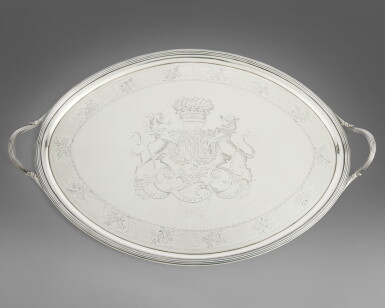
A George III Silver Two-Handled Tray, Timothy Renou, London, 1799
Estimate
5,000 - 7,000 USD
Lot Details
Description
A George III Silver Two-Handled Tray, Timothy Renou, London, 1799
Oval, the center engraved with the marriage arms of the Duke of Somerset, knight of the garter, enclosed by border of bright-cut lattice and flowers, marked on base and engraved with scratch weight 80-19.
79.8 oz
2482 g
length over handles 23 in.
58.7 cm
Sotheby's, London, 13 November, 2020 Lot 113;
Where acquired by the present collector.
The arms are those of Seymour and others for the Dukes of Somerset, the head of which house at the time when this tray was made was Edward Adolphus Seymour (later St. Maur), 11th Duke of Somerset (24 February 1775 – 15 August 1855), who succeeded to the title upon the death of his father on 15 December 1793. His first wife, whom he married on 24 June 1800, was Lady Charlotte Douglas-Hamilton (6 April 1772 – 10 June 1827), daughter of Archibald Hamilton, 9th Duke of Hamilton, by whom he had seven children. His second wife, whom he married on 28 July 1836, was Margaret, daughter of Sir Michael Shaw-Stewart, 5th Bt. of Blackhall, Renfrewshire.
'THE DUKE OF SOMERSET is the son of Webb, Duke of Somerset, by Miss Bonnel [sic], and was born in 1775. The name of their progenitors, who came from Normandy, was, originally, St. Maur, now corruptly Seymour. This family affords a singular instance of an elder branch succeeding a junior. His ancestor, Sir Edward Seymour [1633-1708], had the honour to be the first man of note that joined King William [III]. The present peer was educated at Christ's-Church, Oxford, and came to the title in 1793. In [1800] he married Lady Charlotte Hamilton, daughter of the Duke of Hamilton. When he first came to his title, the duke had a very slender fortune, and, therefore, prudently lived retired, until by legacies and other successions he acquired the means of supporting, with propriety, the high dignity of duke. A few years ago [in 1811] he was able to purchase the fine seat and estate of Bulstrode, [Buckinghamshire] for 100,000£. and upwards. He has no place or favour from government, and, like his ancestors, continued to act the part of a true whig.' (Public Characters of All Nations, Sir Richard Phillips and Co., London, 1823, vol. III, pp. 419-420)
You May Also Like


