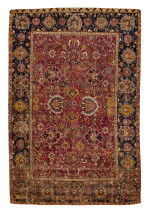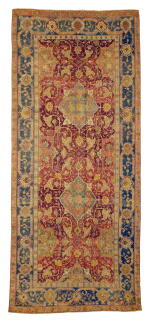
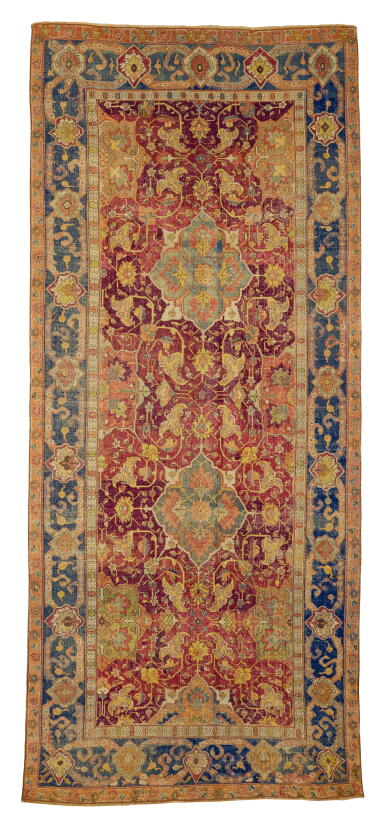
A Safavid Medallion Carpet, Northwest Persia, Second Half 17th Century
Estimate
100,000 - 150,000 USD
Lot Details
Description
A Safavid Medallion Carpet, Northwest Persia, Second Half 17th Century
approximately 14ft. 3in. by 6ft. 1in.
434 by 185 cm
Karekin Beshir, New York;
Mr. and Mrs. Lammot du Pont Copeland, Mount Cuba, Delaware;
Anonymous sale, Sotheby's, New York, 31 January 2014, lot 121;
Where acquired by the present collector.
"Auction Price Guide" in HALI, issue 179, 2014, reproduced p. 137.
The combination of split-leaf arabesque vinery in the field within a palmette-cartouche and strapwork border on this carpet is found on few other Safavid weavings, with the most similar example being a Tabriz carpet formerly in the Berlin Staatliche Museum and lost during World War II, see Arthur Upham Pope, A Survey of Persian Art, New York and London, 1939, vol. VI, pl. 1124. The field pattern itself appears in a few related examples including a Tabriz medallion carpet once in the Charles T. Yerkes collection and now in the Metropolitan Museum of Art, see M. Dimand and J. Mailey, Oriental Rugs in the Metropolitan Museum of Art, New York, 1973, cat. no. 1, fig. 59, p. 39 and a related carpet fragment sold in these rooms, September 20, 2001, lot 2 also published in Pope, op.cit., pl. 1123. The strapwork and palmette cartouche border is found on several Safavid carpets with the most renowned being the Poldi-Pezzoli carpet in Milan, see Pope, ibid, pl. 1118. Here, the border recalls those on the carpets known as the ‘Portuguese’ group, for one example from this distinct group in the Winterthur Museum in Delaware, see Deborah Kraak, “The Head Gardener’s Carpets,” Hali, Issue 89, p. 92, pl. 2. The border system on the present carpet and those of the ‘Portuguese’ carpets, display more stylized drawing than those attributed to Tabriz, as well as differing inner and outer guard borders.
In the carpet offered here, the field is overlaid in an endless repeat of quatrefoil medallions and partial medallions in the manner of early Anatolian carpets, in particular those woven in Oushak with the "Star" design. For an example, see Grant Charles Ellis, Oriental Carpets in the Philadelphia Museum of Art, Philadelphia, 1988, pl. 22. Here, however, the lobed medallions as well as the bold split-leaf arabesques and slightly angular vinery confirm this carpets' Northwest Persian origins. The wide range and juxtaposition of jewel-like colors found here is another hallmark of Safavid carpets, generally more typical of carpets woven in Khorossan on the Eastern side of Persia. The confluence of design influences exhibited by the present carpet is not atypical for carpets woven during the seventeenth century, when weavers and designers moved between court workshops throughout Safavid Persia and beyond, with exchanges between Persia and both Ottoman Turkey and Mughal India. The overall endless repeat medallion pattern in the present carpet (as well as the freedom with which the border is drawn, where the strapwork is unusually spacious and punctuated by stylized ogee cloudbands) appears to be unique, with no other examples in published literature to date. This carpet is therefore an exciting addition to the known corpus of Safavid Persian production.