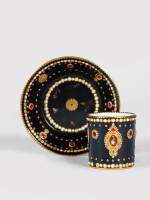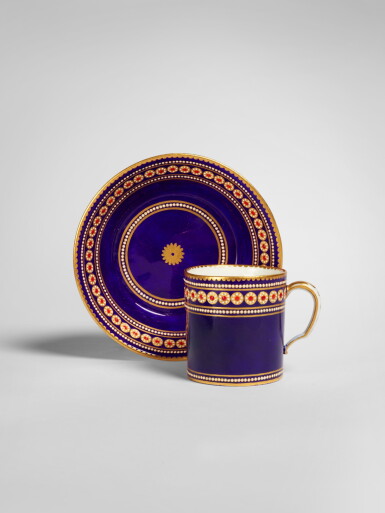
A Sèvres Porcelain 'Jeweled' Bleu Nouveau-Ground Cup and Saucer (Gobelet litron et soucoupe), circa 1780-82
Estimate
4,000 - 6,000 USD
Lot Details
Description
A Sèvres Porcelain 'Jeweled' Bleu Nouveau-Ground Cup and Saucer (Gobelet litron et soucoupe), circa 1780-82
of the third size, finely decorated with a band of red enamelled 'jewels' set on a border of stamped gilt foils, each enriched with tiny white enamel jewels imitating pearls, within gilt-line borders with further white pearls, the foot of the cup and the well of the saucer with a further band of white pearls, gilt-dentil rims, interlaced LL marks in gold, gilder's mark LG for Etienne–Henry Le Guay l'aîné (active at Vincennes and Sèvres 1748-49, 1751-97), the cup with indistinct incised mark, proabably A, 30 & 6, saucer incised numeral 36a
diameter of saucer 4 3/4 in.
12.2 cm
Hans E. Backer, London;
Acquired from the above by an English Collector in 1955;
Thence by family descent in a major stately home collection;
Adrian Sassoon, London;
From whom acquired by the present collector on 26 August, 2021.
The luxurious decoration known as jewelling, in which translucent or opaque enamel bosses were applied over pre-cut gold foils engraved with decorative designs, enjoyed only a brief period of popularity. This was due in part to the considerable time and expense required for its production, as well as the inherently fragile nature of the applied ornament.
Tamara Préaud and Sir Geoffrey de Bellaigue have shown that the two artists principally responsible for this type of decoration were the gilders Joseph Coteau and Philippe Parpette. De Bellaigue further noted that, by about 1782, both men claimed to have invented the technique at Sèvres. The gold foils, which were adhered to the porcelain and served as the foundation for the enamel bosses, were formed by stamping sheets of gold in steel dies engraved by Jean-Pascal Le Guay. The designs for these dies, some of which survive at the Sèvres archives, were supplied by Jean-Baptiste Étienne Genest, head of the painters' studio at the time. A letter dated 2 June 1781 from the comte d'Angiviller, the King's commissaire at the manufactory, to Antoine Régnier, its director, refers to a design by Genest for ten dies intended for this mode of decoration. It would therefore appear that the work of both Coteau and Parpette was carried out under Genest's artistic supervision. For further reading on this decoration technique see A. Sassoon, Vincennes and Sèvres Porcelain: The J. Paul Getty Museum Collection, Malibu, 1991, pp. 119-125;
Related Literature
T. Preaud, "Sevres Enamelled Porcelain: Eight Dies (and a Quarrell), Rediscovered" in Burlington Magazine, No. 128, June 1986, pp. 391-397;
S. Eriksen and G. de Bellaigue, Sèvres Porcelain: Vincennes and Sèvres 1740–1800, London, 1987, p. 139;
R. Savill, The Wallace Collection Catalogue of Sèvres Porcelain, London, 1988, vol. III, pp. 972-973;
R. Savill, Brittle Beauty: Reflections on 18th-Century European Porcelain, London, 2023, pp. 482-488, no. 76,
You May Also Like