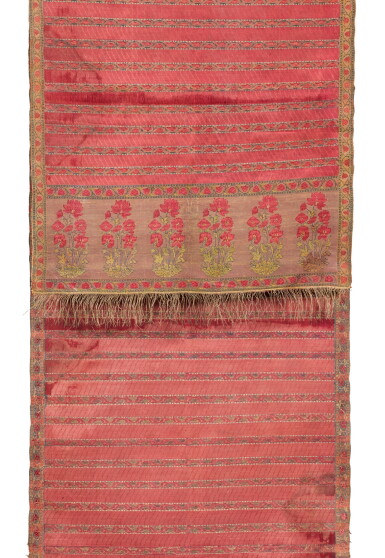
A fine Mughal silk sash (patka), India, Mughal, late 17th century
Auction Closed
October 25, 12:38 PM GMT
Estimate
30,000 - 50,000 GBP
Lot Details
Description
silk and silver and silver-gilt thread, fringe of silver-gilt thread
256.5 by 49.5cm. (101 by 19 ½ in.)
Acquired by Cary Welch by 1980-81
Princes and Painters in Mughal Delhi, 1707-1857, Asia Society Museum, New York, 2012
W. Dalrymple and Y. Sharma (eds.), Princes and Painters in Mughal Delhi, 1707-1857, New York, 2012, no.84, pp.180
The design of this fine silk patka (girdle or waist-sash) consists of a dark red main field with narrow horizontal panels whose designs alternate between a plain red with a faint diagonal stripe and stylised floral scroll in red and green. The panels at either end (pallakas) consist of a silver-thread ground with a row of six large red floral sprays with blue stems and green/gold leaves. Although the floral sprays are somewhat stylised in the conventional pseudo-naturalistic Mughal manner, it is possible to discern several different species of flower, including lotus, carnation, iris and perhaps poppy. There is an outer border containing a meandering floral scroll on gold ground. Very similar patkas dating from the late 17th century are in the Bharat Kala Bhavan, Varanasi (see Stronge 2010, pls.35, 171, pp.57, 210; see also pl.160, p.198) and the Musée Guimet, Paris (see Crill 2015, p.117, fig.122). Further related examples are found in the Victoria and Albert Museum, London (IM.55-1933, IM.56-1933, 317-1907, IM.25-1936, IS.99-1950); the Museum of Fine Arts, Boston (66.858), and the Textile Museum, Washington DC (6.29, T-0609).
Patkas were prominent aspects of courtly attire in 17th and 18th century Mughal India and acted as status symbols, playing an important role in the complex dynamics of court etiquette and hierarchy. Along with robes, daggers (see lot 19), swords and other objects, they were given as gifts by rulers and noblemen to favoured courtiers as part of the elaborate protocol of service, reward, loyalty and fealty. The long, narrow textiles were wrapped around the waist and tied so that the ends hung in front. The sash itself acted as a status symbol and also allowed the wearer to tuck or hang other high-status objects into or on the waistband, such as jewelled daggers, archers’ thumbrings and occasionally pencases. The display aspects meant that elaborate designs with embroidery were often highly favoured. For an informative discussion on Mughal patkas see Cohen 2008, where he observes that the sort of pseudo-naturalistic floral design found in the present example came into use in the 1640s and continued into the 18th century.
Miniature paintings provide an accurate indication of how patkas were worn and their wide variety of designs, as well as the daggers and other accessories that were tucked into them or hung from them. Useful illustrations are found, inter alia, in the royal albums prepared for Shah Jahan (both in the main figures and in the border figures) and in the Windsor Padshahanma with its large number of crowded court scenes (see Welch et al 1987, Wright 2008, Beach and Koch 1997).
You May Also Like