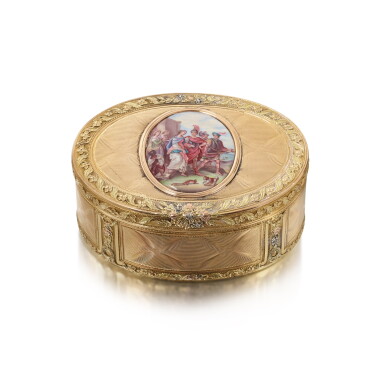
A Four-Colored Gold and Enamel Snuff Box, Esaias Obicker, Hanau, Circa 1770
No reserve
Auction Closed
June 18, 05:01 PM GMT
Estimate
6,000 - 8,000 USD
Lot Details
Description
oval, the lid centered with an oval enamel plaque painted with the Abduction of Helen, after Guido Reni (circa 1628-29), on an unusual engine-turned rose gold ground reminiscent of a cushion, within chased four-colored gold leafy and floral borders, the base and sides similarly decorated, the interior of the lid engraved with a presentation inscription in Cyrillic, maker's mark, Hanau shell control mark for 18 ct gold
Length 3 3/8 in.
8.5 cm
Christie's London, 27 November 2007, lot 48
The bijoutier Esaias Obicker (1733-1802) was first recorded as working in Hanau in 1760 and was active for four decades until the turn of the century (Hesse State Archive, Marburg, HStAM, 81, B 1/80/11). Initially Obicker was in partnership with the Souchay brothers, but he worked on his own from 1762 (Lorenz Seelig, ‘Eighteenth century Hanau gold boxes’, Silver Society of Canada Journal, vol. 18, 2015, p. 45).
The same set of marks as on the present lot can also be found on a small number of Hanau boxes stylistically dating from the early 1760s, which makes sense considering that they were originally modeled after the Paris marks in use from 1756 to 1762; the ‘plough’ mark is reminiscent of the charge mark of Eloy Brichard. The Hanau bijoutiers originally sought to ensure that the gold boxes and other Galanteriewaren (small precious items with a function) sold well to an international clientele at the fairs of Paris, Frankfurt, Leipzig and others in the second half of the eighteenth century. Therefore the Hanau maker’s mark, usually composed of the initials of a bijoutier or those of the surnames of the business partners, was sometimes combined with marks resembling those on contemporary gold boxes produced in trailblazing Paris. While Esaias Obicker seemed to have carried on using this initially early mark for boxes made in the 1770s and 1780s as well, other makers such as Les Frères Toussaint introduced a second set of marks for their later boxes which was based on the Paris marks for 1773/74 (see lot 64 in this sale).
Another oval gold and enamel snuff box of similar date to the present lot and with the same marks for Esaias Obicker, decorated with an enamel plaque representing putti, belongs to the collection of the Musée du Louvre (OA 6782).
The present lot is notably most unusual for the level of inventiveness and degree of execution of the engine-turning, only becoming fully visible as resembling a plushy cushion, almost an optical illusion, when moved around in one's hand.
Engraving source:
L'Enlèvement d'Hélène, Louis Desplaces, after Guido Reni, c. 1737, Rijksmuseum RP-P-OB-63.850
You May Also Like