
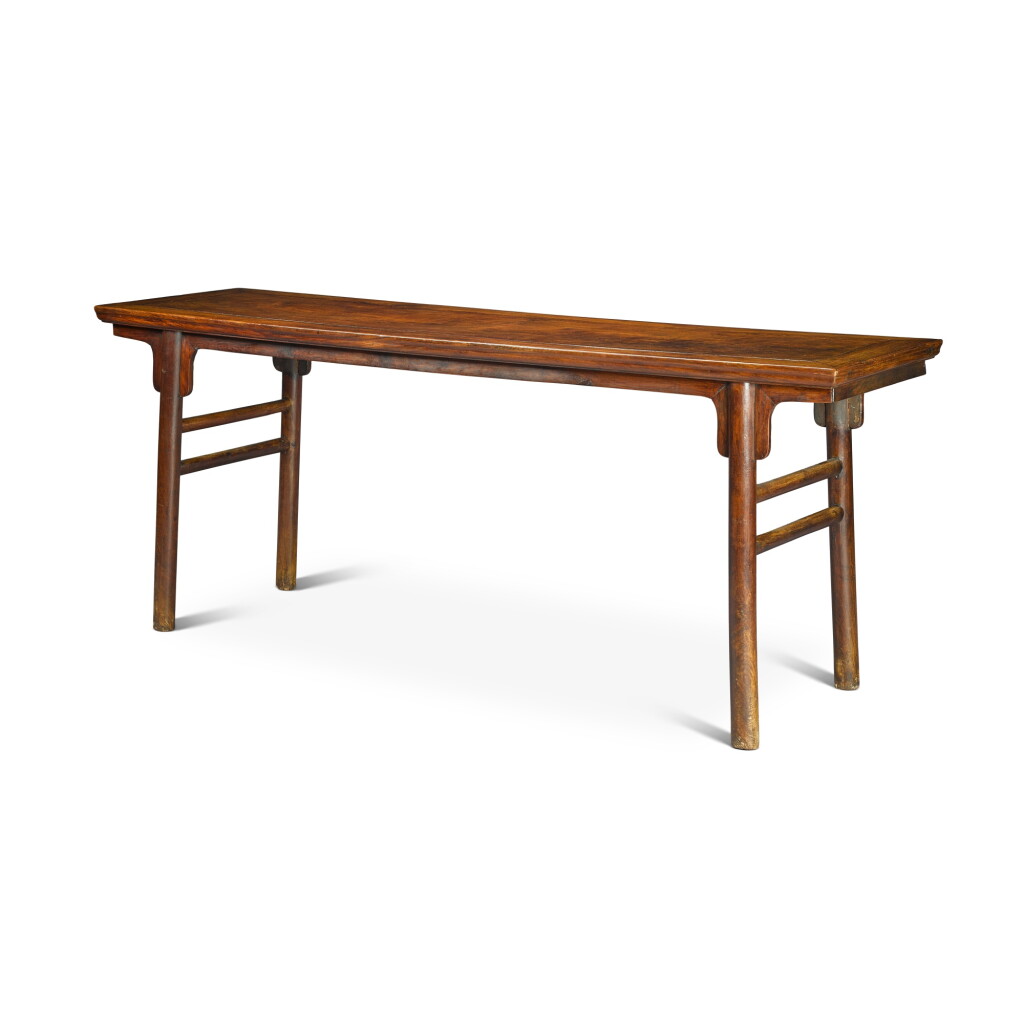
Property of a Gentleman | 私人收藏
A 'huanghuali' recessed-leg table (Hua'an), Late Ming dynasty | 明末 黃花梨夾頭榫畫案
Auction Closed
November 1, 04:48 PM GMT
Estimate
150,000 - 200,000 GBP
Lot Details
Description
Property of a Gentleman
私人收藏
A 'huanghuali' recessed-leg table (Hua'an)
Late Ming dynasty
明末 黃花梨夾頭榫畫案
200.2 by 56.4 by 81 cm, 78 7/8 by 22 1/4 by 31 7/8 in.
Grace Wu Bruce, Hong Kong, 19th February 2006.
嘉木堂,香港,2006年2月19日
Notable for its minimalist form, this table represents one of the most versatile and popular designs in Chinese furniture, as evident in their constant popularity through the generations. Historically referred to as 'character one' table (yi zi shou shi), as the single horizontal stroke of the Chinese character for the numeral 'one' bears resemblance to this linear form, this design appears to have derived from standard wood building construction in use since the Han dynasty. Their light and simple form meant they could be easily moved from one location to another, as revealed in Ming and Qing prints where they are depicted used as altar, painting and also side tables. An illustration of a table of similar design is included in the chapter Lu meng qingyi [Lu's dream of the cherry maid] of the Wanli period version of Quanxiang xinjuan yijian shangxin bian [Beautiful sight: the complete, fully illustrated edition] (fig. 1).
Tables of this type were produced in varying sizes, the present example exemplifying a type of larger dimensions, designed for painting. The height and depth are appropriately proportioned for an artist to stand and freely use the brush over a long paper or silk surface. Fine-grain wood was reserved for painting tables as the craftsmen strove for the pure beauty of the grain and structural form.
See an example of wider proportion included in Wang Shixiang and Curtis Evarts, Masterpieces from the Museum of Classical Chinese Furniture, Chicago and San Francisco, 1995, pl. 55, together with a larger example, pl. 54. Compare also a table of this design but smaller in size illustrated in Wang Shixiang, Connoisseurship of Chinese Furniture, Hong Kong, 1990, pl. B81; another, from the Dr. S. Y. Yip Collection, is illustrated in Grace Wu Bruce, Dreams of Chu Tan Chamber and the Romance with Huanghuali Wood, The Dr. S. Y. Yip Collection of Classic Chinese Furniture, Hong Kong, 1991, pl. 22 and sold in our Hong Kong rooms, 7th October 2015, lot 130; a third table, from the collection of Miriam and Ira D. Wallach, was sold in our New York rooms, 19th / 20th March 2013, lot 466, and another table, sold in our Hong Kong rooms, 22nd April 2021, lot 47.
腿足縮進,不連桌角,乃明代經典式樣,因形似漢字「一」之孑然一筆,素稱「一字首式」。此式脫胎於傳統木造建築,自宋以來頻頻見諸刊本、繪畫,線條簡潔大方,堪稱中式家具不朽之範。觀明清書畫,因其設計簡約,宜置屋中各隅,用途多樣,可作供桌、畫案等。例見明萬曆刊本《全像新鐫一見賞心編》之〈盧夢青衣〉插圖中,盧子伏案,酣睡作夢(圖一)。
這類桌案尺寸不一,此例屬當中較大者,當為畫案,即使佇立揮毫、繪畫巨幅丹青,同樣宜適。案桌形簡質秀,匠師嚴選木材,紋理細膩,尤顯清秀。
參考一略寬之例,載於王世襄及柯惕思,《中國古典家具博物館》,芝加哥及三藩市,1995年,編號55,同書並刊一較大之例,編號54。另見一尺寸較小之例,收錄在王世襄,《明式家具研究》,香港,1990年,圖版乙81。葉承耀藏例,則見伍嘉恩,《攻玉山房藏明式黄花梨家具:楮檀室夢旅》,香港,1991年,編號22,後在2015年10月7日經香港蘇富比易手,編號130。Ira D. Wallach 伉儷舊藏也有一例,2013年3月19/20日在紐約蘇富比拍出,編號466。另參考一近例,2021年4月22日在香港蘇富比拍出,編號47。