F. Masseron à Paris
A rock crystal and gilt-metal mounted verge watch Circa 1640-50
Auction Closed
May 14, 02:23 PM GMT
Estimate
22,000 - 30,000 CHF
Lot Details
Description
F. Masseron à Paris
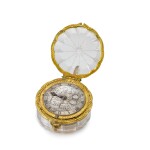
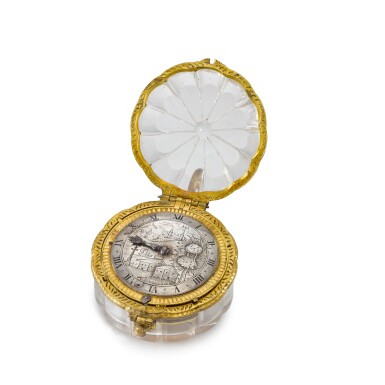
A rock crystal and gilt-metal mounted verge watch
Circa 1640-50
• Movement: gilded full plate, verge escapement, flat two-arm steel balance, screwed-on irregular pierced long balance cock and foot decoratively engraved with flowers and foliage, similarly decorated screw-set ratchet cock, ratchet set-up lacking its tension spring, fusee and chain, turned baluster pillars, signed F. Masseron à Paris
• Dial: silver, chapter ring with Roman numerals, half-hour divisions between, engraved to the centre with a lakeside in the foreground, a walled town in the mid-ground, a castle on a hill in the background, gilt engraved mount, blued steel baluster hand with tulip-form tip and lacking tail
• Case: rock crystal scallop-form with radiating facets to front and back, gilt-metal mounts, short terminal and tulip-form pendant
length including pendant and terminal 47mm
Sotheby's New York, Fine Watches from the Atwood Collection, 11 December 1986, lot 21.
Rock crystal watches were viewed as remarkable curiosities in the mid-17th century. On 5 January 1650 Constantijn Huygens wrote to his brother, Christiaan, from Geneva noting that he had just bought a fashionable new watch with a case made from rock crystal that allowed him to see directly into the movement, describing how it appeared as if made of ice.
A similar rock crystal watch by Benjamin Hill can be found in the collection of the Victoria & Albert Museum, London (accession no. 201-1908), the latter is illustrated in J. F. Hayward, English Watches, 1969, plate 12. A further similar rock crystal watch, signed by Jean Rousseau, is located at the Metropolitan Museum of Art, New York (accession no. 17.190.1014), the latter formerly part of the Pierpont Morgan Collection.
François Masseron is recorded as working in Paris in 1652.