
Henri de Toulouse-Lautrec
Napoléon
Lot Closed
September 26, 03:16 PM GMT
Estimate
30,000 - 50,000 GBP
Lot Details
Description
Henri de Toulouse-Lautrec
1864 - 1902
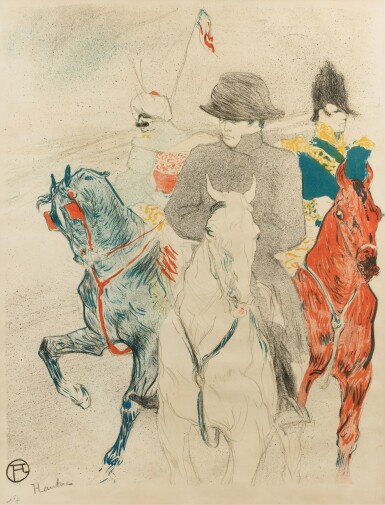
Napoléon
signed in black crayon and numbered in pencil No 7
lithograph printed in colours on wove paper
image: 593 by 460 mm. 23⅜ by 18⅛ in.
sheet: 635 by 494 mm. 25 by 19½ in.
Executed in 1895; this impression is number seven from the edition of 100, printed by Ancourt, Paris.
Delteil 358; Adriani 135; Wittrock 140
Henri de Toulouse-Lautrec stands as an indelibly significant figure in the realm of printmaking, his influence resonating profoundly to this day. Through his mastery of lithography, he revolutionised the medium and elevated it to new heights. Toulouse-Lautrec’s visionary use of colour, emotive contour lines, and assimilation of Japanese print techniques rendered his creations unparalleled among his contemporaries. His posters, created to advertise performers and entertainment venues, captured the essence of Montmartre’s vibrant nightlife and became iconic representations of the era. Toulouse-Lautrec’s prints not only showcased his exceptional artistic talent but also played a significant role in shaping the visual vocabulary associated with Post-Impressionism. His bold approach to composition and abstraction anticipated the artistic developments of the twentieth century, making him a pivotal figure in the evolution of printmaking and modern art as a whole.
His decision to depict Napoleon stands as a departure from his usual artistic inclinations, showcasing divergence from his customary subjects and themes. Toulouse-Lautrec’s choice to depict Napoleon, a figure of historical and political significance, may initially seem incongruous, however his motivation becomes clear upon closer examination. Toulouse-Lautrec was drawn to Napoleon not for his political stature, but for the iconic symbolism he embodied. Napoleon represented power, ambition, and an indomitable spirit, qualities that fascinated the artist. By portraying Napoleon, Toulouse-Lautrec sought to explore and portray the complex interplay between individual identity, societal influence, and the relentless pursuit of greatness that resonated deeply within his artistic sensibilities.