Property from the Collection of Robin Renton
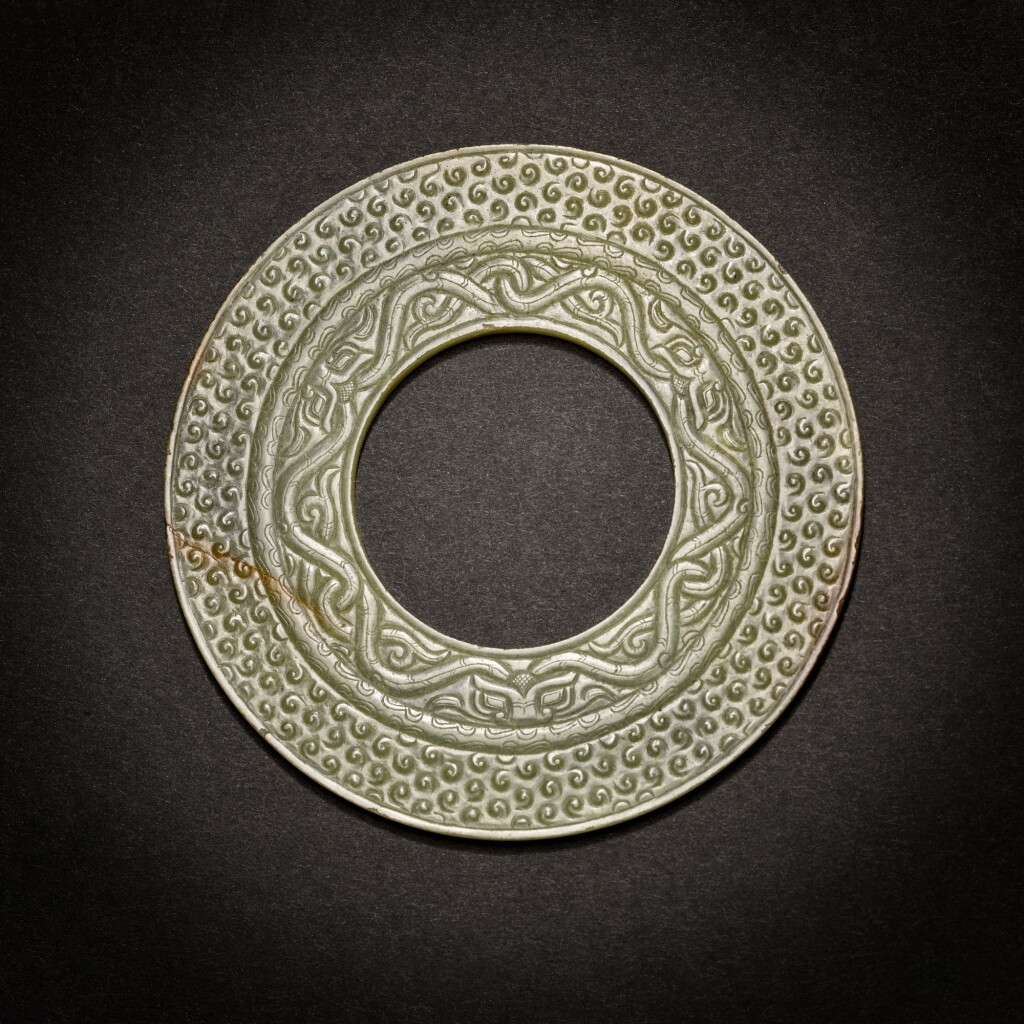
A green jade disc (Bi), Eastern Zhou dynasty, Warring States period
Auction Closed
November 5, 05:06 PM GMT
Estimate
40,000 - 60,000 GBP
Lot Details
Description
metal stand (2)
Diameter 14.9 cm, 5⅞ in.
Mathias Komor, New York.
Collection of Mr and Mrs Eugene Bernat (1896-1982), no. 220.
Sotheby's New York, 7th November 1980, lot 4.
Collection of Dr Isaac Newton (d. 1982).
Bluett & Sons Ltd., London, 18th September 1981.
Jade discs of this type, known as bi, first emerged in the Neolithic period, produced by the Liangzhu culture (ca. 3300-2300 BCE) of the Yangtze River Delta. While continuing to serve an important ritual and funerary function well into the Han dynasty (206 BCE - 220 CE), jade bi soon also developed a more abstract role as symbols of wealth, power and virtue.
Intricately carved with 'rice-grain' spirals framing a serpentine pattern of swirling mythical beasts, jade bi of this quality and large size are attested only in the most lavish of Han archaeological contexts. Compare another bi of closely related design excavated from the tomb of the King of Nanyue (175 - 124 BCE), in Xihan Nanyue wang mu [Tomb of the Western Han King of Nanyue], vol. II, Beijing, 1991, pl. CXI(1); a larger example preserved in the Metropolitan Museum of Art, New York (accession no. 17.118.44), included in Art of the Han, China Institute in America, New York, 1979, cat. no. 75; and another of more crude carving, also uncovered in Guangzhou, in Guangzhou Han mu [Han tombs in Guangzhou], vol. II, Beijing, 1981, pl. XLII.
You May Also Like