
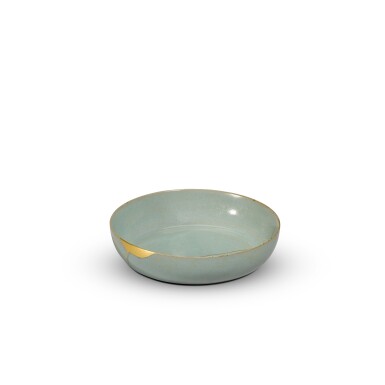
Property from the Collection of Zi Tong Tang
A rare Ru Guanyao brush washer, Northern Song Dynasty
Auction Closed
November 5, 05:06 PM GMT
Estimate
200,000 - 300,000 GBP
Lot Details
Description
finely potted with shallow rounded sides rising from a wide flat base, fully enveloped in a luscious blue glaze, suffused with a latent crackle, the underside heightened with four delicate 'sesame-seed' spur marks, applied with kintsugi-style restoration
Diameter 11.6 cm, 4⅝ in.
Acquired in Hong Kong in the early 2000s.
Shimmering with a water-like surface suffused with the subtlest of craquelure, the present washer is an extraordinarily rare example of Ru ware; designed, thrown and fired for the scholarly brush of the Song Emperor or his closest associates.
The striking simplicity yet infinite complexity of the present washer embodies the very essence of Song philosophy. The minimalist aesthetic of the Song dynasty was deeply rooted in the philosophical currents of Neo-Confucianism, Daoism and Chan (Zen) Buddhism, which each emphasized simplicity, harmony with the cosmic order, and the value of emptiness. Rather than seeking grandeur or ornamentation, Song art aimed to express the essence of things through subtlety, balance, and understatement. This approach reflected a belief in wuwei, or ‘effortless action’, and the idea that true beauty arises when nothing is forced. Chan Buddhism further reinforced this mindset by encouraging direct, unmediated experience and quiet reflection, free from intellectual clutter. In art, this translated into a reverence for calm forms and muted tones that invited introspection rather than more florid stimulation. Just as court painters turned to simplicity and artlessness in their creations, depicting spontaneous moments in humble landscapes frozen at a certain time of day or in certain weather conditions, potters too were admired for achieving glazes of a specific shade (“approaching the blue of the sky after rain”), rather than for the shiny green surface beloved in the Tang dynasty (618-907) for its bright jade-like opulence. The minimalist aesthetic was not merely a style, but a way of seeing the world; one that sought depth in simplicity and clarity in emptiness.
The finest examples of the calm yet extraordinary beauty of Ru ware appear to have been reserved exclusively for the Northern Song court. Produced for only twenty years or so in small-scale workshops to exacting standards and with only two or three surviving examples of many shapes ever recorded, only those pieces of Ru rejected by the emperor were apparently available for sale elsewhere.
Indeed, even by the Southern Song dynasty (1127–1279) as the court fled south to Hangzhou, Ru ware had already become a rare and extraordinary commodity. While official histories record the founding of new guan (‘official’) kilns under Emperor Gaozong (r. 1127–1162) in Hangzhou, designed to imitate the wares of Ru, no other kiln site in the history of Chinese ceramics has succeeded in fully capturing its beauty. By 1151, the ownership of Ru ware appears to have already been considered a marker of extraordinary cultivation and wealth. When high civil official Zhang Jun presented sixteen pieces of Ru ware to the Gaozong Emperor, the moment was noted in the records of Zhou Mi (1232-1298), the Wulin jiushi (‘Ancient matters from Wulin Garden’) for posterity.
By the Ming (1368–1644) and Qing (1644–1911) dynasties, the possession of Ru ware was almost unheard of outside of an Imperial Palace context. While largely not imitated in the Ming dynasty, apparently due to lack of suitable pieces from which to copy, by the Yongzheng reign (1723-17345), the ineffable colours and forms of Ru ware became a key inspiration for the imperial potters and their Emperors, who preserved thirty-one Ru brush washers of various shapes and sizes in the Forbidden City, housed in custom-made, likely Japanese, lacquer boxes. Several Ru pieces are also included in the two Guwan tu (‘Pictures of antiquities’) handscrolls, painted in the Yongzheng reign in 1728 and 1729, respectively, which record art objects in the imperial collection, among them a ‘narcissus basin’ with metal rim (see Regina Krahl, ‘Art in the Yongzheng Period: Legacy of an Eccentric Art Lover’, Orientations, November/December 2005, p. 65 top right), and the bowl, now preserved in the Percival David Collection (see China. The Three Emperors 1662 – 1795, Royal Academy of Arts, London, 2005, cat. no. 168 bottom left).
Even following the accidental discovery of Ru shards at the edge of the village of Qingliangsi near Baofeng county in 1987, and the systematic excavations of the site alongside Zhanggongxiang in Ruzhou city in the early 2000s, the number of extant Ru wares preserved in collections remains exceedingly low, with all but a handful of attested examples now preserved in the world’s most important institutions. According to Regina Krahl’s revised 2021 estimations, only eighty-nine pieces of ‘heirloom’ Ru ware, preserved from antiquity, now appear to survive, with the vast majority preserved in the National Palace Museum, Taipei and the Palace Museum, Beijing. See Regina Krahl, Ruyao No. 88 resides in Dresden, Germany and another chance discovery, Arts of Asia. Spring 2021. And, other than occasional excavated or fire-damaged shards, fewer than ten Ru vessels appear to have ever come to auction since 1940, three of which are now similarly preserved in museum collections, including:
- The bottle from the Eumorfopoulos collection, now in the Sir Percival David Collection in the British Museum (accession no. PDF.61), sold in these rooms, 28th May 1940, lot 135.
- The ‘narcissus basin’ with metal rim from the Ataka Collection, now in the Museum of Oriental Ceramics, Osaka, sold in these rooms, 17th March 1959, lot 26, and again, 24th February 1970, lot 1.
- The brush washer from the K. S. Lo Collection, now preserved in the Hong Kong Museum of Art, sold in these rooms, 15th April 1980, lot 140.
- The dish from the Stephen Junkunc III Collection, now in the collection of Au Bak Ling, sold at Christie’s New York, 3rd December 1992, lot 276.
- The reduced dish from the Stephen Junkunc III Collection, now in a private collection, sold at Christie’s New York, 29th March 2006, lot 401.
- The lobed brush washer from the Alfred Clark Collection, now in a private collection, sold in our Hong Kong rooms, 4th April 2012, lot 101.
- The brush washer from the Le Cong Tang and Chang Foundation Collections, sold in these rooms 15th June 1982, lot 252 and in Hong Kong, 3rd October 2017, lot 5.
Only three other washers of this flat-based shape are known: two preserved in the National Palace Museum, Taipei; and the other, severely fire damaged, from the Percival David Foundation now preserved at the British Museum, London (accession no. PDF,A.25), illustrated in Stacey Pierson, Illustrated catalogue of Ru, Guan, Jun, Guangdong and Yixing wares in the Percival David Foundation of Chinese Art, London, 1999, p. 55, pl. XII. Also compare the brush washer from the collections of Luo Zhenyu and Japanese Prime Minister Inukai Tsuyoshi, of closely related form and kintsugi repair, sold at Council Hong Kong, 2nd April 2019, lot 251; and the teabowl from the collections of Kobijutsu Kusaba and Yuzura Sato, sold at Christie’s Hong Kong, 26th November 2018, lot 8006.


