
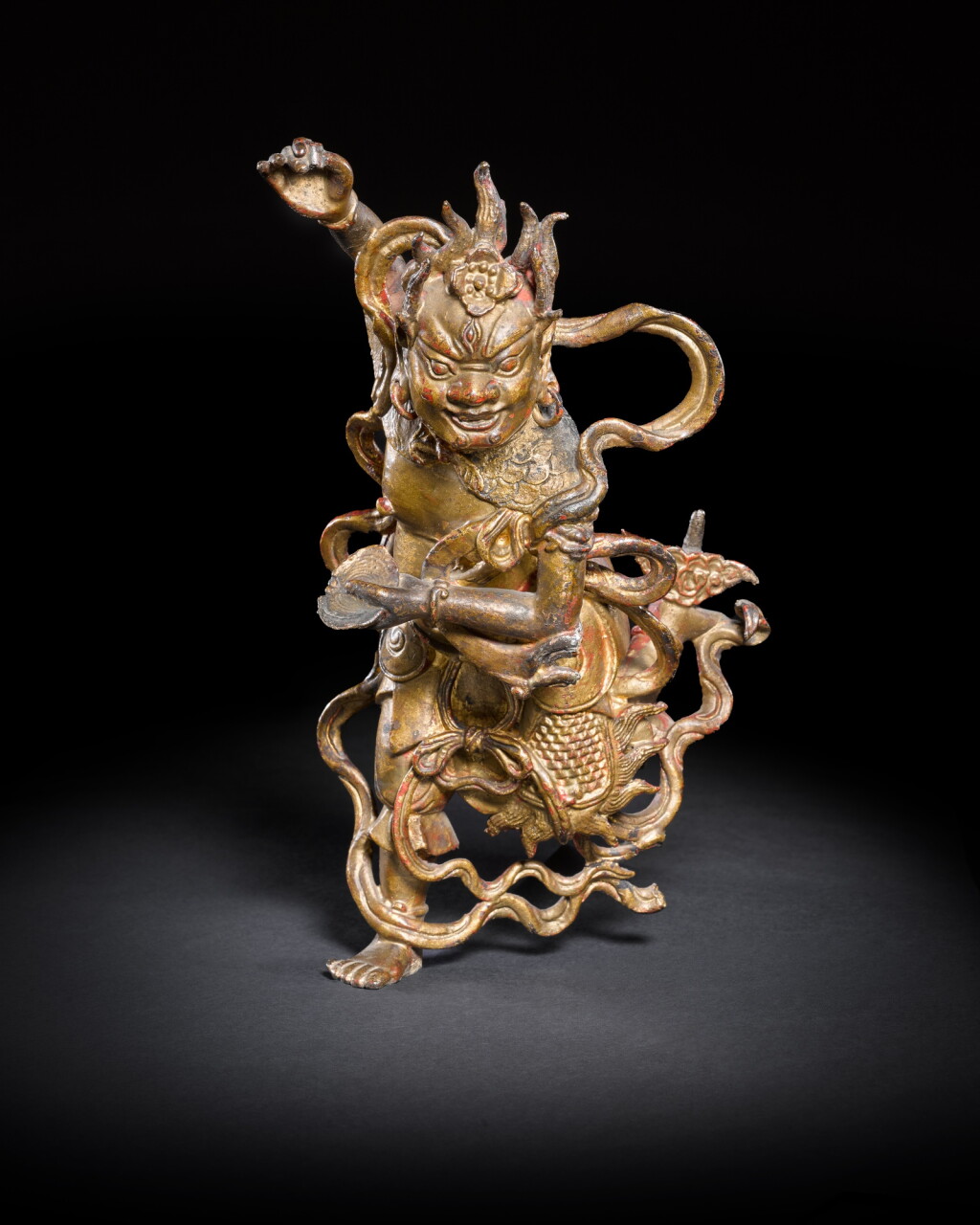
A gilt-red lacquer bronze figure of Kuixing, Dali Kingdom, 12th century
Auction Closed
November 5, 05:06 PM GMT
Estimate
20,000 - 30,000 GBP
Lot Details
Description
Height 29 cm, 11⅜ in.
German Private Collection, acquired before 1987.
Daoist figures from the Dali Kingdom are exceedingly rare, as Buddhism was the official state religion. The Dali Kingdom arose from the unified ashes of the Nanzhao Kingdom (738-937), which had outlawed Daoism by the 9th century. Out of the Meng family rulers, King Fengyou (r. 823-59) was the most demonstrative of his faith, erecting the Chongsheng Temple complex and commissioning thousands of Buddhist statues in the kingdom’s capital. Despite the earlier proscription of Daoism, however, the Dali Kingdom was in fact quite diverse in its ethnic and religious composition. The Bai people had practiced shamanism prior to their introduction to Buddhism, and ‘Theravada certainly was from Upper Burma, Mahayana was from China, and Mijiao in Yunnan was from Tibet. Furthermore, Nestorianism and Islam arrived in Yunnan from the north, as did…Confucianism and Daoism’ as Bin Yang notes in ‘Horses, Silver, and Cowries: Yunnan in Global Perspective’, Journal of World History, vol. 15, no. 3, September 2004, p.317. The Nanzhao regions were originally a cluster of tribes in western Yunnan, and not unified until Meng Piluoge was recognized as ruler in 738. His son, King Geluofeng (r. 748-79), fortified the country against Chinese invasion by allying his country with Tibet. The grandson of Geluofeng, Yimouxun (r. 779-808), implemented a drastically different political strategy, breaking ties with the Tibetans and pledging allegiance to the Tang emperor. According to Angela F. Howard, ‘A Gilt Bronze Guanyin from the Nanzhao Kingdom of Yunnan: Hybrid Art from the Southwestern Frontier’, The Journal of the Walters Art Gallery, vol. 48, 1990, p. 8, the royal family and nobility were subsequently educated in Chengdu, one of the most prosperous and sophisticated cities in China during the Tang dynasty.
The Qingyang Gong, a vast and important Daoist temple complex in Chengdu, was erected in the 9th century, suggesting the strength of the religion in Sichuan at the time. The ambitious young elites of the Meng family and other Nanzhao nobility were likely influenced by the strongly Daoist surroundings, and the worship of Wenchang, the god of letters and scholars, seems especially appropriate given that they were sent to Chengdu to study. Wenchang's celebrated acolyte Kuixing, often depicted brandishing a brush and holding a vessel to measure a scholar's worth, would have been a popular subject of art and veneration.
Compare the face and physicality of the present figure with that of a Yunnan bronze figure of a wrathful guardian attributed to the 10th to mid-13th century, now at the Asian Art Museum of San Francisco (accession no. 1994.23); a closely related gilt-lacquer Kuixing, attributed to the 12th century, offered in our New York rooms, 11th September 2019, lot 786; and another gilt-lacquered multi-armed wrathful deity sold at Christie's Paris, 21st November 2001, lot 134, with a remarkable similarity in facial rendering.
The dating of this lot is consistent with its Oxford Authentication Ltd. thermoluminescence test result, no. C125b48.
You May Also Like


