A monumental and extremely rare archaic bronze ritual food vessel (Ding), Late Shang / early Western Zhou dynasty
Auction Closed
November 5, 05:06 PM GMT
Estimate
600,000 - 1,000,000 GBP
Lot Details
Description
fitted zitan stand and cover (4)
Height 47 cm, 18½ in.
Overall height 70 cm, 27½ in. with stand and cover
Collection of Mok Kon Sang (1882-1958).
Collection of Mok Hing Yiu (1923-2010).
Sotheby’s Hong Kong, 30th May 2018, lot 459.
Timeless Legacy: The Mok Family Collections, The Art Museum, Chinese University of Hong Kong, Hong Kong, 2009, pp 40-41.
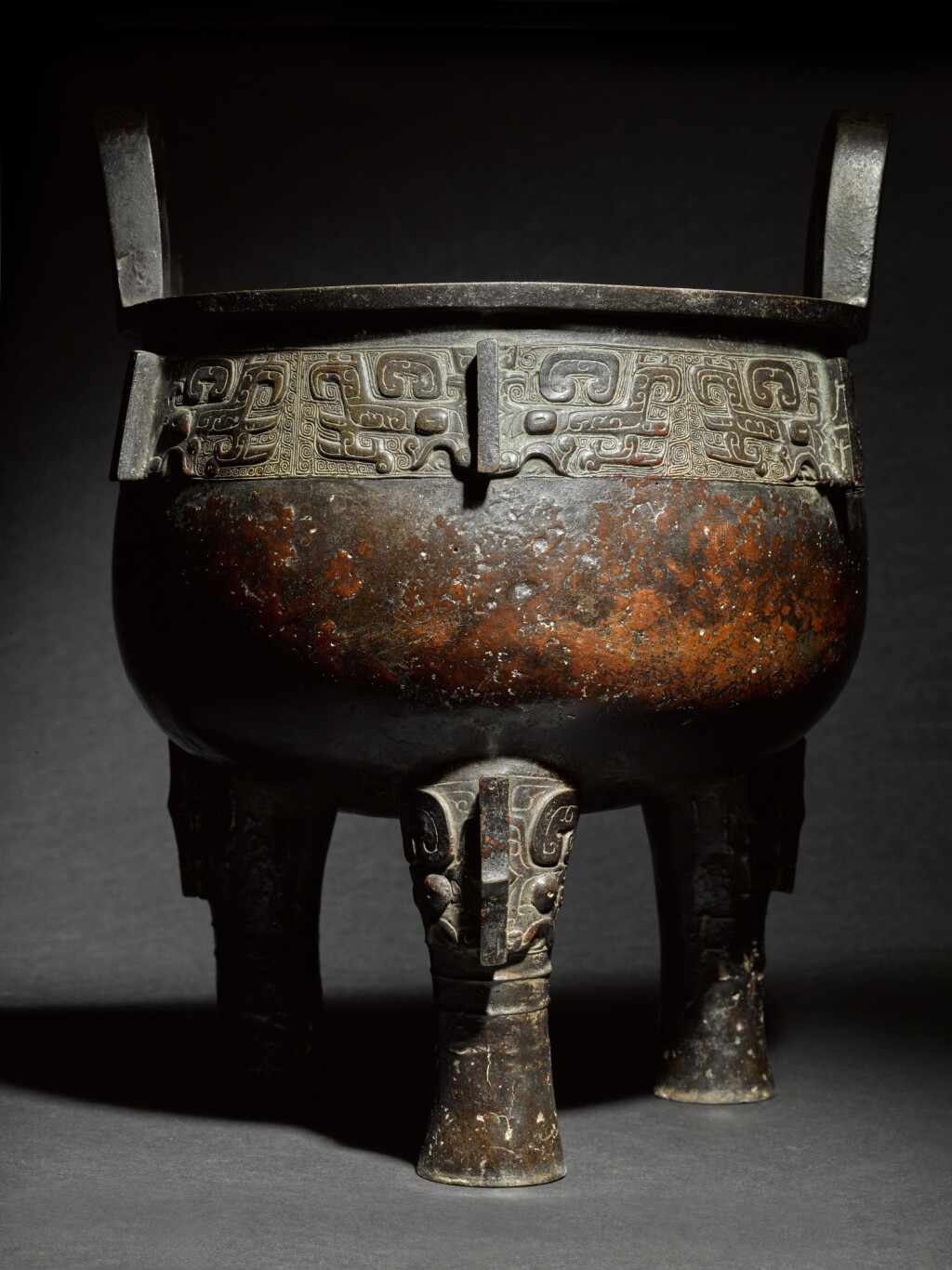
This important and extremely rare ritual bronze vessel, created in the late Shang or early Western Zhou period and highly treasured since its discovery in antiquity, is truly monumental in size; a legacy of the glory of ancient China. Powerfully cast with ferocious taotie masks and incomparable in size to others in private hands, it has an illustrious history from the Qing dynasty, where it was adorned with a zitan stand and cover of Imperial quality, and later preserved in the illustrious collection of Mok Kon Sang (1882-1958).
The present ding shares the same form and decoration with another archaic bronze ding of slightly smaller size from the Qing Court Collection, preserved in the National Palace Museum, Taipei, illustrated in Shang Ritual Bronzes in the National Palace Museum Collection, Taipei, 1998, pl. 17 (fig. 1), where it is ascribed to the late Anyang period. It also shares the same texture of the patina as on the present bronze, the result of similar treatment at the Qing court.
During the Qing dynasty, the black patina on ancient bronzes was highly coveted at the Imperial court, including by the Qianlong Emperor (r. 1735-1795) himself. This black patina, described as glossy and smooth with a texture ‘shiny like lacquer and crystalline as jade,’ indicated both the object's antiquity and its remarkable more recent origins. Referred to as qi gu ('lacquer ancient'), the ancient black patina on archaic bronzes is a durable, tin-rich corrosion layer that forms under specific conditions over millennia, due to the high tin content of the alloy and environmental factors (dampness and acidity) in the tomb.
Important vessels such as the present ding, discovered during and before the Qing dynasty, were treated with hot wax to enhance the black patina, stabilise the surface and deepen its polished jade-like quality, while retaining the colour variations and deposits formed from its long history. Both the present ding and the National Palace Museum example were clearly treated in the same way, as the texture and patina on the surface so clearly matches. For another example of an archaic bronze ritual ding vessel with similar Qing dynasty provenance and ‘black’ patina appearing at auction, see a late Western Zhou / early Spring and Autumn period example from the collections of Fei Nianci (1855-1905), Liu Tizhi (1879-1962) and Dr Wou Kiuan (1910-1997), sold in our New York rooms, 22nd March 2022, lot 6.
Another closely related monumental ding vessel, reputedly from Luoyang, is preserved in the Idemitsu Museum of Arts, Tokyo, illustrated in Ancient Chinese Arts in the Idemitsu Museum, Tokyo, 1989, pl. 1 (fig. 2). The only other ding of comparable stature ever to come to market is the example originally from the collections of T. T. Tsui and Alice and Pierre Uldry, sold at Christie’s New York, 20th March 1997, lot 38, and illustrated in Giuseppe Eskenazi in collaboration with Hajni Elias, A Dealer's Hand: The Chinese Art World Through the Eyes of Giuseppe Eskenazi, London, 2012, pl. 5 (fig. 3). This closely related ding was donated from the Uldry Collection to the Rietberg Museum, Zurich, where it is now on permanent display.
This impressive vessel has an imposing profile, achieved through its deep form, powerful thick legs and dramatic zoomorphic masks with prominent bulging eyes. The sharp-edged crispness of the design and its notable level of preservation, evidence the Shang caster’s technological sophistication and bold creativity. The piece-mould method, preferred by Shang casters and used for making this vessel, allowed craftsmen to showcase their virtuosity and create ever more complex but coherent designs by carving directly into the clay mould. This technique also eliminated the need to alter the decoration by cold-working the metal after the initial pour, thus ensuring it retained its striking sharpness.
Ding are among the most significant products of the Bronze Age in China, associated with royal power and authority and legitimacy to the throne. According to legend, King Yu, founder of the Xia dynasty, cast nine large bronze ding, one for each of the nine provinces in his kingdom. This form, which continuously evolved over the centuries, was derived from pottery tripod vessels made as early as the Neolithic period. Used during ritual ceremonies as food or cooking vessels, ding were very popular among Shang and Zhou dynasty elite and large numbers have been found in royal tombs. The tomb of Fu Hao (d. ca. 1200 BCE) in Anyang, for example, contained over twenty-six vessels of this type.
The perfectly proportioned zitan stand and cover are Qing dynasty creations of Imperial workshop standard, and no expense has been spared in the substantial amount of precious zitan material used. The jade finial itself, dating to the Ming period, would itself have been an object of high veneration and value, a luxurious artefact utilised to decorate the cover of this important vessel.
Mok Kon Sang (1882-1958), the original owner of the present bronze, was the last Chief Comprador for the British trading house Butterfield & Swire, resigning in 1931 to lead a successful career as a patriot capitalist and philanthropist. He founded the Kowloon Motor Bus Company, the Kai Tak Land Company, and The Wing On Company amongst many others. His Huaci Ge (‘Chamber of Colourful Porcelain’) collection of Qing Imperial porcelain was renowned in Guangdong and Hong Kong in the early 20th century. His residence, ‘Fairview’ at 41 Conduit Road, complete in 1911, had the first private elevator in Hong Kong. He was appointed Grand Master for Forthright Service by the Qing government (Mandarin fifth rank) before the 1911 revolution. Amidst the dispersal of important collections including part of the Imperial collection, it is likely that the present bronze was acquired at this time.
You May Also Like