Property of a Lady
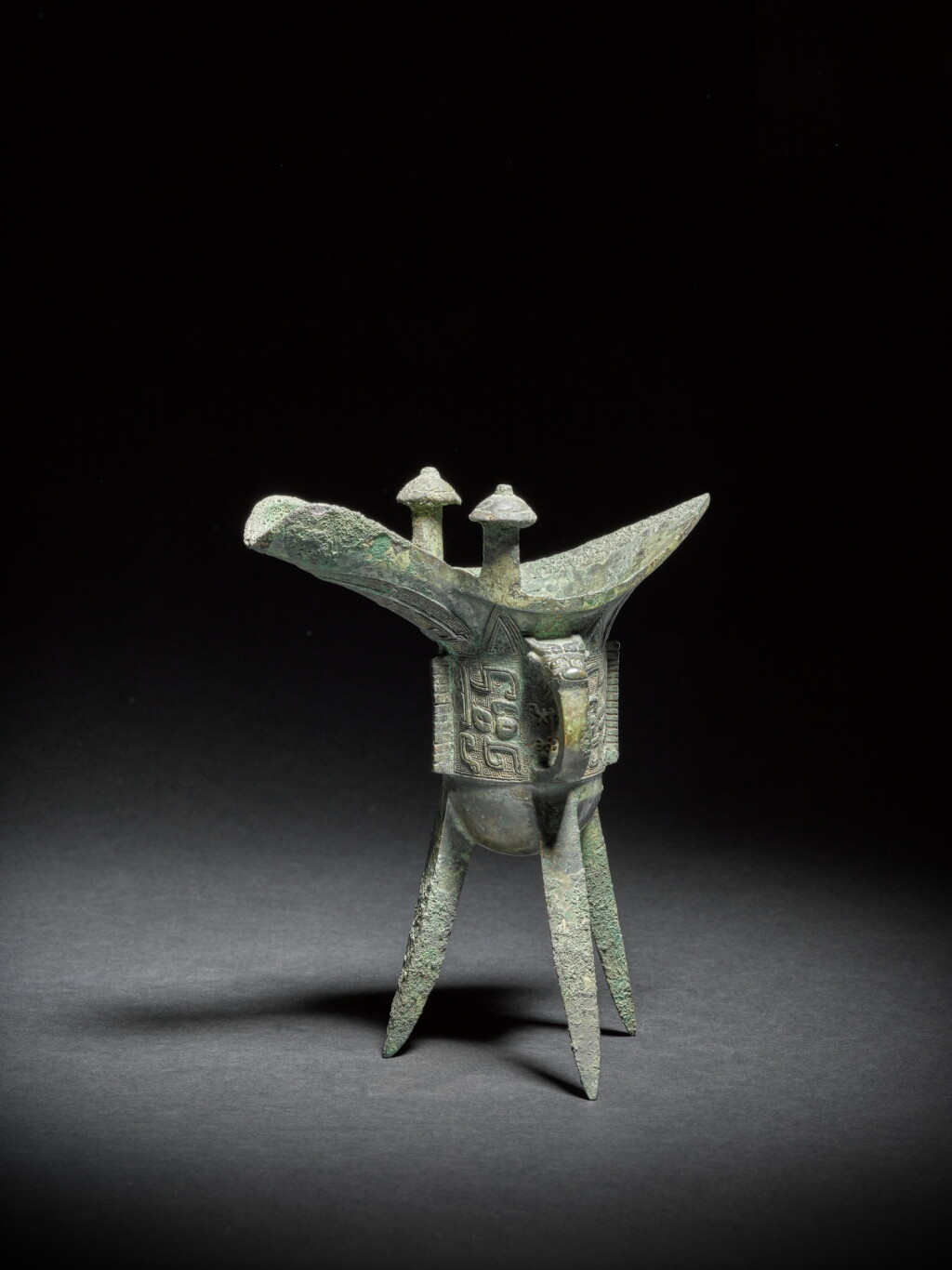
The Yi Che Jue, An inscribed archaic bronze ritual wine vessel, Late Shang dynasty
Auction Closed
November 5, 05:06 PM GMT
Estimate
30,000 - 50,000 GBP
Lot Details
Description
Height 21.5 cm, 8½ in.
Bluett and Sons Ltd., London, 23rd September 1960.
Eskenazi Ltd., London
English Private Collection.
Ancient Chinese Bronzes from an English Private Collection, Eskenazi Ltd., London, 1999, cat. no. 5.
The Institute of Archaeology, Chinese Academy of Social Sciences, ed., Yinzhou jinwen jicheng [Compendium of Yin and Zhou bronze inscriptions], Beijing, 1984, no. 7719 (rubbing).
Wu Zhenfeng, Shangzhou qingtongqi mingwen ji tuxiang jicheng [Compendium of inscriptions and images of bronzes from Shang and Zhou dynasties], vol. 14, Shanghai, 2012, no. 7022.
The present vessel represents a fine and archetypal example of archaic jue vessels, used to hold and warm wine in ritual ceremonies in the late Shang dynasty (c. 1600-1046 BCE. Crisply cast with striking animal masks known as taotie and protruding flanges around its body to frame the composition, the present jue would have been commissioned as part of an extensive ritual assembly for a member of the ancient elite.
This ancient provenance is confirmed by the two boldly cast pictograms beneath the handle, which scholar Chen Mengjia (1911–1966) identifies as yi che — the latter character meaning 'chariot' and likely acting as a clan sign. To date, only one other jue attributed to yi che appears to survive, first recorded in Liang Shangzhuang, Yanku jijin tulu, Beijing, 1943, cat. no. 30, reputedly excavated from the Shang capital of Anyang. Compare also a bronze yu in the Freer Collection at the National Museum of Asian Art, Washington D.C. (accession no. F1941.8), bearing an identical clan mark and attributed to the Mid- to Late Anyang period (12th – 11th century BCE) in John Alexander Pope et al., The Freer Gallery Bronzes, Washington D.C., 1967, pl. 61.
Vessels of this design are well represented in important museums worldwide, such as one preserved in the National Palace Museum, Taipei, and illustrated in the Museum’s Catalogue of the Special Exhibition of Shang and Chou Dynasty. Bronze Wine Vessels, Taipei, 1989, cat. no. 8, where the vessel is likened to a jue excavated from tomb no. 4 in Dasikong village, Anyang, Henan province. See another in the Metropolitan Museum of Art, New York (accession no. 49.135.15), included in the Museum’s exhibition Arts of Ancient China, New York, 2005 and a further example preserved in the British Museum, London (accession no. 1935,0115.22), included in the Museum’s exhibition Ritual and Revelry: The Art of Drinking in Asia, London, 2012.
You May Also Like