
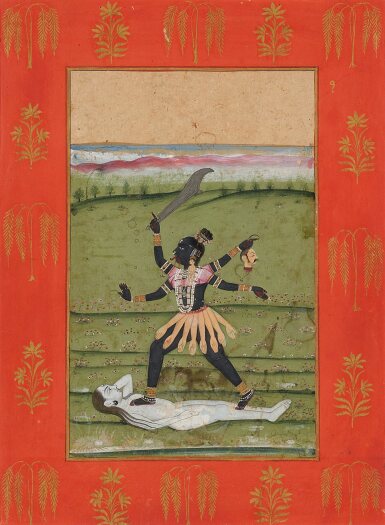
A painting of Kali trampling Shiva, India, Rajasthan, possibly Jaipur, late 18th century
Auction Closed
March 21, 04:25 PM GMT
Estimate
7,000 - 9,000 USD
Lot Details
Description
A painting of Kali trampling Shiva
India, Rajasthan, possibly Jaipur, late 18th century
watercolor heightened with gold on paper
Height 7⅛ in., 18.1 cm; Width 4½ in., 11.4 cm
Collection of Nik Douglas, acquired 17th December 1982.
Collection of James and Marilynn Alsdorf.
Christie's New York, 29th September 2020, lot 24.
According to Hindu mythology, there was once a powerful demon named Raktabija who received a boon allowing him to replicate himself whenever a drop of his blood touched the earth. When the demon engaged in battle with the gods, Kali spread her tongue over the battlefield to prevent any of the demon’s blood from hitting the ground, thus facilitating his defeat. Kali, however, became drunk with bloodlust and after her victory, the goddess went on a rampage. She proceeded to kill anyone who crossed her path, adorning herself with the dismembered parts of her victims. Afraid that Kali would not stop until she destroyed all the cosmos, Shiva laid down on the battlefield in her path. Upon seeing her consort beneath her foot, she suddenly realized her mistake and halted her spree.
This painting illustrates the moment Shiva pacifies Kali, appearing in her form as Dakshinakali, the benevolent mother. Dakshinakali is typically depicted with her right foot on Shiva’s chest, while her more fearsome form as Vamakali is usually shown with her left foot on his chest. She holds a severed head and scimitar in two of her four hands and wears a skirt of dismembered arms from her rampage. Kali’s typical garland of severed heads is replaced here with a string of severed heads around her chignon, and her large, outstretched tongue drips with the blood of her victims. A pale, prostrate Shiva lays below, gazing up at Kali.
By presenting Kali as literally trampling Shiva, this archetypal image demonstrates the extent to which Shiva’s transcendental power is only possible through interaction with Kali.
You May Also Like


