
Andy Warhol
Roll Over Mouse (Toy Painting)
Lot Closed
February 20, 02:02 PM GMT
Estimate
100,000 - 150,000 EUR
Lot Details
Description
Andy Warhol
1928 - 1987
Roll Over Mouse (Toy Painting)
signed and dated 83 on the overlap
acrylic and silkscreen ink on canvas
28 x 35,5 cm; 11 x 14 in.
Executed in 1983.
________________________________________________________
Andy Warhol
1928 - 1987
Roll Over Mouse (Toy Painting)
signé et daté 83 sur le retour de la toile
acrylique et encre sérigraphique sur toile
28 x 35,5 cm; 11 x 14 in.
Exécuté en 1983.
Galerie Bischofberger, Zurich
Galerie Beaubourg, Paris
Private collection, France (acquired from the above)
Private collection, Paris
__________________________________________________
Galerie Bischofberger, Zürich
Galerie Beaubourg, Paris
Collection particulière, France (acquis auprès du précédent)
Collection particulière, Paris
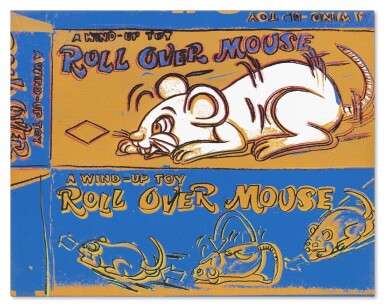
Produced in 1983 at the peak of Andy Warhol's career, Roll Over Mouse is one of the American artist's final works, emblematic of the Pop Art master's iconography and signaling the return of the brightly colored canvases that solidified his status as one of the most significant artists of the 20th century. In Roll Over Mouse, Warhol engages with the symbols of consumer society, infusing a touching, childlike dimension that once again highlights the artist's fascination with commercialization and mass culture. Warhol's knack for transcending the boundaries between art and everyday objects makes this piece a captivating exploration of his artistic vision.
The work is part of the renowned "Toy paintings" series, commissioned by Andy Warhol's long-time friend and Swiss gallery owner Bruno Bischofberger, a decade after the series of Mao portraits. A fusion of painting and silkscreening, inspired by Warhol’s childhood toys, the series has now become a pivotal landmark in the artist's oeuvre, transforming the Zurich gallery – where this painting originated - into a playroom. The artworks were displayed at children's height, against a tapestry adorned with goldfish, inviting viewers to rediscover a lost youthful innocence. This series breaks away from Warhol’s famous 1960s works like Campbell's soup and Brillo boxes. Instead of representing a brand or movie star, the artist, a devoted collector and toy enthusiast, begins with a symbol familiar to every child of the 1960s: a mechanical wind-up mouse that has now become a collector's item. Warhol reuses the mouse’s images on the carboard box to push them to their limits. Stripping away the brand name and infusing bright colors enhanced by intricate outlines, he translates this object into a pop style he masters flawlessly, paying homage to his youth while dramatizing American consumerism. The simple yet ingenious graphics and the painting’s structure generate a striking visual impact and a sense of animation, elevating the work beyond a mere expression of nostalgia. The mechanical mouse thus attains the status of a popular icon.
The 1980s marked the most productive years of Warhol's life. By centering his artistic practice on childhood memories, as evidenced in Roll Over Mouse, the artist underscores that the realm of imagination triumphs over reality. There is no doubt that Warhol harbored a profound fascination for this toy of his youth.
''The bright, highly colored and easily recognizable subjects are designed to stimulate a creative interaction with children,'' Diego Cortez, guest curator of ''Andy Warhol's Children's Show,'' Cushing Gallery of the Newport Art Museum 1985
_____________________________________________________________________________________
Réalisée en 1983 au sommet de la carrière d’Andy Warhol, Roll Over Mouse est l’une des dernières de l’artiste américain et est emblématique de l’iconographie du maitre du Pop Art, marquant le retour des toiles vives aux couleurs chatoyantes qui lui ont permis de devenir l’un des artistes les plus importants du XXe siècle. Dans Roll Over Mouse Warhol joue avec les symboles de la société de consommation en ajoutant, ici, une dimension enfantine, attendrissante qui illustre une fois de plus la fascination de l’artiste pour la commercialisation et la culture de masse. La capacité de Warhol à transcender les frontières entre art et objet de la vie quotidienne fait de cette œuvre une plongée captivante dans le travail de l’artiste.
L’oeuvre s’inscrit dans la fameuse série des « Toy paintings », commandée par le galeriste suisse Bruno Bischofberger, ami de longue date d’Andy Warhol, dix ans après la série des portraits de Mao. Mêlant peinture et sérigraphie, inspirée des jouets de son enfance, la série qui s’est imposée aujourd’hui comme majeure dans le travail de l’artiste transforme la galerie de Zurich, d’où provient directement cette toile, en une salle de jeux : les œuvres sont accrochées à hauteur d’enfants, sur une tapisserie ornée de poissons rouges, permettant au spectateur de retrouver une innocence juvénile perdue. Cette série vient créer une rupture avec celles des années 1960 ayant rendu Andy Warhol célèbre comme les Campbell’s soup ou les boites Brillo. Ici, l’artiste, grand collectionneur et passionné de jouets, ne représente pas de marque ou de star du cinéma mais part d’un symbole pour tout enfant ayant grandi dans les années 1960 : une souris mécanique à remonter désormais devenue objet de collection. Vendue dans une boite en carton rectangulaire décorée de mises en situation du jouet, Warhol réutilise les images pour les pousser à leur paroxysme. En retirant le nom de la marque, en ajoutant des couleurs éclatantes renforcées par des contours travaillés, il traduit cet objet dans un style pop qu’il maitrise parfaitement, rendant hommage à sa jeunesse tout en mettant en scène le consumérisme américain. Les graphismes simples mais astucieux tout comme la structure du tableau créent un effet visuel saisissant et un sentiment d’animation, qui emmènent l’œuvre au-delà d’une simple expression de nostalgie. La souris mécanique atteint le statut d’icône populaire.
Les années 1980 sont les années les plus productives de la vie de Warhol. En mettant ses souvenirs d’enfance au cœur de sa pratique artistique comme avec Roll over Mouse, l’artiste démontre que le monde de l'imagination l'emporte sur la réalité : il ne fait aucun doute que Warhol éprouvait une profonde fascination pour ce jouet de son enfance.
"Les sujets lumineux, très colorés et facilement reconnaissables sont conçus pour stimuler une interaction créative avec les enfants", Diego Cortez, conservateur invité de "Andy Warhol's Children's Show", Cushing Gallery of the Newport Art Museum 1985