
Medieval Seals from the Collection of Abbé Jobal (Lots 19-24)
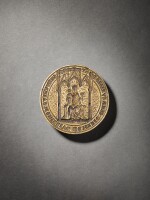
French, Metz, early 15th century | Seal matrix of the Abbey of Clairvaux at Metz
Lot Closed
July 6, 02:22 PM GMT
Estimate
3,000 - 5,000 GBP
Lot Details
Description
Medieval Seals from the Collection of Abbé Jobal (Lots 19-24)
French, Metz, early 15th century
Seal matrix of the Abbey of Clairvaux at Metz
inscribed: S: CONVENTUS : MONIALUM : BE : MARIE : CLAREVALLIUS : MET
copper alloy
accompanied by a 19th-century collector's note, an old wax impression, and a modern plaster impression
5.8cm., 2¼in.
François 'l'abbé' Jobal (1748-1806), Metz;
thence by descent;
Comte Gaston de Lambertye (1832-1907), Metz;
sale of the collection of Abbé Jobal and Comte Gaston de Lambertye, Thierry Parsy, Paris, 30 May 2015, lot 408, where acquired by the present owner
thence by descent;
Comte Gaston de Lambertye (1832-1907), Metz;
sale of the collection of Abbé Jobal and Comte Gaston de Lambertye, Thierry Parsy, Paris, 30 May 2015, lot 408, where acquired by the present owner
Bulletin de la Société d'archéologie et d'histoire de la Moselle, vol. 8, 1865, p. 104, no. IX
Circular seal displaying the Virgin enthroned with the Christ Child beneath a tri-lobed, gothic architectural canopy; the Virgin holds the infant Jesus in the crook of her left arm while clutching a lily in her right hand. Behind the figures, elaborate rinceaux patterns fill the negative space. Outside the gothic edifice, a diapered pattern offsets the central scene through textured ornamentation. The inscription, reads: 'S : CONVENTUS : MONIALUM: BE: MARIE: CLAREVALLIS: MET'. Beginning with the cross located above the farthest right arch, the legend proclaims this item as the seal of the Abbey of Clairvaux in Metz. The cleanly incised majuscule gothic script along with the intricately engraved field indicates a date of production around the early fifteenth century.
According to the sixteenth century chronicles of Phillipe de Vigneulles, The Abbey of Petite Clairvaux was founded by St. Bernard in 1153 during a trip to Metz. Petite Clairvaux was established in response to the closure of the Abbey of Saint Benoit in Woivre. As Vigneulles relates, the nuns of Saint Benoit sought a more 'edifying lifestyle' similar to the teachings espoused by St. Bernard. As a result, a new convent was formed with the help of Bishop Etienne de Bar.
The Collection of Abbé Jobal
François ‘l’abbé’ Jobal was born in Metz, in the parish of Saint-Martin on 4th September 1748. He came from a family that rose to prominence in Lorraine in the sixteenth century and in the tradition of such families their sons became soldiers, lawyers, clergymen and legislators.
The abbé Jobal was a man of some substance and standing. A priest, he became Cannon of the Noble Chapter of the Cathedral of Metz, Vicar-General of Angers and on 22 May 1783 was appointed Councillor Clerc of the Parliament of Metz. He was also an antiquarian who formed a remarkable collection of seal matrices. Perhaps it was his position as Cannon of the Cathedral that gave him access to such a rich vein of ecclesiastical matrices or perceivably his cousin Claude Jobal, who around 1600 had been provost and keeper of the seals in Vaucouleurs, may have been the source. Nonetheless collecting was certainly in his blood as he also formed a numismatic collection both of Merovingian and Carolingian coins, and of the coinage and medals of Lorraine. His collection must have had some renown, as in 1865 Bouteiller & Durand described it as ‘autrefois célèbre’.
Sometime before the revolution and the suppression of the ecclesiastical orders the abbé left France for Martinique, perhaps to join his elder brother, Antoine, who served in the Caribbean from 1778, was in Martinique in 1782 and again in 1783 was to become Commandant of the Island of Tobago 1789-92. Before he left, his seals and his coin collection were packed up for safekeeping, and deposited in the family Château de Lue, with his eldest brother Joseph-François-Louis, Comte de Jobal, a lieutenant general in the Royal Army. The abbé never returned to Lue and is said to have died in 1806.
At the revolution the count went into exile to fight the Royalist cause leaving the estate in the care of his sister Marie-Agathe-Rose, which may in part explain why the collection, hidden in an attic under a pile of rags, was not looted when the Château was pillaged.
On the Count’s return from exile the collection remained out of view for some seventy years until his grandson, the Count Pierre-Gaston de Lambertye displayed the seals at a meeting of the Société d’archéologie et d’histoire de la Moselle on the 14th of December 1865; they were subsequently published in the Society’s journal.
According to the sixteenth century chronicles of Phillipe de Vigneulles, The Abbey of Petite Clairvaux was founded by St. Bernard in 1153 during a trip to Metz. Petite Clairvaux was established in response to the closure of the Abbey of Saint Benoit in Woivre. As Vigneulles relates, the nuns of Saint Benoit sought a more 'edifying lifestyle' similar to the teachings espoused by St. Bernard. As a result, a new convent was formed with the help of Bishop Etienne de Bar.
The Collection of Abbé Jobal
François ‘l’abbé’ Jobal was born in Metz, in the parish of Saint-Martin on 4th September 1748. He came from a family that rose to prominence in Lorraine in the sixteenth century and in the tradition of such families their sons became soldiers, lawyers, clergymen and legislators.
The abbé Jobal was a man of some substance and standing. A priest, he became Cannon of the Noble Chapter of the Cathedral of Metz, Vicar-General of Angers and on 22 May 1783 was appointed Councillor Clerc of the Parliament of Metz. He was also an antiquarian who formed a remarkable collection of seal matrices. Perhaps it was his position as Cannon of the Cathedral that gave him access to such a rich vein of ecclesiastical matrices or perceivably his cousin Claude Jobal, who around 1600 had been provost and keeper of the seals in Vaucouleurs, may have been the source. Nonetheless collecting was certainly in his blood as he also formed a numismatic collection both of Merovingian and Carolingian coins, and of the coinage and medals of Lorraine. His collection must have had some renown, as in 1865 Bouteiller & Durand described it as ‘autrefois célèbre’.
Sometime before the revolution and the suppression of the ecclesiastical orders the abbé left France for Martinique, perhaps to join his elder brother, Antoine, who served in the Caribbean from 1778, was in Martinique in 1782 and again in 1783 was to become Commandant of the Island of Tobago 1789-92. Before he left, his seals and his coin collection were packed up for safekeeping, and deposited in the family Château de Lue, with his eldest brother Joseph-François-Louis, Comte de Jobal, a lieutenant general in the Royal Army. The abbé never returned to Lue and is said to have died in 1806.
At the revolution the count went into exile to fight the Royalist cause leaving the estate in the care of his sister Marie-Agathe-Rose, which may in part explain why the collection, hidden in an attic under a pile of rags, was not looted when the Château was pillaged.
On the Count’s return from exile the collection remained out of view for some seventy years until his grandson, the Count Pierre-Gaston de Lambertye displayed the seals at a meeting of the Société d’archéologie et d’histoire de la Moselle on the 14th of December 1865; they were subsequently published in the Society’s journal.
You May Also Like


