
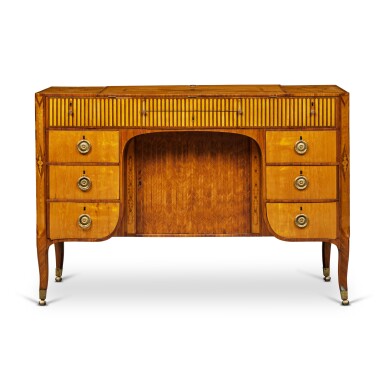
A George III Satinwood, Tulipwood Amaranth and Marquetry Dressing and Writing Table, Attributed To Christopher Fuhrlohg, Circa 1790
No reserve
Lot Closed
February 1, 06:23 PM GMT
Estimate
7,000 - 10,000 USD
Lot Details
Description
A George III Satinwood, Tulipwood Amaranth and Marquetry Dressing and Writing Table, Attributed To Christopher Fuhrlohg, Circa 1790
bearing a label Irwin Untermeyer Collection 11 / F
height 31 1/2 in.; width 46 1/2 in; depth 16 in.
80 cm; 118 cm; 40.5 cm
Judge Irwin Untermyer, New York
The Collection of Arne Schlesch, Sotheby's New York, 5 April 2000, lot 363
Patrick Broome, The Hyde Park Collection, 1965-1990: Twenty-Fifth Anniversary Album, Hong Kong 1989, pp. 242-243
Emily Eerdmans, Classic English Design and Antiques: Period Styles and Furniture, The Hyde Park Antiques Collection, New York 2006, p. 177
Y. Hackenbroch, English Furniture with some Furniture of Other Countries in the Irwin Untermyer Collection, Cambridge 1958, plate 286, fig. 328
Executed in the transitional Louis XV/XVI neoclassical style with fine marquetry inlay and slightly curved legs, the present commode shares a number of similarities to the work of the Swedish-born cabinet-maker, Christopher Fuhrlohg who was employed by John Linnell after 1767. Along with his brother in law Georg Haupt, Fuhrlohg completed his apprenticeship in Sweden and travelled via Amsterdam and Paris to London, arriving during the winter of 1766-67. He remained in Britain for the rest of his life and became cabinet maker to the Prince of Wales, for whom he worked at Carlton House between 1784-5.
The form is very similar to a commode by Christopher Fuhrlohg now in the Lady Lever Art Gallery, as well as the companion pair of commodes at the Metropolitan Museum of Art (illustrated, Lucy Wood, The Lady Lever Art Gallery Catalogue of Commodes, London 1994, pp. 106-114). Another similar pair of commodes attributed to Fuhrlohg was possibly supplied to James Forbes, 17th Lord Forbes, or Sir William Forbes, 5th Bt. Of Craigievar which sold most recently at Christie’s London, 24 November 2005, lot 130. The use of lozenges and intertwined foliage in the inlay is similar to a number of Fuhrlohg’s recorded pieces. Furthermore, the use of the central elongated urn is similar to Robert Adam’s elongated urns with triple rams heads handles. This motif – highly unusual in having an extra ram’s head to the centre of the urn - was used by Fuhrlohg on the top of an English bureau plat at Alnwick Castle (illustrated in Wood, op. cit., p.121, figs. 116-117), on a commode once in the collection of the Earls Temple (illustrated in Wood, op. cit., p.111, fig. 107), and also on the case of a piano, co-made with Frederick Beck in 1777, formerly in the Leverhulme collection and now in a private collection (illustrated in Wood, op. cit., p. 120, figs. 114-115, and in R. Edwards, The Shorter Dictionary of English Furniture, London 1964, p.390, fig. 12.)
Fuhrlohg's own furniture and the stock-in-trade of his Gerrard Street house was sold by Christie's on 21 February 1787 and described as consisting of a 'Great variety of Elegant Mahogany and Sattin-Wood articles, curiously [finely] Inlaid, several of which are on a new Construction, such as Bookcases, Commodes...' (G. Beard and C. Gilbert, Dictionary of English Furniture Makers 1660-1840, Leeds 1986, pp. 323-325).
You May Also Like


