
Property from an Important European Collection
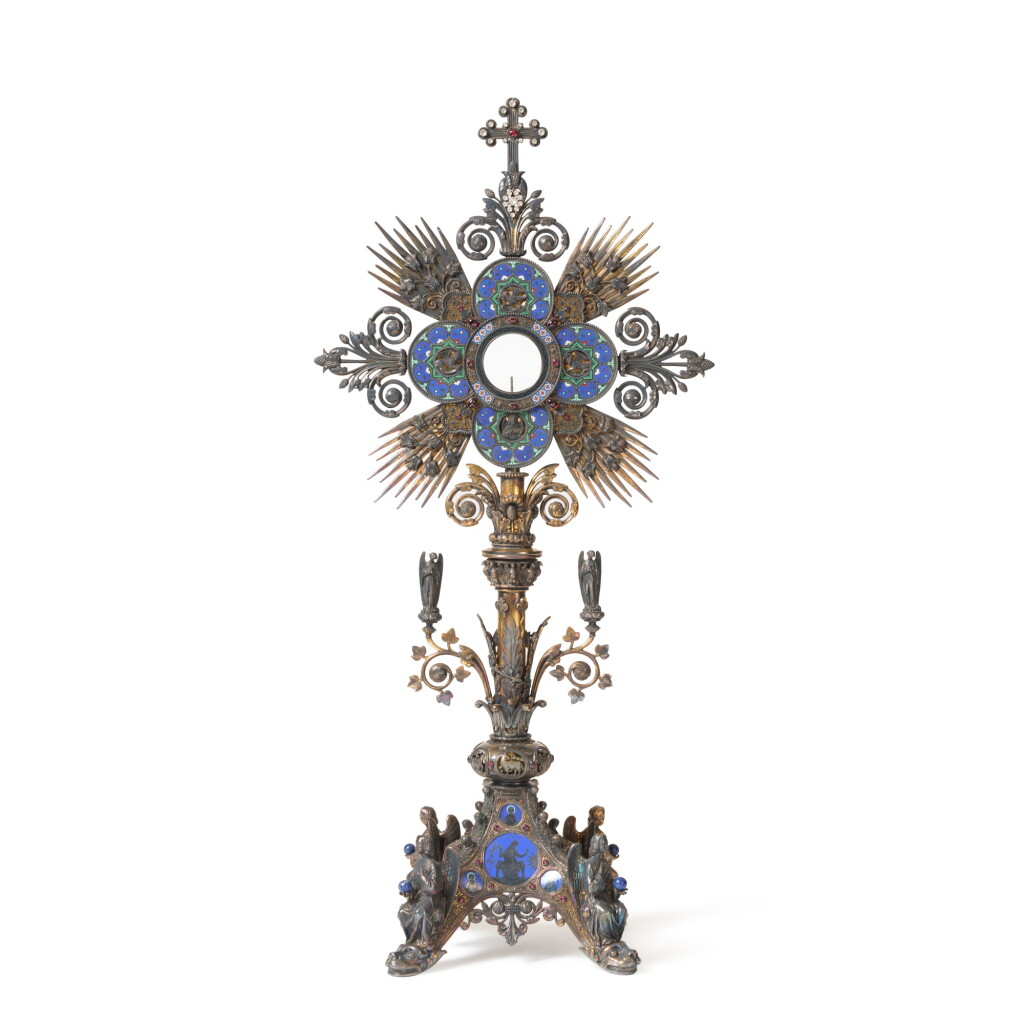
A French enameled parcel-gilt silver monstrance, Placide Poussielgue-Rusand, Paris, circa 1870
Lot Closed
December 5, 03:53 PM GMT
Estimate
30,000 - 50,000 EUR
We may charge or debit your saved payment method subject to the terms set out in our Conditions of Business for Buyers.
Read more.Lot Details
Description
The base set with enameled roundels of saints and personifications of the cardinal directions, surrounded by chased scrollwork and garnet cabochons supported on four dragon heads supporting angels holding lapis lazuli globes, the stem with rising foliage and centring two scrolling ivy branches with standing angels, the glass luna of the monstrance in the centre of a quatrefoil frame decorated symbols of the four evangelists and with blue, green and red enamel, with four bursts of sun rays, all surmounted by a cross, the underside of the base engraved with a presentation inscription, in original leather-covered case.
93cm, 36½in. high
6150gr., 197½oz
Placide Poussielgue-Rusand (1824-1889) built up a reputation in the second half of the 19th century as one of the finest manufacturers of ecclesiastical silver. His grandfather Mathieu Poussielgue travelled to France from Malta, where the family had lived since the mid-17th century, bringing with him his family including Placide’s father, Antoine Jean Baptiste. In 1823 Placide's father married the daughter of Mathieu-Placide Rusand, a Lyon-based printer and publisher. Rusand brought his son-in-law (who had now added his wife's surname to his own) into the family business and entrusted him with the Paris branch of the printing operations. Placide's uncle was running an ecclesiastical bookshop in Paris which also sold a selection of gold and silver religious artwork.
Placide Poussielgue-Rusand registered his first mark in 1847 and took over the business of Louis-Isidore Choiselat who manufactured bronze and silver liturgical objects. He was awarded a Prize Medal at the 1851 Exhibition in London and received awards at nine further international exhibitions.
The design for the current lot features in the 1893 trade catalogue for Poussielgue-Rusand Fils. It was available to order in gilt bronze, with gilt bronze base and stem or in silver gilt. The designer is given in the catalogue (Pere A. Martin), somewhat unusually for a trade catalogue where designers were often jealously guarded by manufacturers. Arthur Martin (1801-1856) was a Jesuit priest with a strong interest in archaeology of early Christianity. He went on to become a prolific artist-designer and church architect. He received rare praise from the often severe English architecture and furnishings journal The Ecclesiologist when it reviewed the church silver at the 1855 Paris Exhibition.
'Poussielgue-Rusand's church plate shows that, when working apart from the Abbé Martin's inspiration, his own knowledge is not to be trusted...In this artist's collection we observed a pax which was poor; a crown, jewelled, was fine; a pair of censers very commonplace; and the question suggests itself how is it that the thurible, an article so beautiful in itself, is made so little of?'
A monstrance by Poussielgue-Rusand of almost exactly the same design is in the Musée d'Orsay, Paris, accession number OAO 1117.
The presentation inscription on the underside of the base reads:
SOUVENIR DU 12 JUIN 1870
OFFERT PAR LES SOEURS DE LA STE FAMILLE
A L'OCCASION DU CINQUANTIEME ANNIVERSAIRE
DE LEUR FONDATION