
PASSOVER HAGGADAH WITH LADINO TRANSLATION, VENICE: VENDRAMIN, 1740
Auction Closed
November 20, 08:47 PM GMT
Estimate
7,000 - 10,000 USD
Lot Details
Description
PASSOVER HAGGADAH WITH LADINO TRANSLATION, VENICE: VENDRAMIN, 1740
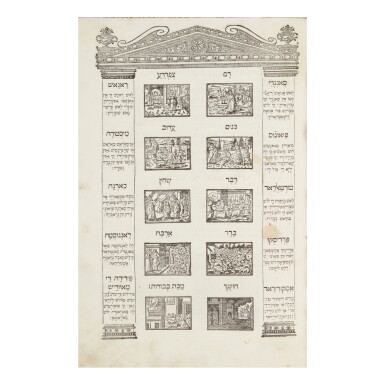
24 folios (14 1/8 x 10 in.; 358 x 258 mm) on paper; modern foliation in pencil in Arabic numerals near gutter at foot. Title page printed in red and black ink within a simple decorative border; each page of text enclosed in an elaborate architectonic frame; numerous woodcut initials containing miniature depictions of figures and scenes; large woodcut illustrations placed at the head and/or foot of most pages; smaller woodcuts of Moses, Aaron, David, Solomon, Samuel, Elijah, Isaiah, and Jeremiah often flanking the text. Scattered thumbing and staining, especially on pages whose text relates to the meal itself; minor repairs in outer edges of ff. 5-[7] and in gutter at foot of ff. [15]-[16]; short tears at foot of ff. [8], [20], [23], [24] repaired; longer tear extending upward and outward from gutter on f. [24] repaired. Modern half-vellum over marbled boards; title, place, and date lettered on spine; modern paper flyleaves and pastedowns.
This Passover Haggadah, following the Sephardic rite and with translations, instructions, and rhymed captions given in Ladino, is a direct descendant of the 1629 Venice edition (see lot 44). The main differences are the title page printed in red and black ink and the addition of border decorations portraying the prophets Samuel, Elijah, Isaiah, and Jeremiah. Since this new imprint was commissioned by Meir ben Hayyim Moses da Zara, the name of Moses Parenzo was omitted from the title page and from Rabbi Leon Modena’s introduction to Tseli esh. As in the earlier editions of this Haggadah, the Ladino version lacks the Nirtsah section that, in other rites, usually appears at the end of the Seder, reflecting the reality that Nirtsah’s cycle of post-meal songs had not yet been universally accepted among Sephardic communities. Because of the resulting reduction in the number of pages, some of the illustrations and text had to be rearranged, and one image (that of the three angels visiting Abraham and Sarah) was removed entirely.
Literature
A.M. Habermann, “The Jewish Art of the Printed Book,” in Cecil Roth (ed.), Jewish Art: An Illustrated History, revis. Bezalel Narkiss (London: Vallentine, Mitchell, 1971), 163-174, at pp. 172-173.
Cecil Roth, “Ha-haggadah ha-metsuyyeret she-bi-defus,” Areshet 3 (1961): 7-30, at p. 22.
Vinograd, Venice 1777
Avraham Yaari, Bibli’ogerafyah shel haggadot pesah me-reshit ha-defus ve-ad ha-yom (Jerusalem: Bamberger & Wahrman, 1960), 12-13 (nos. 112, 117).
Isaac Yudlov, Otsar ha-haggadot: bibli’ogerafyah shel haggadot pesah me-reshit ha-defus ha-ivri ad shenat [5]720 (Jerusalem: Magnes Press, 1997), 18-19 (nos. 181, 189).