
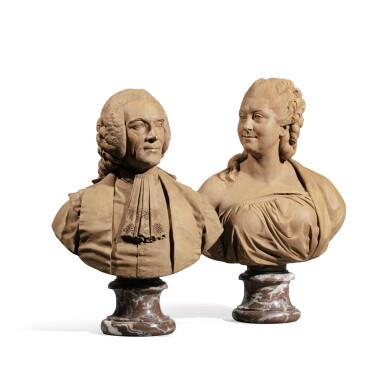
CIRCLE OF AUGUSTIN PAJOU | GENTLEMAN AND HIS WIFE
Lot Closed
June 30, 03:52 PM GMT
Estimate
8,000 - 12,000 EUR
Lot Details
Description
FRENCH, CIRCA 1760
CIRCLE OF AUGUSTIN PAJOU (1730-1809)
GENTLEMAN AND HIS WIFE
pair of terracotta busts, on a Languedoc red marble base
(gentleman) 69 by 50 by 30 cm, 27⅛ by 19 ⅔ by 11 ⅞ in. ; (wife) 73 by 49 by 25 cm, 28 ¾ by 19⅓ by 9 ⅞ in. ; (both bases) 17 cm, 6 ⅔ in.
__________________________________________________________________
FRANCE, VERS 1760
ENTOURAGE D'AUGUSTIN PAJOU (1730-1809)
GENTILHOMME ET SON ÉPOUSE
paire de bustes en terre cuite ; sur un piédouche en marbre rouge du Languedoc
(gentilhomme) 69 x 50 x 30 cm, 27 ⅛ x 19 ⅔ x 11 ⅞ in. ; (épouse) 73 x 49 x 25 cm, 28 ¾ x 19 ⅓ x 9 ⅞ in. ; (piédouches) 17 cm, 6 ⅔ in.
Due to the various measures taken to deal with the Covid-19 epidemic, property collection and shipment of this lot will be delayed until the offices where it is located are able to reopen. Please refer to the “auction details” tab. Thank you for your understanding
Please contact FRpostsaleservices@sothebys.com for any shipping inquiries.
[En raison des circonstances actuelles liées au COVID-19, la livraison de ce lot ne pourra intervenir qu’après la réouverture des locaux de Sotheby’s dans lesquels il se trouve. Nous vous remercions de votre compréhension et nous vous invitons à consulter l’onglet « auction details ».
Pour toute
demande concernant le transport, veuillez contacter FRpostsaleservices@sothebys.com.]
Related Literature
J. Draper, G. Scherf, Pajou, Sculpteur du Roi 1730-1809, exh. cat. Paris, musée du Louvre, 1997-1998, pp. 220-228.
__________________________________________________________________
Référence bibliographique
J. Draper, G. Scherf, Pajou, Sculpteur du Roi 1730-1809, cat. exp. Paris, musée du Louvre, 1997-1998, pp. 220-228.
Through their style, their bearing and the modelling of their faces, these terracotta portraits are reminiscent of works by Augustin Pajou (1730-1809), pupil of the famous portrait artist Jean-Baptiste II Lemoyne (1704-1778) and winner of the prix de Rome in 1748. Together with Jean-Antoine Houdon (1741-1828), he is one of the most prominent proponents of portrait sculpture in France during the second half of the 18th century. Relatively rare before 1700, the representation of portrait couples was developed throughout the 18th century and particularly by the artist Pajou.
We can note the attention to detail, with the finely chiseled eyes that bring out the pupils, the high forehead, the carefully modelled hair, the lace foulard of the male figure and the dignified air that can be perceived in the man and the woman. The man is depicted in a formal manner with an impassive expression whereas the woman is smiling slightly. A certain similarity can be discerned between the depiction of the wife, simply dressed with a 'chemise à la grecque' and one of her shoulders bare with the bust of 'Madame du Barry', one of the artist's most well-known feminine portraits exhibited at the Salon of 1773 (Musée du Louvre, inv. n° M.R. 2651).
__________________________________________________________________
Par leur style, leurs attitudes et le modelé de leurs visages, ces portraits en terre cuite peuvent être rapprochés des œuvres d'Augustin Pajou (1730-1809), élève du grand portraitiste Jean-Baptiste II Lemoyne (1704-1778) et lauréat du Prix de Rome en 1748. Avec Jean-Antoine Houdon (1741-1828), il est un des grands virtuoses de l’art du portrait sculpté en France dans la seconde moitié du XVIIIe siècle. Relativement rares avant le tournant du siècle, se développe vers 1700 la représentation de couples en paire, notamment dans l'œuvre de Pajou.
On remarque l'attention portée aux détails, tels les yeux finement incisés faisant ressortir les pupilles, le haut front dégagé, la chevelure soigneusement modelée, le foulard en dentelle de l’homme. L'attitude digne perceptible dans les deux figures : alors que l’homme est présenté de manière formelle avec le visage impassible, la femme esquisse un léger sourire. On peut constater une certaine similitude dans la représentation de l’épouse, simplement vêtue d’une chemise 'à la grecque' laissant apparaître l’une de ses épaules, avec le buste de Madame du Barry, l’un des portraits féminins les plus reconnus de l’artiste exposé au Salon de 1773 (Musée du Louvre, inv. n° M.R. 2651).