Revival: A Unique Collection of 19th-century Jewels
Eugène Fontenay
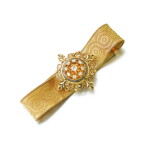
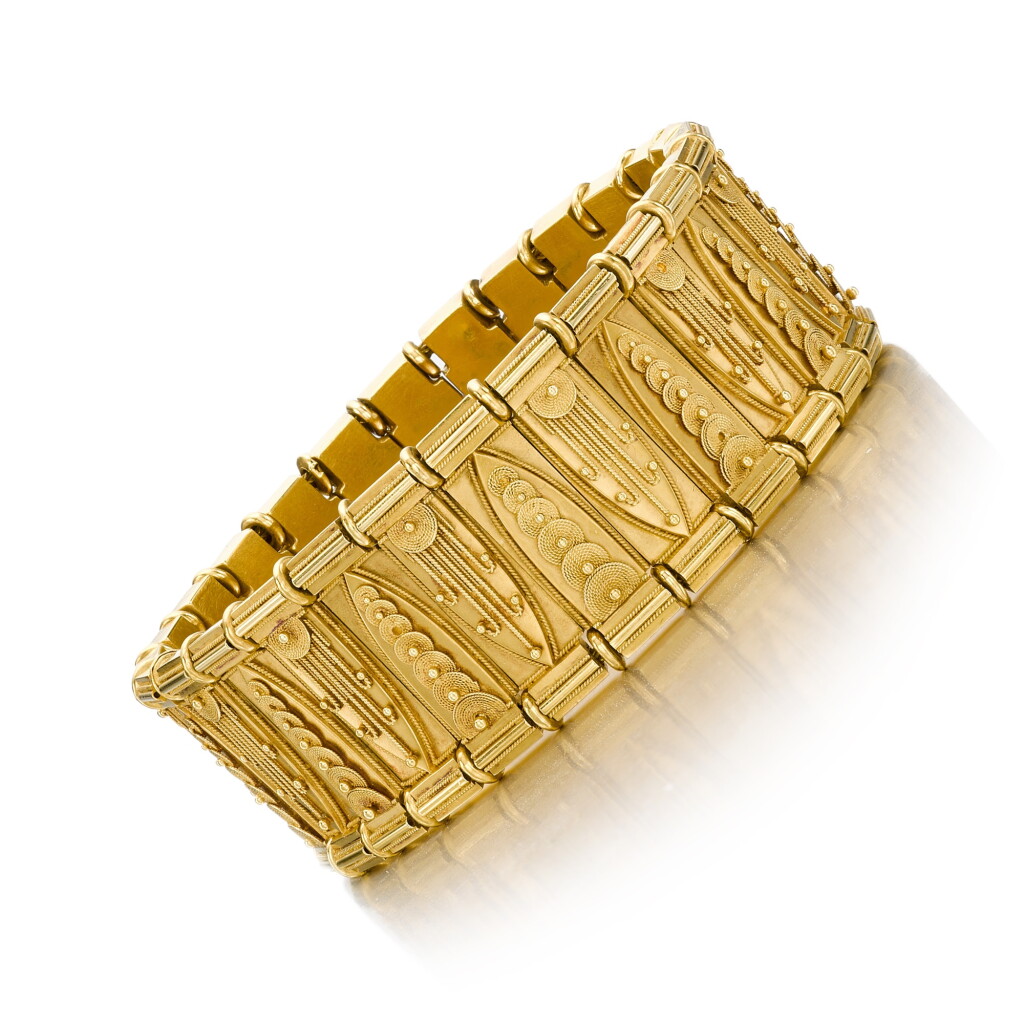
Etruscan Revival gold bracelet, circa 1870
Lot Closed
November 27, 03:13 PM GMT
Estimate
4,500 - 6,500 GBP
We may charge or debit your saved payment method subject to the terms set out in our Conditions of Business for Buyers.
Read more.Lot Details
Description
Designed in the Etruscan style with articulated alternating geometric panels, one panel decorated with overlaid discs of wire with a central bead, the other with wire work discs emitting curving threads, to a hidden woven chain, length approximately 180mm, maker's mark, French assay mark.
Henri Vever, French Jewellery of the Nineteenth Century, translated by Katherine Purcell, 2001, page 619 for bracelets of similar design.
Eugène Fontenay (1824-1887) was a Parisian jeweller known for his Archaeological Revival Jewellery. As a third-generation jeweller, he first apprenticed with Marchand and Dutrieh, the latter known for rediscovering the art of enamelling on gold. By the age of 24, Fontenay set up his own workshop at 2 rue Favart in Paris’ 2nd arrondissement, north of the Palais Royal. In 1861, jewels from the famous Campana Collection, one of the nineteenth century's greatest assemblages of Greek and Roman antiquities acquired by Napoleon III for the French nation, were exhibited at the Louvre Museum. Italian Archaeological Jewellery thus became a source of inspiration for Fontenay. At the Paris Exhibition in 1867, Fontenay held his first exhibition under his name and was awarded a gold medal for his designs based on Greek, Roman, and Etruscan jewellery.
Instead of literally copying jewels from antiquity, Fontenay adapted the elements of ancient jewellery and created jewels that were more compatible with current lifestyles and fashion. His necklace designs showcased his formidable talent, and according to Henri Vever, he successfully revamped “the parures of the beauties of Mycenae, of Cyprus and Tyr into ornaments for the Parisienne of today.”
Fontenay was very much involved with the academic side of the jewellery trade. Along with other jewellers including Frédéric Boucheron and Antoine Mellerio, Fontenay became one of the founders of the Chambre Syndicale de la Bijouterie-Joaillerie-Orfèvrerie, and supported the establishment of a network for younger craftsmen, including a school where all aspects of the trade could be taught to future students. He also shared his depth of knowledge by publishing articles in magazines and journals, including the Revue des Art Décoratifs. His book, Bijoux Anciens et Modernes was published posthumously in 1887.
You May Also Like