
Gustave Doré
Battle of Ascalon, 12 August 1099
Lot Closed
June 13, 01:46 PM GMT
Estimate
10,000 - 15,000 EUR
We may charge or debit your saved payment method subject to the terms set out in our Conditions of Business for Buyers.
Read more.Lot Details
Description
Gustave Doré
Strasbourg 1832 - 1883 Paris
Battle of Ascalon, 12 August 1099
Watercolour and gouache on paper laid down on panel, unframed
Signed lower right G. Doré
57,5 x 86,2 cm ; 22½ by 34 in.
H. Leblanc, Catalogue de l’œuvre complet de Gustave Doré, Paris, 1931, p. 541.
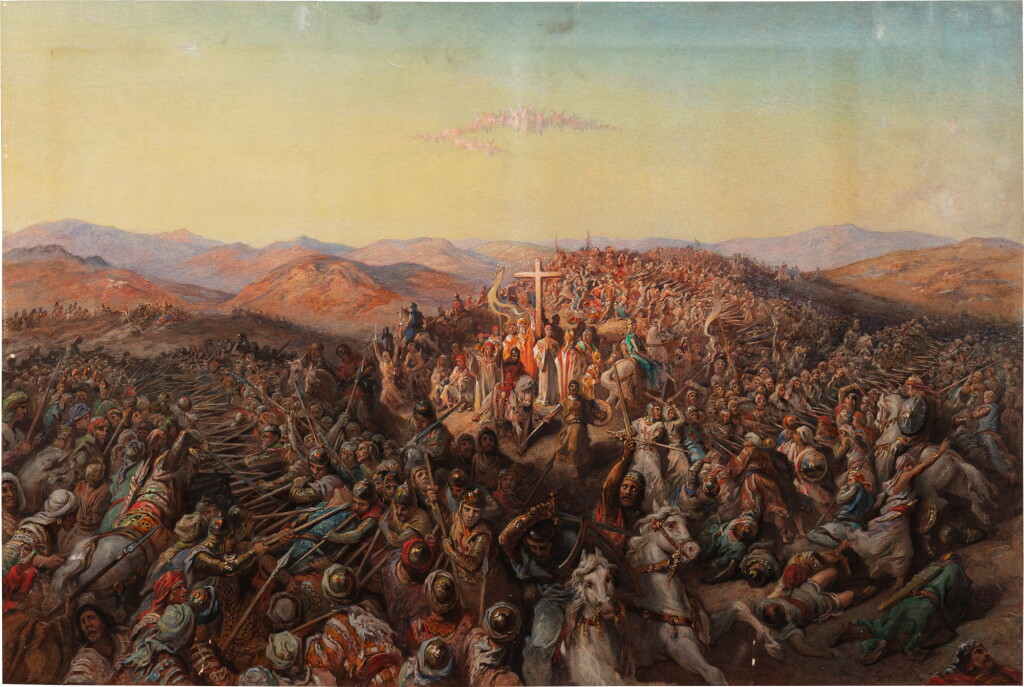
Dated 1875, this watercolour depicting The Battle of Ascalon completes the cycle of illustrations commissioned from Gustave Doré for L’Histoire des Croisades by François-Joseph Michaud. First published in 1812, the book was reprinted in 1877 with the artist’s illustrations.
Then aged about forty, Gustave Doré was already renowned for his illustrations of literary works, which included books by Dante, Cervantes and Rabelais. Here he has tackled the illustration of a book which is not literary fiction but purely historical. As such, the subject of the Crusades was a pretext for various themes that were dear to the artist: the epic narrative, the exaltation of heroic and patriotic sentiments, religion, and the violence of battle and its sometimes fatal outcome.
The Battle of Ascalon set the Christian army led by Godefroy de Bouillon against the army of Al-Afdhal, the Egyptian vizir, at the gates of the city of Ascalon, on 12 August 1099. It would end in victory for the Franks, thus marking the end of the First Crusade.
Gustave Doré has chosen to depict the moment when the Franks were repelling the Egyptian army. In the centre of the composition, a Christian cross dominates the throng, at its foot a small group of praying churchmen and two horsemen, lit by the last rays of the setting sun, evoking divine light. All around, the attacking Egyptian army seems to be coming from every direction, but is being repulsed by the Frankish soldiers. The detailed drawing of the foreground and central figures mutates in the background into simple dots disappearing into the distance, emphasizing the huge numbers of combatants and the extent of the battle.
Engraved in 1881 by Charles William Sharp, the work was also mentioned as being in the Doré Gallery in London by Henri Leblanc (see Bibliography).