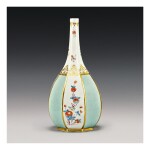

A MEISSEN SELADON-GROUND KAKIEMON OCTAGONAL FACETED BOTTLE VASE CIRCA 1730
Auction Closed
October 24, 05:26 PM GMT
Estimate
7,000 - 10,000 USD
Lot Details
Description
A MEISSEN SELADON-GROUND KAKIEMON OCTAGONAL FACETED BOTTLE VASE CIRCA 1730
painted with flowers alternating with celadon-ground panels, the shoulder with gilt scrollwork and the neck with further small flower sprigs, crossed swords mark in underglaze-blue, incised Dreher's mark 3 for Johann Ephraim Bormann (Rückert, 1990, p. 103), incised Japanese Palace inventory number N=291-W.
Height: 8½ in.
21.7 cm
The Royal Collections of Saxony, Japanese Palace, Dresden
Christie's London, February 28, 1994, lot 265
Cassidy-Geiger, 2008, no. 10, p. 189, illus.
Ninety-six 'Aufsatz-Bouteillen' were delivered to the Japanese Palace according to an invoice of 1734, see Dieter Hoffmeister, Meissener Porzellan des 18. Jahrhunderts Catalogue, Hamburg, 1999, Vol. II, p. 384.
A 1730 projected floor plan of the Japanese Palace shows Meissen porcelains were allocated to the upper floor. On the plan a square-shaped pavilion room on the facade facing the city is inscribed 'Seladon Porcell', published by Samuel Wittwer, The Gallery of Meissen Animals, Augustus the Strong's Menagerie for the Japanese Palace in Dresden, Munich, 2006, p. 33, pl. 33. Asian porcelains were allocated to the lower floor. In a contemporary account by Johann Georg Keyssler, of October 23, 1730, he describes the Japanese Palace: 'The rooms of the upper story, which is to be thirty-eight feet high, are to contain nothing other than Meissen porcelain...The second room is to contain many kinds of celadon-colored porcelain with gilding, and the walls are to be fitted with mirrors and other ornaments.' Wittwer, 2006, pp. 263-64.
A 'Specification von Porclian' of 1736, which was probably produced in conjunction with French Architect Zacharia Longuelene's plans of 1735, includes under 'No. 2' hundreds of seladon wares including 24 eight-sided bottles. For the full document see Maureen Cassidy-Geiger, 'Meissen Porcelain ordered for the Japanese Palace: A Transcription of the Specification von Porcilan of 1736', Keramos 153, 1996, where celadon wares are listed on pp. 120-121.
The 1770 inventory of the Japanese palace records: 'Neun und Funfzig Stück diverse Aufsatz-Bouteillen, Celadon-Couleur, mit weißen Feldern, darein kleine Blümgen und Zierrathen gemahlt, auch vergoldten Rändgen, No. 291.', [fifty-nine various display bottles, celadon color, with white panels painted with small flowers and decorations, also gilt rims, No. 291], Claus Boltz, 'Japanisches Palais-inventar 1770 und Turmzimmer-Inventar 1769', Keramos 153, 1996, p. 31.
Notable examples of seladon bottle vases to appear at auction bearing the Japanese Palace inventory number N=291-W include another example of the present form, sold at Sotheby's London, April 14, 2011, lot 393, formerly in the Rothschild Collection sold in an anonymous sale, Christie's London, October 17, 1977, lot 65; one sold at Christie's Geneva, November 10, 1986, lot 146 (together with a one with inventory number N=332.W); and two examples sold at Christie's London, June 2, 2009, lot 53.
Quadrangular-shaped bottle vases also feature this inventory number, examples of this form include that sold at Bonhams London, December 7, 2011, lot 158, formerly in the Rothschild Collection, sold in an anonymous sale, Christie's London, October 17, 1977, lot 64; a pair from the Hoffmeister Collection, sold at Bonhams London, November 25, 2009, lot 22; also formerly in the Rothschild Collection, sold at Christie's London, March 28, 1977, lot 38; and a further pair sold at Christie's London, December 11, 2007, lot 53.