
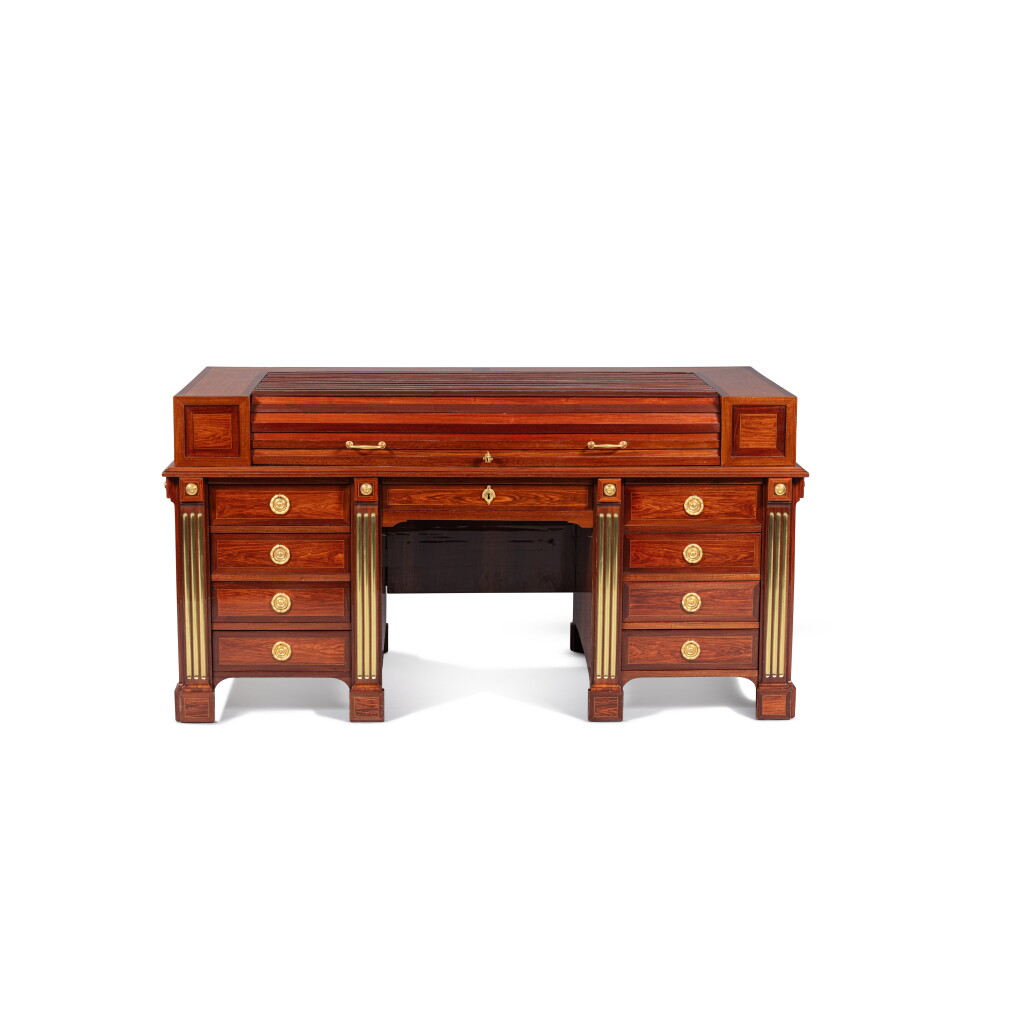
A Louis XV tulipwood, amaranth, holly wood and gilt-bronze marquetry mechanical desk, circa 1760-1770, stamped Pierre Garnier
Auction Closed
November 5, 09:38 PM GMT
Estimate
70,000 - 100,000 EUR
Lot Details
Description
the upper section formed by a ribbed cylinder opening to reveal an interior with twelve side drawers, resting on two pedestals each with four drawers and a frieze drawer, with doors to the outer sides, on square feet, stamped P. GARNIER
Height 41 3/8 in., width 73 5/8 in., depth 37 in. ; Haut. 105 cm, larg. 187 cm, prof. 94 cm
Importation of these lots into the U.S. may be prohibited or may require licenses and certificates issued by the appropriate agencies (U.S. Fish & Wildlife Service) to be exported and additional licenses and certificates to be imported. U.S. Fish & Wildlife Service reserves the right to block export into the US. Fish and Wild Life reserves the right to block export to the U.S. The inability of a buyer to export or import these lots, or a confiscation by a government agency, cannot justify a delay in payment or the cancellation of a sale.
Possibly delivered to the président de Boulainvilliers, Anne-Gabriel-Henri Bernard, Marquis de Boulainvilliers (1724-1798), Château de Passy;
Mes Couturier et Nicolay, Hôtel Drouot, Paris, 26 March 1984, lot 74;
Collection of Lily and Edmond Safra;
Property from the Collections of Lily & Edmond J. Safra, Sotheby's, New York, 18 October 2011, lot 730.
P. Kjellberg, Le Mobilier Français du XVIIIe siècle, 1989, p. 388, fig C;
C. Huchet de Quenetain, Pierre Garnier, 2003, ill. p. 1 and mentioned p. 97, cat. N°111.
Pierre Garnier (1726–1800), cabinet-maker, received master in 1742
The son of the Parisian cabinetmaker François Garnier, Pierre was one of the pioneers of neoclassical furniture, alongside Joseph Baumhauer. He worked in particular with the architect Charles de Wailly and maintained close ties with leading figures of his time, including the Marquis de Marigny, for whom he produced various pieces of furniture in the Greek style.
Architectural furniture
This elegant bureau forms part of a group of early pieces in the neoclassical style, classified as ‘highly architectural’ by Christophe Huchet de Quenetain in his 2003 monograph on the cabinetmaker. Within this group are two bureaux à cylindre, including the present and the one formerly in the Ann and Gordon Getty Collection in San Francisco.
They are distinguished by the originality of their design, featuring an almost perpendicular cylinder, and by the richness of their architectural detail. Finally, they are recognisable by the use of pilasters with three flutes, surmounted by a square, reminiscent of the furniture by Lalive de Jully. The desk from the Ann Getty collection is dated by an ink inscription from 1767, six years after the first Greek-style secrétaire attributed to Pierre Garnier.
Other pieces of furniture belong to this same group, notably a pair of commode held in the Swedish Royal Collections at Gripsholm Castle, a chiffonier and a four-drawer mahogany-veneered commode, dating from the 1760s. Finally, there are other bureaux without cylindrical sections, notably one formerly in the Steinitz collection (gallery catalogue, Paris, 2004, pp. 92–194).
The possible provenance of this bureau
The 1782 inventory of the Château de Passy, owned by President de Boulainvilliers, mentions "un bureau à cylindre de bois de palissandre garni de ses différents tiroirs, anneaux entrées et pilastres de cuivre " (‘a rosewood bureau à cylindre fitted with various drawers, copper rings, lock plates and pilasters’). A year later, this same bureau is described as "un secrétaire à cylindre de 6 pieds de long garni de ses tiroirs avec anneaux et mains, rosettes et entrées de serrure de cuivre doré d’or moulu le dit secrétaire en bois d’amarante et satiné" (‘a bureau à cylindre, 6 feet long, fitted with drawers featuring rings and handles, rosettes and lock plates in ormolu; the said secretaire is made of amaranth wood and bois satiné’. Only two known bureaux match this description: the one in the Ann & Gordon Getty Collection and the present example. It remains, however, impossible to determine with certainty which of the two comes from the prestigious collection of the President of Boulainvilliers.
This bureau was also part of the prestigious collection of Lily and Edmond J. Safra, one of the finest private collections dedicated to the decorative arts, and bears witness to the significance of this bureau within Pierre Garnier’s body of work.