
To be Sold on Behalf of the Dutch State
Rembrandt Harmensz. van Rijn
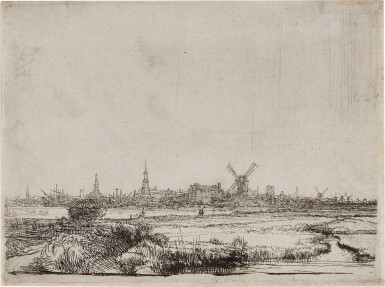
A View of Amsterdam from the Kadijk
Auction Closed
July 3, 10:51 AM GMT
Estimate
70,000 - 100,000 GBP
Lot Details
Description
To be Sold on Behalf of the Dutch State
Rembrandt Harmensz. van Rijn
(Leiden 1606–1669 Amsterdam)
A View of Amsterdam from the Kadijk
Etching, circa 1641, a fine, atmospheric impression of New Hollstein's only state, rich and black in the foreground, printing with great clarity in the background, sulphur tinting in the sky at left and many vertical wiping marks in the sky, particularly at right, on paper with a partial Arms of Amsterdam watermark (Ash & Fletcher Fb, Hinterding F.a-c)
plate: 114 by 154 mm
sheet: 117 by 156 mm
With P. & D. Colnaghi & Co., their inv. no: C18574;
Francis Garford (d. ca. 1893), England (L.1000 and L.1066)
his sale, London, Christie’s, 24 February 1893;
with Kunsthandel Frans Jacobs, Amsterdam,
where acquired by the former owner
Kunsthandel Frans Jacobs, Amsterdam in ‘Veranderend Amsterdam’, 6 September to 12 October 1997
E. Hinterding and J. Rutgers, The New Hollstein: Dutch and Flemish etchings, engravings and woodcuts 1450-1700, Rembrandt, 2013, no. 203
A. Hind, A Catalogue of Rembrandt’s Etchings: chronologically arranged and completely illustrated, 1923, no. 176
White & Boon, Rembrandt’s Etchings: An Illustrated Critical Catalogue, 1969, no. 210
The view in this etching is that of Amsterdam from the North East, shown in reverse. To the right the windmills of the walled fortifications are seen, of which the largest and closest to the viewer is the so-called ‘Rijzenhoofd’ on the outmost bulwark of the river IJ. On Rapenburg Island to the left of the Rijzenhoofd are the shipyards and warehouses of the Dutch East India Company; next to which in sequence are the Montelbaanstoren tower, the Oude Kerk, possibly the Westerkerk, and, in the far distance, the Haringpakkerstoren (Herring Packers Tower). Rembrandt has executed with a painterly eye, introducing the picturesque, dark scrub in the foreground, forming a repoussoir. It is likely that Rembrandt executed this plate outdoors, playing with the view as he did so.
Martin Royalton-Kisch, former curator of northern European prints and drawings at the British Museum, notes that the style of the etching is indistinguishable from the two signed and dated horizontal etchings of 1641, Landscape with Cottage and a large Tree (New Holl. 198) and Landscape with Cottages and a Hay Barn: Oblong (New Holl. 199), thus revising the former date given to the present (undated) etching of 1640, to the correct date of 1641. Royalton-Kisch observed that the three etchings together form a broad and very convincing panorama of Amsterdam, in which View of Amsterdam is in the centre, with Landscape with Cottage and a large Tree fitting perfectly on the left, and Landscape with Cottages and a Hay Barn: Oblong continuing the panorama to the right. Theo Laurentius further proposed that Rembrandt did actually intend to etch a panorama in three parts, but abandoned the idea in favour of working up the three component parts as independent etchings. Laurentius also went on to suggest that The Windmill (New Holl. 200), also dated 1641, was the first idea (also relinquished) for the left hand side of the panorama, observing the common dark line beneath the A View of Amsterdam from the Kadijk and The Windmill.
The sulphur tinting and vertical wiping marks in the present impression are a rarity, and in the latter respect it is comparable to the impression at the Rijksmuseum, Amsterdam, object no. RP-P-1961-1116, which was formerly in the collections of Hendrikus Egbertus Ten Cate (Lugt 533b) as well as Henry Studdy Theobald (Lugt 1375). Theobald was described by Lugt as having ‘une des plus belles collections d'estampes que l'on puisse imaginer.’ These vertical wiping marks in both impressions lend depth to the skies, and suggest a deluge. The atmosphere of lowering skies is further enhanced in the present impression by the delicate sulphur tinting. These qualities make for a rich and painterly effect, in contrast to the flattening effect of the blank sky which is most often encountered in this work.