
Jusepe de Ribera, called lo Spagnoletto
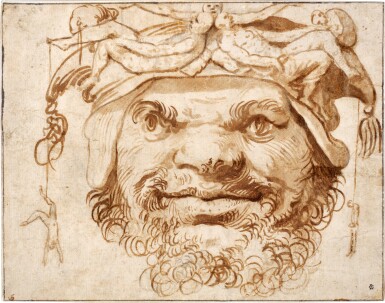
Jusepe de Ribera, Grotesque head with a fool hat
Auction Closed
July 3, 10:51 AM GMT
Estimate
150,000 - 250,000 GBP
Lot Details
Description
Property of a Private Collector
Jusepe de Ribera, called lo Spagnoletto
(Játiva 1591 - 1652 Naples)
A Grotesque Head with small naked males surmounting his jester's cap, with different tassels on each side, and hanging'Lilliputian' figures
Point of the brush and brown ink and two shades of brown wash, with touches of grey wash, over traces of black chalk;
bears numbering in brown ink, lower left: 6.
194 by 254 mm
Prof. Dr. Wilhelm Alexander Freund (1833-1917), Strasbourg and Berlin (L.954), his stamp on the old backing sheet,
probably his sale, Amsterdam, 'De Brakke Grond', C.F. Roos and A.G.C. De Vries, 19-21 February 1906, possibly lot 255: 'Fr. Primaticcio. Tête de fou. A la sépia. Hauteur 19.5 cm. Largeur 25 cm.';
Eugène Rodrigues (1853-1928), Paris (L.897),
his sale, Paris, Hôtel Drouot, 28-29 November 1928, lot 65 ('École Allemande XVIe Siècle. Mascaron grotesque. Au pinceau, au lavis de bistre. Timbre de la collection W. A.Freund... Cadre XVIe siècle, en ébène. H. 195 - L. 250);
Charles Férault (b. 1877), Paris and Biarritz (L.2793a), his mark faintly stamped at the lower right;
possibly Geneviève Aymonier-Férault, Paris;
sale, Paris, Christie's, 27 March 2003, lot 51 (as Ecole bolonaise, 16ème siècle);
with Jean-Luc Baroni, New York and London (An exhibition of Master Drawings and Oil Sketches), 2005, no. 12, reproduced
Naples, Museo di Capodimonte, et al., ritorno al barocco da caravaggio a vanvitelli, 2009-10, vol. II, p. 62, no. 3.18 (entry by Cristiana Romalli), p. 63, reproduced;
Madrid, Museo Nacional del Prado, Seville, Fondatiòn Focus, and Dallas, Meadows Museum, Jusepe de Ribera, The Drawings, Catalogue raisonné, 2016, (ed. Gabriele Finaldi, texts by Elena Cenalmor, Gabriele Finaldi, Edward Payne) pp. 318-320, no. 132, reproduced
N. Turner, 'Another study for Ribera's early Adoration of the Magi', Apollo Magazine, January 2004, p. 32, reproduced fig. 3;
G. Finaldi, 'Dibujos inéditos y otros poco conocidos de Jusepe de Ribera', Boletín del Museo del Prado, 2005, no. 41, p. 42, note 4 ('Esta hoja, fascinate por su iconografía y que probablemente data de los últimos años de la década de 1630, está relacionada con un grupo de dibujos que muestran hombres pequeños trepando sobre grandes figuras...El significando último del tema queda pendiente de un estudio más profundo.');
C. Romalli, 'Alcuni fogli del Seicento: osservazioni sul mercato e disegni in collezioni private, in Le Dessin Napolitain, Actes du colloque international (ed. F. Solinas and S. Schütze), Rome 2010, p. 319;
N. Turner, 'A Grotesque head by Jusepe de Ribera in the Ashmolean Museum, Oxford', Master Drawings, vol. 48, 2010, pp. 456-457, reproduced fig. 1, and p. 461, notes 5, 6;
V. Farina, Al sole e all'ombra di Ribera: questioni di pittura e disegno a Napoli nella prima metà del Seicento, Naples 2014, vol. I, pp. 63 and 65-66, reproduced fig. 35;
Idem, 'Ribera's Satirical Portrait of a Nun', Master Drawings, vol. 52 (4), 2014, pp 475-477, reproduced fig. 7, and 480, note 16;
G. Finaldi, Jusepe de Ribera, The Drawings, Catalogue raisonné, Madrid/Dallas 2016, pp. 318-20, no. 132, reproduced, under no. 112, p. 276, and 133, pp. 321-22;
D. Ekserdjian, 'Ribera, the master draughtsman', The Art Newspaper, Review, October 2017, p. 21, reproduced;
M. McDonald, Exhibitions: 'Ribera's drawings,' The Burlington Magazine, May 2017, (CLIX), pp. 424-25 (as not autograph)
This extraordinary sheet, with its most striking visual imagery, is one of the most important drawings by Ribera to have surfaced in the last two decades. The sheet was first attributed and published as Ribera by Nicolas Turner, in 2004 (see Literature). It was first exhibited in the Museum of Capodimonte, Naples (2009-10) and more recently at the Prado and other venues, in 2016 (see Exhibited).
Mysterious and satirical iconographies are characteristic of Ribera's imaginative, sarcastic, and capricious mind. Often, like in the present sheet, these drawings are executed as works in their own right, probably for the artist's own consumption or to be shared with friends, amused by their mocking and polemic imagery. The majority of Ribera's drawn oeuvre was not necessarily made in preparation for painted or engraved works. Drawings certainly have a vital place in the artist's creativity, and more importantly are the ideal vehicle for expressing intimate, often intriguing and mysterious messages.
The grotesque bearded head that is the subject of this drawing, described by Turner in 2010 as 'a smiling black man' (see Literature), wears a jester's cap and gazes to the left, his piercing eyes resembling those of an owl. The face fills almost the entire sheet. His cap is surmounted by three small bodies, lying in a triangular arrangement, while two smaller ones, crouching at the sides, are defecating. Even more extreme is the sight of the naked bodies covered in sores, which Turner suggests could be a reference to the bubonic plague.1 To the sides, two Lilliputian figures dangle from ropes attached to the feet of the main figures, one hanging by the neck the other by the leg, grotesquely complementing the tassels of the jester’s cap. These Lilliputian figures can be related to a number of such motifs in Ribera's capriccio drawings: see for instance the sheet in the Prado depicting a masked man, Il Capitano, an ambiguous and cowardly character from the Commedia dell'Arte (fig. 1), where we see several small naked men climbing up the subject’s body, trying to reach the top of his hat.2
As Turner noted in 2010, another very similar drawing, depicting a Grotesque Head of a bearded man with hairy skin, is in the Ashmolean Museum, Oxford.3 That drawing bears a traditional, probably 17th-century, attribution to Ribera, which has been partly erased. The sheet is laid down on an elaborate mount commissioned by the collector Francesco Maria Niccolò Gabburri (1676-1742), and the attribution to Ribera is also written on the verso of the Gabburri mount, in red chalk: Caricatura di Giuseppe Ribera Spagnolo/di sua mano.4
Both the present drawing and that in the Ashmolean are dated by Turner to the late 1630s, a dating endorsed by Finaldi and other scholars,5 though Viviana Farina has instead proposed a much earlier dating, to the 1610s.6 The two drawings are executed in exactly the same technique, both drawn with the point of the brush and shades of brown wash. Moreover, as Turner observed, they share close similarities in the physiognomy of the faces, though the present sheet is more sinister.7 The contours of the head and shoulders of the Oxford drawing have, however, been silhouetted, which today compromises the reading of the sheet.
Another study that can be closely associated stylistically with the present drawing, employing the same distinctive technique, is the Head of a man with a balaclava over his eyes, identified as Ribera by Aidan Weston-Lewis in 2011, among the Carracci school drawings in Berlin.8 Again, the eccentricity of the subject in the Berlin sheet is very typical of Ribera. As here, the artist has employed the point of a brush with two shades of brown ink, resulting in thicker, more fluid lines when compared with artist's use of pen and ink.
When using the point of the brush Ribera is capable, as in the present sheet, of subtle variations in the strokes and their intensity, clearly demonstrating a reassured and elegant handling of the media. There is an enormous vivacity in the representations of these head studies, the uniqueness of which is matched by the artist’s dexterity in the use of the media employed, which can only be the work of a great mind. Although the Berlin sheet can also be dated to the late 1630s,9 an interesting stylistic comparison can also be made with an earlier sheet, Head of a man in profile (datable to the late 1620s), now in the Prado, which is executed with the point of the brush, red ink and red wash.10 Though drawn with the tip of a thinner brush, there is a comparable use of parallel lines, and other very similar passages.
These various brush drawings are among the most engaging of all the artist's surviving works, reflecting very powerfully Ribera's unique personality and spirit. Their technique, favouring the point of the brush and shades of brown wash, results in thicker lines, similar to the effect of a chiaroscuro woodcut, as Aidan Weston-Lewis rightly noted when describing the Berlin Head of a man with a balaclava over his eyes.11
Defined by extraordinary quality and invention, Ribera’s wash caricatures constitute a lesser known but exceptionally original and powerful aspect of the artist's draughtsmanship, the exact meaning of which remains shrouded in mystery.
- See Turner op. cit., 2010, p. 456, where he points out that in Ribera's lifetime the most serious outbreak of the bubonic plague was in the area of Milan in 1629-1631
- Madrid, Museo Nacional del Prado, inv. D8743; Madrid/Seville/Dallas, 2016, pp. 176-180, cat. 62, reproduced; further examples are: A man wearing a large Cloak with a small naked figure holding a banner seated on his head, New York, Metropolitan Museum, inv. 1981.395; A man wearing a Phrygian cap with small figures climbing on it, Philadelphia, Philadelphia Museum of Art, inv. 1984-56-8; Head of a woman wearing a veil with small naked figures on it, private collection; respectively: Madrid/Seville/Dallas, 2016, cats. 110, 111, 135
- Oxford, Ashmolean Museum, inv. WA 1863.1480; Madrid/Seville/Dallas, 2016, cat. 133
- The Madrid/Seville/Dallas 2016 catalogue entry (see note 3 above) states that the old attribution on the verso is not in the hand of Maria Niccolò Gabburri (1676-1742), though it is also found on other portrait drawings with the same provenance
- See, Madrid/Seville/Dallas, 2016, loc. cit.
- Farina, op. cit., 2014, p. 475; Farina has also suggested that the Ashmolean drawing could represent a court jester
- Turner, op. cit., 2010, p. 457
- Berlin, Staatlische Museen zu Berlin, inv. KdZ 20821; Madrid/Seville/Dallas, 2016, cat. 112, reproduced. It is interesting to note that the present sheet was sold as Bolognese School, 16th century when it first appeared on the art market (see Provenance)
- Madrid/Seville/Dallas, 2016, loc. cit.
- Madrid, Museo Nacional del Prado, inv. D6239; Madrid/Seville/Dallas, 2016, cat. 70
- Madrid/Seville/Dallas, 2016, p. 276
You May Also Like


