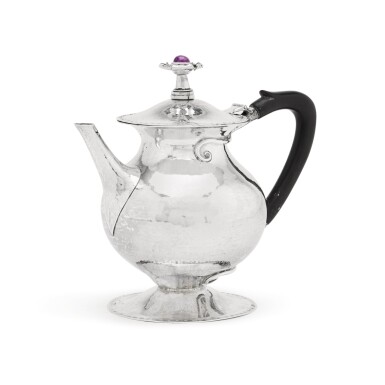
Charles Robert Ashbee: an Arts & Crafts silver teapot, Guild of Handicraft Ltd., London 1900
Lot Closed
May 17, 12:33 PM GMT
Estimate
4,000 - 6,000 GBP
Lot Details
Description
A Victorian Arts & Crafts silver teapot
Guild of Handicraft Ltd., London 1900, designed by Charles Robert Ashbee
The sperical body with a spot-hammered finish, the cover and foot with beaded borders, the wood handle leading to tendril brackets, with an amethyst-set flower head finial with ivory insulator.
16cm.; 6 1/4in. high
388gr.; 12 1/2oz. all in
This teapot is of a similar outline to one illustrated in C.R. Ashbee’s essay, Modern English Silverwork, which he published in 1909 and dedicated to ‘the Trade Thief whose conscience is soothed by the knowledge that he is acting upon business principles.’
The architect and designer, Charles Robert Ashbee was born on 17 May 1863, the only son of Henry Spencer Ashbee (1834-1900), senior partner in Charles Lavy & Co., general export and commission merchants, and his wife, Elizabeth (née Lavy, 1841-1919). Ashbee was educated at Wellington College and between 1883 and 1886 at King’s College, Cambridge. He also studied under the architect, George Frederick Bodley (1827-1907), one of the founders of Watts & Co., the well-known wallpaper manufacturers and interior design specialists. Ashbee, a passionate supporter of the Arts and Crafts movement, established his Guild and School of Handicraft in 1888. Although the school closed in 1895, The Guild continued, with workshops at Essex House, 401 Mile End Road. The business was registered on 8 July 1898 as a limited liability company under the style of the Guild of Handicraft Ltd. The company opened a West End showroom at 16a Brook Street, New Bond Street and later, in 1902, the workshops moved to Essex House, Chipping Campden, Gloucestershire.
Stung by the financial failure of the Guild of Handicraft Ltd., which was voluntarily wound-up in 1908, Ashbee published his Modern English Silverwork. ‘This book of my Silver designs,’ he wrote, ‘represents a selection of some 200 pieces taken indiscriminately from out of the portfolios of the Guild of Handicraft, and designed and made in my workshops during the last 20 years. . . . I do not know if any excuse be needed for the publication of the drawings, beyond the fact that I wanted to get them together; and the further fact that after 20 years work I see so many cheap, and tawdry and lame repetitions of them in the shop windows, that in fairness to myself I thought the designs should have the chance of going out as I wished them or intended them to appear. An artist under the conditions of Industrialism has no protection, any tradesman can steal his designs, he has no copyright as the author has, and it does not pay him to register, as it does the engineer or the man in control of a machine that reduplicates; if therefore a tradesman is bent on stealing, there is nothing to stop him, and as far as I am concerned he may as well steal correctly. I dedicate this book therefore to the Trade Thief, desiring him only – if indeed he have any æsthetic honour, thieves sometimes have! - to thieve accurately.’
Ashbee went on to write that a good example of silversmithing ‘should first have feeling and character, and this should be expressed both by the designer and the Craftsman.’ These qualities are amply exhibited in this present teapot.
You May Also Like