
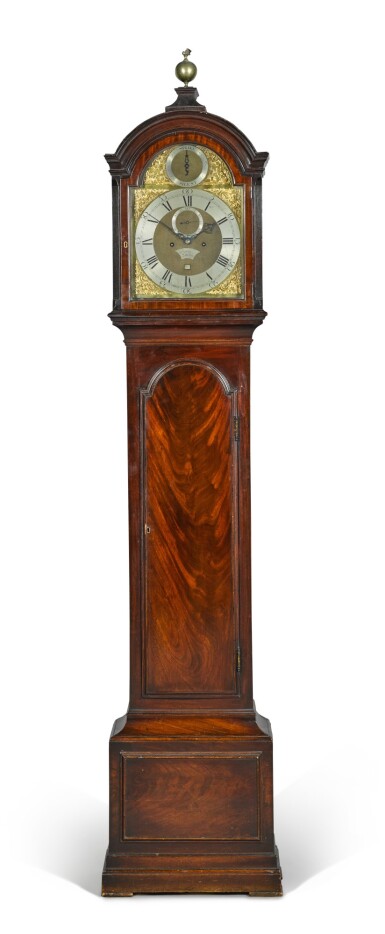
A George III mahogany longcase clock, John Holmes, London, circa 1775
Lot Closed
May 17, 11:53 AM GMT
Estimate
6,000 - 10,000 GBP
Lot Details
Description
A George III mahogany longcase clock, John Holmes, London, circa 1775
12-inch dial with rococo spandrels, matted centre with subsidiary seconds dial and date aperture, signed on a silvered plaque Holmes, London, strike/silent dial in the arch, the substantial movement with five knopped pillars, anchor escapement with reduced recoil, maintaining power, roller suspension to the Ludlam-type wood rod pendulum, rack striking on a later coiled gong, the case with moulded cresting and single ball finial above reeded canted hood corners and foliate side frets, finely moulded broken-arch trunk door and panelled plinth with stepped base
229cm 7ft 6in high
In 1760 Holmes moved with his young family to new premises in The Strand, just east of Somerset House, where he was to remain for the rest of his life. A fine and innovative maker, he was particularly well connected in the horological world in London during the second half of the 18th century. He maintained his close association with John Smeaton and corresponded with Oxford astronomer and mathematician Rev William Ludlam. In 1792/3 Holmes was appointed to the Parliamentary sub-committee to report on one of Thomas Mudge's marine timekeepers. After his death in 1797 the business was continued by his wife and two of his sons until it finally closed in 1816.
For extensive information regarding John Holmes, his life and clocks see Antiquarian Horological Society Journal, Vol. 27 No.3, pp.289-301 and Vol.27 No.6 pp.643-653
You May Also Like


