
MASTERPIECES OF TIBETAN ART FROM THE NYINGJEI LAM COLLECTION
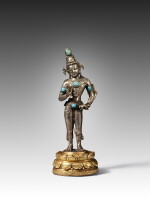
The Nyingjei Lam gem-inset silver and gilt-copper figure of Avalokiteshvara Padmapani, Tibet, 12th / 13th century
Auction Closed
September 18, 04:57 PM GMT
Estimate
800,000 - 1,000,000 USD
Lot Details
Description
The Nyingjei Lam gem-inset silver and gilt-copper figure of Avalokiteshvara Padmapani
Tibet, 12th / 13th century
西藏 十二 / 十三世紀 銀嵌寶蓮華手菩薩立像連銅合金鎏金蓮花座
Himalayan Art Resources item no. 68450.
HAR編號68450
Height 9½ in., 24 cm
Ashmolean Museum, Oxford, 1996–2005 (on loan).
The Sculptural Heritage of Tibet: Buddhist Art in the Nyingjei Lam Collection, Ashmolean Museum, Oxford, 1999.
Arte Buddhista Tibetana: Dei e Demoni dell' Himalaya, Palazzo Bricherasio, Turin, 2004, cat. no. IV. 24.
Rubin Museum of Art, New York, 2005–2018 (on loan).
Casting the Divine: Sculptures of the Nyingjei Lam Collection, Rubin Museum of Art, New York, 2012–13.
Masterworks: Jewels of the Collection, Rubin Museum of Art, New York, 2014–2015.
David Weldon and Jane Casey Singer, The Sculptural Heritage of Tibet: Buddhist Art in the Nyingjei Lam Collection, London, 1999, pl. 15.
The bodhisattva is identified as Avalokiteshvara by the diminutive effigy of Buddha Amitabha in the hair behind the central crown panel. The right hand is raised in the gesture of fearlessness (abhaya mudra) and the left holds the stem of the lotus (padma) associated with this form of the bodhisattva Avalokiteshvara as Padmapani, the lotus bearer.
This rare Tibetan silver statue set into a circular gilt-copper lotus pedestal is modeled after eastern Indian sculpture such as the 11th or 12th century Pala period (8th-12th century) silver Maitreya with a gilt-copper base in the Cleveland Museum of Art, see David Weldon and Jane Casey Singer, The Sculptural Heritage of Tibet: Buddhist Art in the Nyingjei Lam Collection, London, 1999, fig. 15. The distinctive Pala-style belt tied at the waist and the textured belt with a large central gem setting are stylistically related to the Cleveland figure, as well as the otherworldly expression on the face with heavily lidded eyes rolled up in a meditative state, and the tall jatamakhuta with large gem finial. However, despite the parallels with eastern Indian medieval works, this sculpture differs significantly from the Pala original, especially in the exuberantly large gem settings and the lotus pedestal that is finished with a decorated rim, in contrast to the base of the Cleveland Pala figure which is designed to fit into a separate throne with a prabhamandala attached to a lug in the middle of the back of the figure. The base of the Nyingjei Lam figure has a slot at the back but no tang protruding at the back to fix a separate prabhamandala. The pedestal’s sealing plate is engraved with a Tibetan style lotus and the Eight Auspicious Emblems (Tib. tashi tagye). With the statue’s close affinities to eleventh or twelfth century eastern Indian sculpture as well as its important stylistic departures, this unique silver figure with distinctive gem settings and its elegant gilt-copper pedestal may be attributed to Tibet and dated to around the twelfth or thirteenth centuries.
此尊為觀世音菩薩,依寶冠後阿彌陀佛小像可辨。右手施無畏印,左手持蓮花莖,故亦稱蓮華手菩薩。
此尊銀像立於銅鎏金蓮花座上,風格汲取自印度東部,可比十一至十二世紀帕拉王朝(八至十二世紀)彌勒銀像連銅鎏金座一尊,藏克利夫蘭藝術博物館,錄David Weldon及Casey Singer,《The Sculptural Heritage of Tibet: Buddhist Art in the Nyingjei Lam Collection》,倫敦,1999年,頁22,圖15(圖一)。腰帶見典型帕拉風格,嵌寶瑰碩,面容脫塵,雙目微張,髮髻高聳,髻頂亦見碩麗嵌寶,皆與克利夫蘭藝術博物館例頗似。雖與印度東部同時期造像相類,較之帕拉王朝原型,此尊亦有區別,如嵌寶尤其醒目,且蓮花座邊沿滿飾,反觀克利夫蘭例,底座單獨作,身後接背光。菩薩道此尊不另接背光,所連底座封板鐫刻西藏蓮花及吉祥八寶。此尊銀像受十一至十二世紀印度東部造像影響明顯,然嵌寶及銅鎏金底座應屬十二至十三世紀西藏風格之典型。