
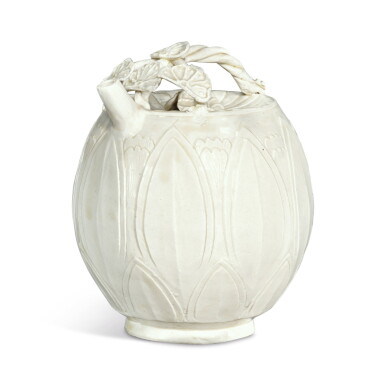
PROPERTY FROM A GERMAN PRIVATE COLLECTION | 德國私人收藏
A WHITE STONEWARE EWER, FIVE DYNASTIES/LIAO DYNASTY, 10TH/11TH CENTURY | 五代/遼 十/十一世紀 白釉刻蓮紋提粱壺
Auction Closed
November 4, 07:52 PM GMT
Estimate
30,000 - 50,000 GBP
Lot Details
Description
PROPERTY FROM A GERMAN PRIVATE COLLECTION
德國私人收藏
A WHITE STONEWARE EWER
FIVE DYNASTIES/LIAO DYNASTY, 10TH/11TH CENTURY
五代/遼 十/十一世紀 白釉刻蓮紋提粱壺
the ovoid body rising from a short foot, finely carved with overlapping lotus petals and leaves, the rim set with a handle in the form of entwined stems set with small flowerheads, a short spout to one side of the rim, covered overall with a clear glaze
Height 13.5 cm, 5¼ in.
In its material and carving style, this ewer is characteristic of products from the Longquanwu kilns in Beijing, which made fine white stonewares influenced by Ding forms, yet stylistically independent. Similarly carved ewers with regular side handle, with a related profile but a sloping shoulder set off at a distinct angle rather than the sunken shoulder seen here, have been recovered from the kiln site, see Beijing Longquanwu yao fajue baogao/Excavations of the Longquanwu Kiln-site in Beijing, Beijing, 2002, col. pl. 5, fig. 1, and pp. 284f. The present shape is rare, but a comparable ewer with plain lobed sides, excavated from a tomb in Inner Mongolia, is illustrated in Peng Qingyun, Zhongguo wenwu jinghua daquan. Taoci juan [Complete masterpieces of Chinese cultural relics. Ceramics volume], Taipei, 1993, no. 489; another with a peony scroll around the body, excavated at Liaoyang in Liaoning is published in Zhongguo taoci quanji [Complete series on Chinese ceramics], vol. 9, Shanghai, 2000, pl. 16