
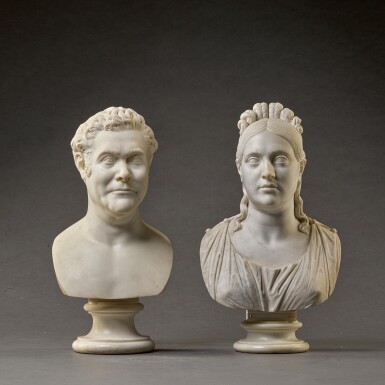
FILIPPO ALBACINI (1777-1858), ITALIAN, ROME, CIRCA 1825 | PAIR OF BUSTS OF PRINCE GIOVANNI AND PRINCESS ANNA MARIA TORLONIA
Lot Closed
July 9, 03:14 PM GMT
Estimate
24,000 - 35,000 GBP
Lot Details
Description
FILIPPO ALBACINI (1777-1858)
ITALIAN, ROME, CIRCA 1825
PAIR OF BUSTS OF PRINCE GIOVANNI AND PRINCESS ANNA MARIA TORLONIA
the female bust signed: ALBACINI ROMANO
the male bust signed and dated: ALBACINI FECE IN ROMA 1825
marble
68cm., 26¾in. and 64cm., 25¼in.
To view the Shipping Calculator, please click here
Torlonia Collection, Rome
The son of the eminent neoclassical sculptor Carlo Albacini (1735-1813), who was famed as one of the greatest restorers of antiquities in Rome, Filippo Albacini is best known for his masterpiece, the Wounded Achilles in the Devonshire Collection at Chatsworth. Commissioned by William Cavendish, 6th Duke of Devonshire, in 1823 and completed in 1825, the over-life-size marble of the Homeric hero was universally hailed as an exemplar of Roman neoclassicism. Albacini's Achilles was given pride of place in the sculpture gallery at Chatsworth alongside works by neoclassical masters such as Canova, Thorvaldsen and Bartolini and continues to find admirers today; most recently it was the star of the Troy exhibition at the British Museum (2019). Despite the success of his Achilles, details of Filippo Albacini's life and work remain relatively obscure. He is known to have trained in his father's studio and to have been a protégé of Antonio Canova, with whose support he became a teacher at the Accademia di San Luca. In 1813 he executed busts of Leonardo da Vinci and Antonio da Correggio, which were installed in the Pantheon and later transferred to the Campidoglio.
Dated 1825, the year Albacini completed the Achilles, the present pair of busts of members of the illustrious Torlonia family testifies to Albacini's high standing in Roman society as a sculptor of aristocratic portraits. His skill in this field is amply demonstrated in the fresh naturalism and sense of character exhibited in the busts. An important member of the Torlonia dynasty, Giovanni Torlonia, 1st Prince of Civitella-Cesi (1755-1829) was a banker who administrated the finances of the Vatican. He was greatly favoured by Popes Pius VI and Pius VII, who bestowed numerous titles on him and eventually elevated him to the level of Patrician. A pair of busts of the same sitters, tentatively attributed to Pietro Tenerani, is illustrated in E. Majo et al., Bertel Thorvaldsen, 1770-1844: Scultore danese a Roma, Rome 1989, p. 19, figs. 15 and 16.