
Property from a Private Collection
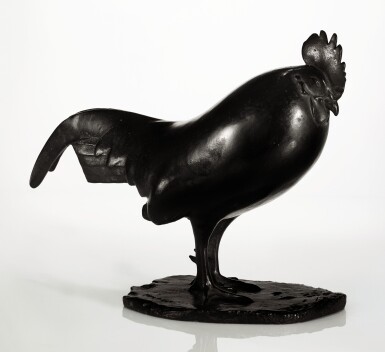
FRANÇOIS POMPON | COQ DORMANT
Auction Closed
December 12, 09:10 PM GMT
Estimate
25,000 - 35,000 USD
Lot Details
Description
Property from a Private Collection
FRANÇOIS POMPON
COQ DORMANT
designed circa 1914, executed 1925
executed by A. A. Hébrard, Paris
patinated bronze
signed Pompon, numbered (9) and with foundry mark Cire Perdue A.-A. Hebrard
8¼ x 5 x 12¼ in. (21 x 12.7 x 31.1 cm)
Galerie Saint Louis, Lyon, France
Private Collection, Stamford, Connecticut
Thence by descent to the present owner
Robert Rey, "Deux Sculpteurs Animaliers: Pompon," Art et Décoration, January 1922, p. 85
Catherine Chevillot, Liliane Colas and Anne Pingeot, François Pompon, Paris, 1994, p. 194, no. 52
Sotheby’s would like to thank Liliane Colas for her assistance with the cataloguing of this lot.
François Pompon made a name for himself during the late 19th Century as one of the most talented sculptors in Paris, assisting such revered artists as Auguste Rodin and Camille Claudel. During this period, he often showed works at various Paris salons but, while his skill was admired by his peers, the importance of his work was not widely recognized for several decades. Pompon’s later success, which came when the artist was in his sixties, was propelled by his reaction against the increasingly expressionistic style promoted by his contemporaries, such as Rodin. As a result, Pompon developed his own aesthetic, characterized by fluid contours and pure volumes. He turned away from the human form as subject and, inspired by the diverse creatures he viewed at the ménagerie of the Jardin des Plantes, began sculpting animals.
At the Paris Salon d'Automne of 1922, Pompon’s work finally received the recognition it deserved. In an issue of Art et Décoration from the same year, one critic explored the contradictory quality of Pompon’s seemingly simplistic yet incredibly complex work: “The perfection of the silhouette is an important criteria. If placed in front of a wall the beast projects a shadow that appears to reflect a living subject (‘there is a rooster, it is sleeping’), it means that the piece is successful… Is it a scientifically accurate depiction of the animal? No, because the final result does not seek to reproduce nature. Pompon wants to depict the animal under its most constant aspect and capture its essence.”
Conceived prior to 1914, Coq Dormant is emblematic of Pompon’s pioneering modernist aesthetic, which offered an alternative to Cubist deconstruction. Fonderie Hébrard cast 46 examples of the model in bronze between 1918 and 1932 in editions numbered 1 to 10, A1 to A10, B1 to B10, C1 to C10 and D1 to D6. The present lot, numbered 9, is from the earliest edition of the model, executed in 1925. It was sold at Galerie Saint Louis in Lyon, France, in the same year and was presented as a gift to an American textile merchant. The work has remained within the family since the period. An example of this model is in the collection of the Smithsonian Institution, Washington, D.C. (accession no. 66.4099).