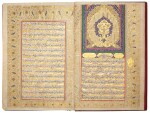

Sharf-e Qazvini, Tarikh-e Mu'jam (A History of Persia from Kayumarth to Anushirvan), signed by Muhammad Husayn al-Husayni Shirazi, Persia, probably Shiraz, dated 1261 AH/1845-46 AD
Auction Closed
March 31, 12:40 PM GMT
Estimate
8,000 - 12,000 GBP
Lot Details
Description
Persian manuscript on cream paper, 127 pages plus 2 fly-leaves, 15 lines to the page, written in black nasta’liq, important words and phrases in gold, red and blue, headings in gold, text within black, gold and blue rules, catchwords, occasional marginal notes, folio numbers and the names of Persian kings at upper left corners, outer margins with double black rules, the opening double page with illumination in polychrome and gold and text in reserved clouds against a gold ground, the final flyleaf with an old typed and a hand-written label, in lacquered binding signed on the top board by Lutf ’Ali Shirazi
34.7 by 23.3cm.
The inscriptions in the upper left corners of the folios list the names of pre-Islamic kings of Iran, from Kayumarth to the Sassanian ruler Anushirvan, indicating that this is the text of tarikh-e mu’jam, also known al-mu’jam fi tarikh muluk al-ajam. The text was composed in 1256-57 AD by Sharaf al-Din Fazlullah Husayni Qazvini, known as Sharf-e Qazvini.
This manuscript was commissioned by Mirza Nabi Khan Qazvini, Governor of the province of Fars. Qazvini was a son-in-law of the Qajar ruler, Nasir al-Din Shah, and the father of Mirza Husayn Sepahsalar, who was Prime Minister to Nasir Al-Din Shah. The manuscript was copied by Muhammad Husayn Al-Husayni al-Munshi al-Shirazi in 1261 AH (1845-46 AD). The colophon and the lacquer binding erroneously include the date 1161 AH (1748-49 AH). A calligrapher with the same name is recorded as a Royal Scribe under Nasir Al-Din Shah, he continued working under Muzaffar Al-Din Shah. His recorded works are dated between 1274 AH/1857-58 AD and 1316 AH/1898-99 AD (M. Bayani, Ahval va athar-I khawshnavasan, vol.3, Tehran, 1969, pp.689-694). If the scribe of our manuscript is the Royal Scribe (katib al-sultan), this is his earliest recorded work before he entered the service of the Nasir al-Din Shah.
The fine lacquer binding is signed by the artist Lutf’ali Shirazi (d.1871-72) who is known for his lacquer paintings of flowers. His recorded works date between 1841-42 and 1865-66 (M.A. Karimzadeh Tabrizi, The Lives & Art of Old Painters of Iran, vol.2, London, 1990, pp.561-8 and D. Khalili et al, Lacquer of the Islamic lands, London, 1997, cat. nos.155-163, pp.206-215).
This manuscript was commissioned by Mirza Nabi Khan Qazvini, Governor of the province of Fars. Qazvini was a son-in-law of the Qajar ruler, Nasir al-Din Shah, and the father of Mirza Husayn Sepahsalar, who was Prime Minister to Nasir Al-Din Shah. The manuscript was copied by Muhammad Husayn Al-Husayni al-Munshi al-Shirazi in 1261 AH (1845-46 AD). The colophon and the lacquer binding erroneously include the date 1161 AH (1748-49 AH). A calligrapher with the same name is recorded as a Royal Scribe under Nasir Al-Din Shah, he continued working under Muzaffar Al-Din Shah. His recorded works are dated between 1274 AH/1857-58 AD and 1316 AH/1898-99 AD (M. Bayani, Ahval va athar-I khawshnavasan, vol.3, Tehran, 1969, pp.689-694). If the scribe of our manuscript is the Royal Scribe (katib al-sultan), this is his earliest recorded work before he entered the service of the Nasir al-Din Shah.
The fine lacquer binding is signed by the artist Lutf’ali Shirazi (d.1871-72) who is known for his lacquer paintings of flowers. His recorded works date between 1841-42 and 1865-66 (M.A. Karimzadeh Tabrizi, The Lives & Art of Old Painters of Iran, vol.2, London, 1990, pp.561-8 and D. Khalili et al, Lacquer of the Islamic lands, London, 1997, cat. nos.155-163, pp.206-215).