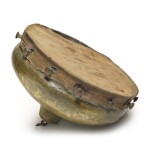

An engraved brass hawking drum, Persia or India, 17th or 18th century
Auction Closed
March 31, 12:40 PM GMT
Estimate
10,000 - 15,000 GBP
Lot Details
Description
of squat bulbous form with foliate knobs around the edges to hold skin, suspension hook, the body engraved with split-palmettes on a punched ground, part of decoration intentionally left blank, animal hide skin
18.2cm. height; 28.8cm. diam.
Please note the following amendments to the printed catalogue:
Please note this lot is dated 17th or 18th century and not as previously stated in the online catalogue.
Falconry was a favourite pastime among rulers and courtiers in both Persia and India. Indeed, the subject of a courtier or prince holding a bird of prey was a perennially popular one in Mughal painting. A hand-held drum such as this would likely have been attached to the saddle of the hunter's horse, and been utilised both to flush out game and to indicate to the hunting party the hawk's feats. The section left blank on the underside shows how the drum would be held by the owner whilst protecting the finely-engraved decoration to the rest of the piece.
The split-palmette trellis pattern with trefoil pendants is derived from Safavid metalwork bowls (for example, see A.S. Melikian-Chirvani, Islamic Metalwork from the Iranian World, 8-18th Centuries, Victoria and Albert Museum, London, 1982, no.61). There are also North Indian elements in the decoration, notably the quatrefoil minor band, the ring-punched ground, the loose foliate scroll, and the raised hexafoil knops. A Safavid hawking drum of this form is now in the Victoria and Albert Museum, London, inv. no.1060-1869, while a further example, attributed to Mamluk Syria or Egypt, 14th century, was sold in these rooms, 22 April 2015, lot 19.
The split-palmette trellis pattern with trefoil pendants is derived from Safavid metalwork bowls (for example, see A.S. Melikian-Chirvani, Islamic Metalwork from the Iranian World, 8-18th Centuries, Victoria and Albert Museum, London, 1982, no.61). There are also North Indian elements in the decoration, notably the quatrefoil minor band, the ring-punched ground, the loose foliate scroll, and the raised hexafoil knops. A Safavid hawking drum of this form is now in the Victoria and Albert Museum, London, inv. no.1060-1869, while a further example, attributed to Mamluk Syria or Egypt, 14th century, was sold in these rooms, 22 April 2015, lot 19.