
Property from a Private Collection 私人收藏
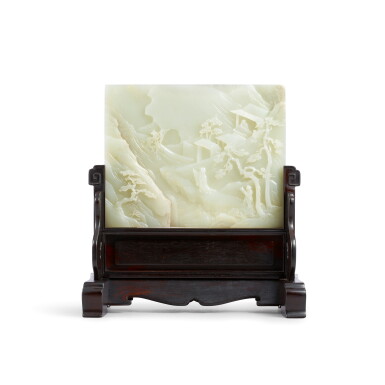
A carved celadon jade 'figural' table screen Qing dynasty, Qianlong period | 清乾隆 青白玉携琴訪友圖硯屏
Auction Closed
April 22, 07:57 AM GMT
Estimate
800,000 - 1,200,000 HKD
Lot Details
Description
Property from a Private Collection
A carved celadon jade 'figural' table screen
Qing dynasty, Qianlong period
私人收藏
清乾隆 青白玉携琴訪友圖硯屏
of rectangular form, intricately worked in varying levels of relief on one side with a mountainous riverscape depicting a scholar followed by an attendant carrying a qin, further rendered with another figure seated in a pavilion above, the reverse in low relief with pine and prunus branches, wood stand
screen 20.4 cm
An East Coast American private collection, formed prior to 1949 when the collector resided in China.
美國東岸私人收藏,1949年前旅居中國期間入藏
The motif rendered on one side of the jade panel alludes to the legend from the Spring and Autumn period about two friends named Boya and Zhong Ziqi, where the former was a master of the qin and the latter was good at listening. This subject has been especially favoured among scholars to embody friendship as the term zhiyin (‘to know the tone’) also refers to an understanding and empathetic friend.
Table screens were often placed in scholars' studios in the Song dynasty, where they served as not only an aesthetic enjoyment but also an implement to block dust particles from landing in the ground ink. The Southern Song dynasty scholar Zhao Xihu explains in his book on antiques Dongtian qinglu ji [Pure Records of the Cave Heaven] that the usage of screens in scholars’ studios did not begin until the Song dynasty. By the Ming and Qing dynasties, screens became widely popular and their production, from the choice of material to the execution of the craftsmen, became increasingly refined.
硯屏青白玉製,正面浮雕山林樓臺,松桐挺拔,流水湍急。山道上老人身著長袍,當風而立,轉頭看著緊隨身後的持琴童子,右手指向前方房舍;房舍樓閣上老人憑欄遠望,等待客人的到來。背面工匠巧用自然石紋,淺雕梅竹雙清。此屏紋飾雕琢精細,嫻熟流暢,
「攜琴訪友」,以春秋時伯牙與鍾子期的故事為藍本,歷代相傳,為文人雅士鍾愛的題材。伯牙琴技高超,樵夫鍾子期善聽琴,從伯牙琴聲中悟出他的心意,成為知音好友。
硯屏常見於文人案頭,既可觀賞,亦可用以硯墨時擋蔽風塵。南宋文人趙希鵠在《洞天清祿集》中對文房清玩進行分類及鑒賞,為後人對文房清玩的鑒賞考證之典範。《洞天清祿集》曰:「古無硯屏……自東坡、山谷始作硯屏。」硯屏始於宋,盛於明、清,而且用材更為講究。