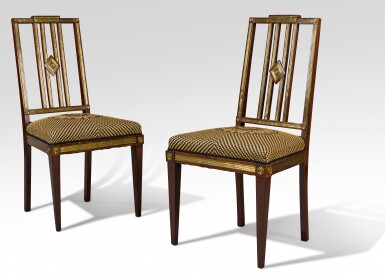
A pair of Russian gilt-brass mounted mahogany side chairs, first half 19th century
Auction Closed
October 6, 05:06 PM GMT
Estimate
4,000 - 6,000 EUR
Lot Details
Description
with a pierced backrest decorated with a central lozenge adorned with fluting and pastilles, the frieze with a similar decor, resting on tapering square legs, with a modern beige and brown woven upholstery decorated with a central medallion
(2)
Haut. 96 cm, larg. 49 cm, prof. 43 cm ; Height 37 ¾ in, width 19 ¼ in, depth 16 ⁷⁄₈ in
Please note that on 27 July 2022 the United States imposed import tariffs on certain Russian goods. This lot may be subject to a tariff upon import into the United States. The amount of the import tariff due is a percentage of the value declared upon entry into the United States.
Christie's, New York, 20 May 2008, lot 328.
Related Literature :
A. Kuchumov, Pavlovsk. Palace & Park, Leningrad, 1975, p. 80, ill. 52
G. Loukomski et Th. Heneage & Co, Tsarskoïe Selo. Furniture & Interiors, 1987, p. 57
A. Chenevière, Russian Furniture, The Golden Age 1780-1840, Londres, 1988
E. Ducamp, Pavlovsk, The Palace and the Park, Paris, 1993, pp. 170, 171, 173
This pair of chairs is representative of Russian furniture in the so-called "Jacob" style, produced in the early 19th century. Their geometric structure, with clear lines and minimal ornamentation, reflects the prevailing Neoclassical aesthetic of the period. Made of mahogany, the chairs are adorned with decorative brass elements whose systematic use is a defining feature of the style. This formal vocabulary recalls certain models created by Georges Jacob in France at the end of the 18th century, particularly his openwork-back chairs, the most famous and elaborate of which is the suite delivered for Marie-Antoinette at the dairy pavilion of Rambouillet, after designs by Hubert Robert.
The expression “Russian Jacob,” whose origin and usage remain unclear, does not indicate a direct lineage from the French cabinetmaker Georges Jacob (1739–1814), but rather a loose reference to a Neoclassical taste inspired by the French model. While Jacob was among the first to use mahogany for seat furniture in France and to follow the antique revival movement led by David, his influence on Russian production is primarily material rather than stylistic. In the Russian Empire, this style spread widely from the 1790s onward, particularly in Saint Petersburg and Moscow, but also in various provincial centers. Furniture of this type can be found in Russian imperial residences, notably a series of chairs and armchairs delivered for the library of Grand Duchess Maria Feodorovna at Pavlovsk.
Examples of this style appear only occasionally on the art market. A few comparable pieces have surfaced in recent years, including a suite offered by Pierre Bergé & Associés (12 December 2007, lots 385, 386, and 387), and an armchair sold at Brissoneau Daguerre (21 May 2003, lot 387).
You May Also Like