
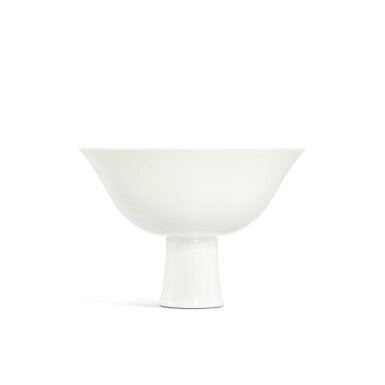
Property from an Asian private collection | 亞洲私人收藏
A fine and extremely rare anhua-decorated 'sweet-white' stem bowl, Seal mark and period of Yongle | 明永樂 甜白釉暗花八吉祥紋高足盌 《永樂年製》模印款
Auction Closed
April 8, 02:15 PM GMT
Estimate
3,500,000 - 4,500,000 HKD
Lot Details
Description
Property from an Asian private collection
A fine and extremely rare anhua-decorated 'sweet-white' stem bowl,
Seal mark and period of Yongle
亞洲私人收藏
明永樂 甜白釉暗花八吉祥紋高足盌 《永樂年製》模印款
w. 15.3 cm
Sotheby's Hong Kong, 24th November 1987, lot 40.
Christie's Hong Kong, 30th November 2011, lot 2922.
Christie's Hong Kong, 1st June 2016, lot 3221.
香港蘇富比1987年11月24日,編號40
香港佳士得2011年11月30日,編號2922
香港佳士得2016年6月1日,編號3221
Yongle porcelains inscribed with the imperial reign mark are extremely rare. Imperial reign marks were first used during the Yongle period, and were inscribed both on Buddhist gilt-bronze images and on porcelains used in Buddhist rituals, namely monochrome white and red stembowls and white monks’ cap ewers. On porcelains the mark is always in archaic script and in the four-character form, and has been traced by Liu Xinyuan to the style of the court calligrapher Shen Du, whom the Yongle Emperor is said to have greatly admired; see the exhibition catalogue Imperial Porcelain of the Yongle and Xuande Periods Excavated from the Site of the Ming Imperial Factory at Jingdezhen, Hong Kong Museum of Art, Hong Kong, 1989, pp. 40f. and 74f.
Fragments of numerous monochrome ‘sweet-white’ stembowls of Yongle mark and period have been recovered from the waste heaps of the Ming imperial kiln site, both in the early and the late Yongle stratum. The mark is always inscribed on the inside of the bowl, either in the centre or on the sides, and can be incised or impressed in anhua technique, as in the present example. A reconstructed stembowl and three sherds from the early Yongle stratum of the kiln site were included in the exhibition Jingdezhen chutu Ming chu guanyao ciqi / Imperial Hongwu and Yongle Porcelain Excavated at Jingdezhen, Chang Foundation, Taipei, 1996, cat. nos. 110 and 158-60.
Examples of Yongle-marked stembowls with anhua-decorated Eight Buddhist Emblems (bajixiang) are exceptionally rare. A related example, but with an incised mark within a medallion of petal panels, formerly in the Meiyintang Collection and included in Regina Krahl, Chinese Ceramics from the Meiyintang Collection, London, 1994-2010, vol. 2, no. 652, was sold in these rooms, 8th April 2013, lot 8. Compare also a stembowl with the mark surrounded by waves, also sold in these rooms, 20th November 1984, lot 349.
永樂一朝,書有年款之瓷器極為珍稀。御器年款,始用於永樂年間,署於鎏金佛造像與佛教祭典用瓷之上,如甜白或祭紅高足盌、白釉僧帽壺。永樂瓷上年款多作四字篆體,劉新源溯篆款為倣書家沈度之風所作,據知永樂帝對他甚為景仰,詳見展覽圖錄《景德鎮珠山出土永樂宣德官窰瓷器展覽》,香港藝術館,香港,1989年,頁40f、74f。
明官窰遺址碎瓷堆永樂初及晚期地層,曾出土為數頗多署款甜白釉高足盌殘片。但見年款均寫於盌內器心或裏壁,有劃花或暗花方式書款。例見窰址明初地層出土高足盌殘器及破瓷三片,皆展於《景德鎮出土明初官窰瓷器》,鴻禧美術館,台北,1996年,編號110及158-160。
永樂署款甜白釉暗花八吉祥紋高足盌極罕。玫茵堂舊藏類例,惟年款陰刻,收入康蕊君,《玫茵堂中國陶瓷》,倫敦,1994-2010年,卷2,編號652,2013年4月8日經香港蘇富比易手,編號8。另有一例,年款外飾波浪紋,1984年11月20日在香港蘇富比拍出,編號349。
You May Also Like


