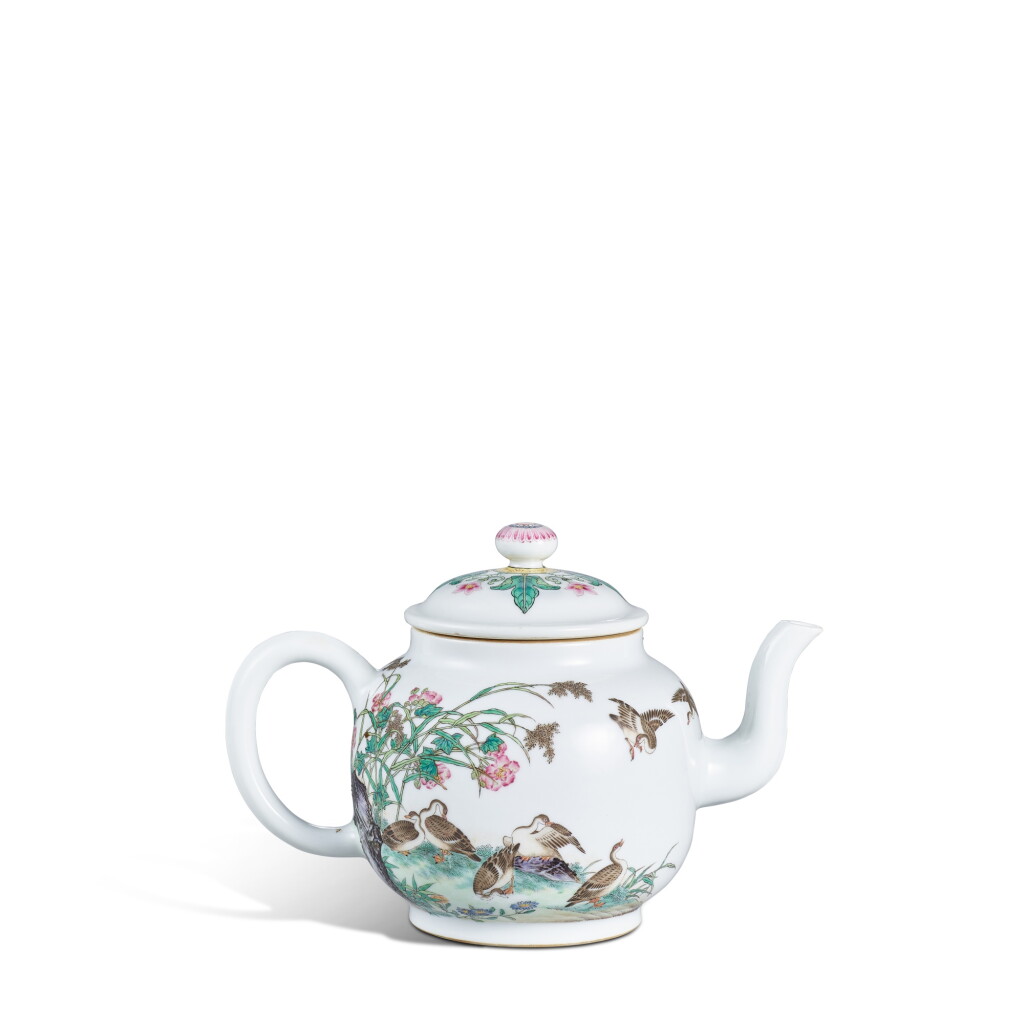
An exceedingly rare and important imperial falangcai 'geese' teapot and cover, Blue-enamel mark and period of Qianlong, Matching record dated to the 17th day of the 9th month in the 5th year of the Qianlong period (corresponding to 1740) | 清乾隆 琺瑯彩「飛鳴宿食」圖茶壺 《乾隆年製》藍料款 據錄製於乾隆五年九月十七日
Premium Lot
Auction Closed
May 5, 01:09 PM GMT
Estimate
30,000,000 - 80,000,000 HKD
Lot Details
Description
l. 18.5 cm
Collection of a former lady of the Qing court, acquired in the early 20th century, and thence by descent.
An Asian private collection, acquired directly from the above family.
來源
前清宮仕女舊藏,入藏於二十世紀初,此後由家族繼承
亞洲私人收藏,直接得自上述家族
“Flying with a Cry, Resting to Refuel”
Regina Krahl
The most beautiful, sensitive paintings ever done on porcelain are undoubtedly those created by court artists for a very short period inside the Forbidden City in Beijing, in the early part of the eighteenth century. Originally enamelled with foreign colours (‘falangcai’), the items painted under the very eyes of the emperors are more closely connected to the rulers than any other imperial porcelains. The workshops in the palace precincts were intimate ateliers with small enamelling kilns, fitted into existing historic halls in the Forbidden City, in direct vicinity to the emperors’ living quarters. Production took place on a very small scale, with pieces commissioned, executed and delivered individually or in pairs and duly recorded in the palace archives. These were not official wares that would have served at the official functions the emperors had to perform, but luxury items for the use or simply the pleasure of the respective rulers. They were not stored out of sight in the grand palace warehouses, but kept in close proximity inside the Qianqinggong (Palace of Heavenly Purity) and the Yangxindian (Hall of Mental Cultivation). Falangcai porcelain was always very special and is extremely rare.
The Jingdezhen imperial kilns in Jiangxi province provided fully fired porcelain blanks for the Beijing workshops. For delivery to Beijing, special porcelains seem too have been selected. The enamels were soon produced in situ, also in small batches, and differ from those developed for the large-scale production at Jingdezhen. Since the vessels were completely plain, falangcai porcelains painted in the palaces have the distinction of imperial reign marks being inscribed in overglaze enamel rather than the otherwise typical underglaze blue.
The beginnings in the late Kangxi period (1662–1722) were still an experimental period, when the enamels could only be applied onto an unglazed surface; Jingdezhen therefore sent unglazed porcelains, but since the unglazed surfaces had to be fully covered with enamel, painterly decoration like on the present piece was not possible. The Kangxi Emperor already seems to have aimed for true paintings on porcelain, however, and commanded court painters to the workshops. Even esteemed European court artists such as Giuseppe Castiglione (1688–1766) and Matteo Ripa (1682 – 1746) were not exempt from that duty, as recorded in a letter by Ripa, who leaves no doubt that they disliked to be confined in that workshop, where the atmosphere may have been rather rough.
In the Yongzheng period (1723–1735), the technical problems had been solved and porcelains could be enamelled like paintings in ink and colours on silk or paper. The finest falangcai wares were done during the Yongzheng and early Qianlong (1736–1795) reigns and show subtle, superbly composed nature scenes accompanied by poetic colophons and even (painted) seals, like the present teapot. That this exquisite painterly style, which required accomplished artists, was so short-lived is probably explained by the perennial shortage of painters at the falangcai workshops who could (or would) perform this task. Very soon such demanding paintings were superseded again by much heavier and denser decoration covering more of the white porcelain surface, which porcelain painters were more familiar with.
The Beijing workshop mainly enamelled porcelain bowls and dishes, as well small items such as cups and snuff bottles; vases are extremely rare, but rarer still are teapots, even though the Kangxi, Yongzheng and Qianlong Emperors all seem to have had a special interest in tea. The Qianlong Emperor was a great tea connoisseur, who was particular not only with the teas he preferred but also with the water used, recommending dew harvested from lotus leaves. He composed many poems on brewing tea and later had tea pavilions built in several imperial gardens. The reason for the general rarity of falangcai teapots may be that space in the small enamelling kilns inside the Forbidden City was at a premium; teapots and their covers took up probably more cubic volume than any other objects fired there.
The Qing Archives of the Imperial Workshops (zaobanchu) and the Palace Records of Porcelain (ciqidang) state that “on the 17th day of the 9th month in the fifth year of the Qianlong reign (corresponding to 6th November 1740), Eunuch Cheng Jingui reported that Eunuch Gao Yu and others submitted… a pair of porcelain-bodied ‘flying-with-a-cry-resting-to-refuel’ teapots (citai feiming sushi yuan hu yidui)… They entered the Palace of Heavenly Purity (Qianqinggong), were fitted into boxes, and stored among the graded porcelain wares in specially made cases.”
The pair to the present teapot, painted with the same theme of geese stopping over to rest and refuel before flying off again with their cries, is in the Sir Percival David Collection in the British Museum, London (PDF,A.833) (fig. 1). The two vessels are matching in every respect, with complementary rather than identical designs, as was the rule for falangcai pairs. The poetic lines are the same, with the following translation by Stephen Allee offered for the British Museum piece:
As autumn fills the rivers and lakes, together they eat and drink,
When wind roars through rushes and reeds, off they fly with a cry.
The three seals renhe, sifang, and qingyan, also the same on both pots, are otherwise rare among falangcai porcelains. The Percival David piece retains a cover that was painted to match.
Flocks of wild geese in migration, ‘flying with a cry, resting to refuel’, had for centuries been a popular topic of paintings and poems. Several Chinese painters had undertaken the challenge of rendering one kind of bird in ever changing poses and motions to represent the constant movement and endless variation of nature. A long handscroll entitled A Hundred Geese, preserved in the Honolulu Museum of Art, Honolulu, Hawaii, 1927 (2121), is a brilliant tour-de-force showing off such mastery by an anonymous painter of the late Song/early Yuan period (thirteenth century). This or a similar painting must have inspired the contemporary poet Dai Biaoyuan (1244–1310) to a poem with the same title, where he muses on his uncertain times, as he sees wild geese lucky to have escaped the hunter and to have been painted instead.
Wild geese remained a frequent theme of Chinese poetry, their migratory habit generally serving as a symbol for the change of seasons, and in the northern part of the country as a sign of arriving autumn, before the birds head off for warmer climes in the south. On this pair of teapots (the present and the Percival David piece), the geese are making a stopover on their journey on a patch of land by the water. The painter managed to depict altogether probably three dozen geese on their surfaces, one dozen on each pot and half a dozen, presumably, on each cover (distributed over outside and inside), all in different attitudes.
The association with autumn, which is directly referred to in the colophon, is also reflected in the vegetation depicted. The glorious hibiscus bush, flowering in late summer, signals arriving autumn, as are the small asters, here combined with common reed and bamboo. As a detail in realism the painter has introduced some most delicate pale dotting, probably to evoke dew-covered gossamer, as often found in marshes in autumn, created by spiders and other insects. While the layout is composed like a handscroll and can be ‘read’ by turning the vessel 360 degrees, it is also specially configured for this particular shape, as the grass-covered ground on both sides of the vessel slopes down from handle to spout, following the direction of the liquid when pouring.
The enamels are intense, strong and pastose, and can really be felt on top of the glossy porcelain when touched, unlike typical Jingdezhen enamels. The colour scheme is highly sophisticated, with the browns of birds and flowering grasses set against a wide-ranging palette of greens, with highlights in rose-pink. The craggy rocks with their pitch-black edges set against a rare tone of bluish aubergine are peculiar to Beijing enamelling.
Falangcai pieces such as these were highly individual productions not only in terms of their decoration, but even in terms of the blanks sent from Jingdezhen. Particularly fine and shiny porcelain was chosen for the purpose. The two pots have the same proportions and features, with a somewhat oval profile with fairly steep sides and a relatively steep spout, which is otherwise rare. Spout and handle are finely bevelled to create a clear ridge down their length, which makes the form very distinctive. Unusual is also the tall, bell-shaped cover of the Percival David teapot, which on our vessel is missing. These are specifics not normally seen in the kilns’ standard line of teapots. Most other recorded Qianlong and Yongzheng falangcai examles are more globular, with more outward flaring spouts, spout and handle of circular section, and come with the shallower cover, like the one now associated with the present piece.
The cover of our teapot was most likely replaced in the Forbidden City. That covers were broken or misplaced in the vast palace compound and therefore exchanged was not unusual and the same fate seems to have beset a Yongzheng teapot today in the Palace Museum, Taipei, which equally has a cover with formal flower decoration that does not take up the main design of the vessel (see the list below). With its rare formal flower design and yellow scroll border, the present cover is also characteristic of the style of Beijing’s falangcai rather than Jingdezhen’s imperial workshops.
Only five other falangcai teapots appear to be recorded from the Qianlong reign, including the pair to the present piece. This companion teapot in the Sir Percival David Collection at the British Museum has been much published, for example, in Regina Krahl and Jessica Harrison-Hall, Chinese Ceramics. Highlights of the Sir Percival David Collection, London, 2009, pl. 48; and in the Illustrated Catalogue of Qing Enamelled Wares in the Percival David Foundation of Chinese Art, rev.ed., London, 1991, no. A833. Only one other Qianlong teapot is decorated with a painterly motif – prunus and rocks – all around the vessel and inscribed with a poem, a vessel also in the Sir Percival David Collection and illustrated ibid., no. A809 (fig. 2). The other three Qianlong falangcai teapots are closer in their proportions and silhouette to the present piece, including their covers, but very differently decorated: a pair, in the Palace Museum, Taipei, shows overall red and blue scrollwork with scenes of ladies and children reserved in panels, see Ye keyi qing xin – cha qi, cha shi, cha hua/Empty Vessels, Replenished Minds: The Culture, Practice, and Art of Tea, Palace Museum, Taipei, 2002, pl. 131 (showing one of the pair) (fig. 3); the third, in the Palace Museum, Beijing, is fully covered with monochrome puce enamel and decorated with incised formal borders only, see Zhongguo taoci quanji [Complete series on Chinese ceramics], vol. 15, Shanghai, 2000, pl. 71 (fig. 4).
Seven falangcai teapots are known of Yongzheng mark and period, also including one pair. The Taipei Palace Museum owns five of them, all included in the Taipei tea exhibition 2002 (op.cit.); only one of them, pl. 104, shows an all-round painterly design of magpies among flowering branches, and also has a non-matching cover with a formal flower design; pl. 101, of more depressed shape, is painted with blue enamel landscape panels surrounded by a mille-fleurs pattern; pl. 102, shows butterfly roundels; and pl. 103, magpies among flowers in panels within a grisaille flower pattern. A teapot painted with a blue landscape is in the Design Museum, Copenhagen, see Geng Baochang, Ming Qing ciqi jianding [Appraisal of Ming and Qing porcelain], Hong Kong, 1993, fig. 425; and one with a lotus design is in the British Museum from the Sir Percival David Collection, published in the Illustrated Catalogue of Qing Enamelled Wares, op.cit., no. A825. From the Kangxi reign falangcai teapots are known only with enamelling on unglazed brown stonewares provided by the Yixing kilns of Jiangsu province.
The Beijing workshops had used the design of geese among hibiscus and soft rush already in the Yongzheng period on a cup, today in a private collection, sold in these rooms 14th November 1989, lot 314, and illustrated in Sotheby’s: Thirty Years in Hong Kong, Hong Kong, 2003, no. 320 (fig. 5); it is inscribed with only the second line of our poem, but bears the same seals, which otherwise are extremely rare. Another geese design, but in a style closer to the above-mentioned Song/Yuan painting, purely in sepia tones, with the birds shown among reeds only, and inscribed with a different poem, appears on a pair of falangcai wine cups of Qianlong mark and period in the Palace Museum, Taipei, see Fengge gushi. Qianlong nian shi falangcai ci/Story of an Artistic Style. Imperial Porcelain with Painted Enamels of the Qianlong Emperor, Palace Museum, Taipei, 2021, nos 1–40 and 1–41.
飛鳴宿食
康蕊君
十八世紀初期,在紫禁城內由宮廷畫師繪製、內廷作坊燒造的瓷器,無疑是中國歷史上最精美、細膩之例。此批御瓷,在皇帝親自監督下,以琺瑯彩繪飾,與帝王息息相關。造辦處作坊設于紫禁城內,毗鄰寢宮之地,闢小型瓷窰用以作釉上彩,規模受限,產量甚稀,由帝王詔命燒製,成器多單件或成對,詳細記錄於清宮檔案內。如此珍品,已非宮廷日常用器,而是皇帝專用御瓷,或者賞翫之寶。多保存於乾清宮、養心殿內,博帝王歡心,而非藏於一般貯物庫房。琺瑯彩瓷之珍稀、尊貴,不在話下。
琺瑯作使用之瓷胎,由江西景德鎮御窰廠燒製,釉上留白,精挑細揀後送至北京,在紫禁城內進行釉上繪燒,成品數量少,與景德鎮的大規模官窰燒製相異。因送至北京時,瓷胎已滿施透明釉,此類御瓷以釉上彩書年款,與多數官窰的釉下青花年款相異,可謂其特徵。
始自康熙晚期,琺瑯彩瓷試燒階段,僅能繪琺瑯於澀胎上,景德鎮御窰廠遂燒製無釉澀胎以供之,此時期,瓷身通體外觀滿罩琺瑯彩,必須滿彩的裝飾風格,自然與本品如畫卷之姿,大異其趣。然而,康熙皇帝早已以在瓷器上實現正統繪畫為目標,根據馬國賢信箋中記載,歐洲傳教士畫師們,即使盛名如郎世寧與馬氏自身,也得忍受艱苦的作坊環境、濃熾的焰氣,奉命輪職。
雍正一朝,琺瑯彩燒造技術的進步,方能在瓷釉上繪出如同紙上或絹上的彩墨繪畫,現存最為精緻的琺瑯彩瓷,即出自雍正至乾隆早期,畫風細膩寫實,構圖自然清逸,搭配相應的詩文,甚至鈐印,如同本壺。可惜這樣精美的瓷上繪畫,僅延續短短數載,或因琺瑯作短缺如此善畫人手。不久,更為華麗繁複的裝飾風格,逐漸取代成為主流,留白的地方少了,反而一般傳統瓷匠畫工更能勝任。
造辦處作坊多燒造小型瓷盌、盤、盃、鼻煙壺,瓷瓶相當少,瓷壺更少,雖然康熙、雍正、乾隆三帝皆愛茶。乾隆皇帝尤其擅長品鑑茗茶,不僅重視茶葉,烹茶水質亦講究,最為推崇荷葉上蒐集來的晨露,曾作過為數不少與茶相關的御製詩,並建造多座茶亭。琺瑯彩茶壺之稀珍,或因為紫禁城瓷窰甚小,茶壺與蓋較其他器物,更佔空間,遂少燒造。
《清宮內務府造辦處活計檔》與《瓷器檔》記載,「乾隆五年九月十七日(1740年11月6日),太監程進貴來說,太監高玉等交……磁胎飛鳴宿食元壺一對……入乾清宮配匣等次磁器內配匣盛裝。」
與本品成對之例,現藏倫敦大英博物館大維德基金會,紋飾與此壺相應,描寫雁群閒憩待高鳴啟程之瞬,館藏編號:PDF,A.833(圖1)。二壺構圖互相呼應,其餘各方面都一致,正是琺瑯彩瓷成對之律。詩文一致:「秋滿江湖同飲啄,風喧蘆葦自飛鳴。」三朱印,「仁和」、「四方」、「清晏」,亦同。大維德藏例,仍保有雁紋原蓋。
雁群遷徙,「飛鳴宿食」,向來為詩畫盛行題材之一,現存數本歷代名作可見畫家致力於融筆墨於自然,捕捉、描繪雁姿生生不休的動態。夏威夷檀香山藝術博物館藏一長卷《百雁圖》(藏品編號:2121),作於宋元之際(十三世紀),繪雁群暫泊於水岸,草豐雁肥,搖曳抖擻,千姿百態,引人入勝。此作或啟發同期文人戴表元(1244–1310年)作同名詩〈百雁圖〉,記錄曾目睹野雁幸運躲過獵殺,反而入了名家之畫一暢事。
雁群隨著季節遷徙,作為時節更替的象徵,常常入詩,在國境北方,大雁南遷,即是秋風到來的先訊。前述的大維德藏壺,紋飾描寫雁群在長途遷徙中,短憩於水邊一方小灘岸,與本品相加後,裡裡外外應共描繪了約三十六隻大雁,壺身各十二,壺蓋內外各六,姿態各異。
壺上詩文亦明確指出秋天,並運用植物反映、加強秋天的意涵。芙蓉花盛放,多在夏末,意指秋將到來,紫菀也同,搭配蘆葦與竹葉。為求自然寫實,畫人運用極為細緻的密點細筆,展現秋天郊野常見,蛛蟲織網上閃耀的露水霧氣。畫面佈局雖以通景,可周繞賞玩,構圖亦見巧思,雁群休憩的水洲,由壺把處往壺流下行,依順著斟茶時茶壺傾斜的方向,妙不可言。
光潤釉面上的琺瑯彩,濃麗鮮豔,觸感厚實,與景德鎮燒造之釉上彩相異。色調極為細膩,雁羽棕褐、繁花密草,以深淺濃淡、層次豐富的綠色底調相襯,再綴以嫩粉嬌紅。岸岩深黑皴筆,染以青藍濃紫,乃北京琺瑯作特有。
此類琺瑯彩瓷件件皆是特製,不僅是紋飾設計,打從在景德鎮御窰廠時,瓷胎挑選已經是萬中選一,祇有最精緻細潤的,方能雀屏中選。本品與大維德藏例,二者壺身比例、特徵皆一致,側視微顯橢圓,壺腹曲線陡落,壺流造形相應,較為昂揚。壺把、壺流圓潤,中線起稜,更是此對壺獨有之特徵。後者壺蓋圓挺如鐘,甚為罕見造形,本品原蓋則已佚失。上述特點,異於一般標準器。多數雍正、乾隆琺瑯彩瓷壺,器形圓鼓,壺流更外撇,壺流、壺把圓骨無稜,壺蓋則矮圓,如本品現蓋。
本壺之壺蓋,應在紫禁城時,已得更替。宮內上下萬事碌碌,數百年歲月中,壺蓋佚失或破損都是常有之事,參考台北故宮博物院藏一件雍正瓷壺,蓋同為花卉紋飾,與壺身題材不符(見下述類例)。現蓋的花卉紋飾與黃地卷草紋,皆是北京琺瑯作典型風格,非出自景德鎮御窰廠。
著錄記載僅見另五例乾隆朝琺瑯彩瓷壺,包括前述本品對壺,現為大維德基金會藏品,倫敦大英博物館,曾廣為刊載,如康蕊君與霍吉淑,《Chinese Ceramics. Highlights of the Sir Percival David Collection》,倫敦,2009年,圖版48;《IllustratedCatalogue of Qing Enamelled Wares in the Percival David Foundation of Chinese Art》,倫敦,1991年再版,編號A833。大維德基金會藏另一件乾隆琺瑯彩壺,繪庭石與梅枝,書詩文,繪工精湛,錄於,同上,編號A809(圖2)。另三例,器形比例、輪廓、壺蓋,皆與本品近類,紋飾各異,一為台北故宮博物院藏品成對,壺身密綴紅、藍彩錦地花紋,二側開光內繪仕女四藝圖,見《也可以清心:茶器、茶事、茶畫》,故宮博物院,台北,2002年,圖版131(其中一壺,圖3);第三例為北京故宮博物院藏品,通體施以單色胭脂紫彩,僅剔刻邊沿飾紋,出版於《中國陶瓷全集》,卷15,上海,2000年,圖版71(圖4)。
現知雍正朝琺瑯彩瓷壺七例,包括一雙對壺,其中五件為台北故宮博物院所藏,皆載於前述2002年茶文化展覽,前述出處;僅一例為通景紋飾,圖版104,繪喜鵲嬉於繁花枝頭,書詩文,鈐三印,壺蓋綴制式蓮瓣紋,並非呼應壺身主題;圖版101,百花地開光,內繪青山水;圖版102,二側飾團花蝶紋;圖版103,墨彩花卉紋地上開光,二側分別繪雙鵲、雙鵪,搭配花卉、竹石。哥本哈根,丹麥藝術與設計博物館藏一壺,綴青山水,錄於耿寶昌,《明清瓷器鑑定》,香港,1993年,圖45;還有一例藏於大英博物館大維德基金會,繪荷花,出版於《Illustrated Catalogue of Qing Enamelled Wares》,前述出處,編號A825。康熙朝琺瑯彩茶壺,僅知作於江蘇宜興燒造的無釉紫砂胎上。
早在雍正朝,紫禁城琺瑯作已始繪飛鳴宿食於瓷上,如私人收藏一例小盃,1989年11月14日售於香港蘇富比,編號314,刊於《香港蘇富比三十週年》,香港,2003年,編號320(圖5),盃上只書本品的第二句詩,但鈐印一致,極為珍稀。雁紋,還可見於一對乾隆琺瑯彩赭墨蘆雁紋酒鍾,繪畫風格更得前述宋元之風,詩句與本品相異,現藏台北故宮博物院,見《風格故事:乾隆年製琺瑯彩瓷》,故宮博物院,台北,2021年,編號1–40、1–41。
You May Also Like