The Geri Brawerman Collection: A Tribute to Los Angeles and A Legacy of Giving
Mark Rothko
Untitled
Auction Closed
November 21, 01:55 AM GMT
Estimate
3,000,000 - 5,000,000 USD
Lot Details
Description
The Geri Brawerman Collection: A Tribute to Los Angeles and A Legacy of Giving
Mark Rothko
(1903 - 1970)
Untitled
signed Mark Rothko (on the reverse)
oil on paper mounted on canvas
23 ⅝ by 17 ⅞ in. 60 by 45.4 cm.
Executed in 1967.
The following work is being considered for inclusion in the forthcoming Mark Rothko Online Resource and Catalogue Raisonné of works on paper, compiled by the National Gallery of Art, Washington, D.C.
Marlborough Gallery, New York
Private Collection, Rome
Galerie Beyeler, Basel
Private Collection, Florida
The Pace Gallery, New York
Acquired from the above in January 1992 by the present owner
Rome, Marlborough Gallery and Bergamo, Galleria Lorenzelli, Mark Rothko, 1971, pl. 1, n.p., illustrated in color (Rome)
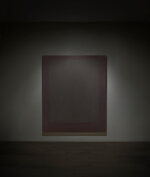
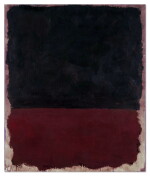
Provocative in its exquisite palette and radical candor, Untitled is a paragon of Mark Rothko's acclaimed paintings on paper. Executed in 1967, just three years before the artist's passing, the present work dates to a period of profound creative transformation, in which Rothko devoted himself almost entirely to the medium of paper. In response to health concerns that prevented him from working on large canvases, Rothko embraced the versatility and intimacy of paper, producing compositions of extraordinary depth and meditative force that rival the resonant power of his monumental paintings. Bearing distinguished provenance, Untitled has been held in the esteemed collection of Geri Brawerman, celebrated patron of the arts and philanthropist, for over three decades. A radiant and deeply evocative exemplar of his mature practice, Untitled embodies the intense potency of contrasting hues and delicate brushstrokes that distinguish Mark Rothko as among the most dynamic and influential artists of the twentieth century.
Rendered in a timeless palette with an exquisite command of composition and paint, Untitled reinforces Rothko's position as a master colorist. In Untitled, Rothko distills his palette into a milky, luminescent white set against deep, noir-like hues, creating a unique, combative tension between the colors. The two chromatic entities hover within a singular spatial field, their soft, feathered edges suspended in halos of light. Floating against the atmospheric beige ground, the black-and-white forms radiate a harmonious, charged synergy, their relationship generating a transcendental sense of stillness and motion. The pigment appears both freshly applied and eternally fixed, an optical paradox achieved through Rothko's nuanced technique of layering and feathering paint, which eliminates hard edges in favor of a subtle blending of pigment. Abandoning the classical structures of line and form, the work's holistic surface emulates the nature of a void, the black pigment seemingly absorbing surrounding light with its matte surface. Rothko achieves this divine ethereality through a nuanced feathering technique, eliminating hard edges from his compositions in favor of a subtle blending of pigment. Rothko's signature technique differentiated him from other Abstract Expressionist peers, who revolutionized abstract painting through their own means. The gentle accumulation of layers of oil paint in the present work mirrors the exacting process used in Rothko's monumental paintings, in which the thoughtful accretion of pigment realizes a magnificent sense of depth and transcendence. The edges of Rothko's forms are suspended in halos, which afford his painted surfaces a heavenly aura. Thereby, his paintings at once evoke stillness and motion, as if the pigments on the surface have been freshly applied yet are eternally fixed.
The present work dates to a critical period in Rothko's career. In 1967 and 1968, Rothko worked with an unrelenting curiosity, continually probing the relationship between the conscious and unconscious. Investigating the critical nature of man, Rothko wrote, "Freed from a false sense of security and community, the artist can abandon his plastic bankbook, just as he has abandoned other forms of security. Both the sense of community and of security depend on the familiar. Free of them, transcendental experiences become possible." (The artist quoted in: James E. B. Breslin, Mark Rothko: A Biography, Chicago, 2012, p. 239) Rothko's later paintings reflect a complete disillusionment with the parameters of contemporary society and an elimination of dependency on the familiar.
This experimentation gave rise to the present work, which is imbued with atmospheric somberness, ritualistic stillness, and contemplative power. In the spring of 1968, at his doctors' advice, Rothko refrained from working on a large scale. In working primarily with works on paper, Rothko experienced a wave of prolific creativity, as these works became a vehicle of immense creative expression and experimentation, breaking the boundaries of what painting could be. In his final years, Rothko's artistic ambition reached its pinnacle with a body of works on paper that is unparalleled in its virtuosity and brilliance. Untitled encapsulates Rothko's genius pursuit of form and light, deeply engrossing the viewer on a physically more intimate scale.
As observed by Diane Waldman of Rothko's final works, "No longer is his art earthbound, sensual, corporeal. He had attained a harmony, an equilibrium, a wholeness, in the Jungian sense, that enabled him to express universal truths in his breakthrough works, fusing the conscious and the unconscious, the finite and the infinite, the equivocal and the unequivocal, the sensuous and the spiritual." (Diane Waldman, in: Exh. Cat., New York, The Solomon R. Guggenheim Museum, Mark Rothko, 1903-1970: A Retrospective, 1978, p. 69). In Untitled, Rothko achieves profound transcendence and connects the colored entities in a composition that perfectly balances the sensual and the spiritual. Cosmically enrapturing, the present work is an exquisite instance of the emotional fortitude of Rothko's final period, rendered in a deeply reflective, personal scale.
You May Also Like