Property from a Distinguished Estate, New York
Edgar Degas
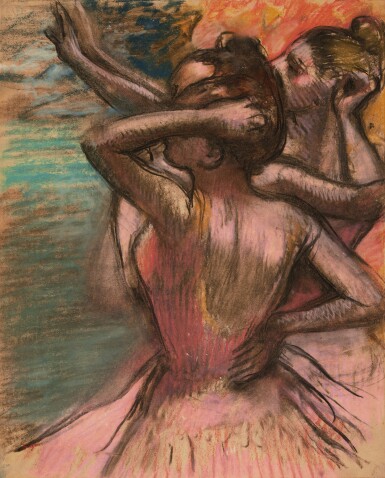
Trois danseuses
Auction Closed
November 21, 01:55 AM GMT
Estimate
3,500,000 - 5,000,000 USD
Lot Details
Description
Property from a Distinguished Estate, New York
Edgar Degas
(1834 - 1917)
Trois danseuses
stamped Degas (lower left)
pastel on tracing paper mounted on card
26 ⅜ by 20 in. 67 by 51 cm.
Executed circa 1897.
Estate of the artist
Galerie Georges Petit, Paris, Atelier Degas, 1ère Vente, 6-8 May 1918, lot 276 (consigned by the above)
Simon Bauer, Paris (acquired at the above sale)
Galerie Durand-Ruel, Paris (acquired from the above on 23 October 1930)
M. Ledoux (acquired from the above on 28 January 1966)
Edgar William and Bernice Chrysler Garbisch, Maryland
Sotheby Parke Bernet, New York, 12 May 1980, lot 13 (consigned by the above)
Acquired at the above sale by the present owner
Paris, Galerie Durand-Ruel, Edgar Degas, 1834-1917, 1960, no. 54, n.p.
Paul André Lemoisne, Degas et son oeuvre, vol. III, Paris, 1946, no. 1280, p. 742; p. 743, illustrated
Franco Russoli and Fiorella Minervino, L'Opera completa di Degas, Milan, 1970, no. 1097, p. 135, illustrated (titled Tre Ballerine che si rassettano)
Paul André Lemoisne, Degas et son oeuvre, vol. III, Paris, 1984, no. 1280, p. 742; p. 743, illustrated
Edgar Degas was unusual among the Impressionists in drawing inspiration not from the fleeting effects of light in the open air, but from the hidden spaces of the Paris Opéra. He turned his attention inward to explore the atmospheric glow of lamps in stage wings and rehearsal rooms, uncovering a different kind of visual drama in the artificial illumination of the theater. Entry to these behind-the-scenes areas was tightly controlled, however, and accessible only to a select few. It wasn’t until the late-1880s that Degas secured the full backstage access he had long sought, allowing him to immerse himself more completely in the world that had captivated his imagination and featured in his work for decades. Degas became such a regular fixture of the Palais Garnier that he remarked to the director: "You have done me so many favours, that I feel myself a little tied to your fortune and that I am about to become, as they say, one of your employees" (quoted in Jill DeVonyar and Richard Kendall, Degas and the Dance, New York, 2002, p. 14).
In this exceptional large-scale pastel, three dancers from the corps de ballet, outfitted in bright tutus, stand in the wings in nervous anticipation, waiting for their cue to dance. It is a triumph of stage-lit color effects from this prized late period in which Degas employs several audacious formal strategies. The composition is tightly cropped, revealing the dancers only from the waist up. Pressed closely together with their elongated limbs overlapping in unexpected ways, the three figures are at first glance difficult to distinguish from one another. The dancer nearest to the viewer arches her back, her muscles visibly engaged, and in a daring compositional experiment, almost entirely obscures the other two figures from view. She clasps her waist with one hand while lifting the other to adjust her hair, a gesture that partially conceals her face, in a pose that recalls similar compositions by the artist now in the collections of the Princeton University Art Museum and the Detroit Institute of Arts. Trois danseuses aligns precisely with the qualities that curator Martin Schwander identified as hallmarks of Degas’s mature style, which “include discontinuous spaces, asymmetrical compositions (becoming increasingly diffuse as they expand outward from the center), unusual viewpoints, and unconventional poses with the figures always in the area nearest to the viewer” (Martin Schwander, ibid., p. 17).
Degas documented these seemingly abrupt movements and unusual poses in his sketches of ballerinas in rehearsal and on stage, constantly reworking, rearranging and reframing his own personal corps of ballerinas. Repetition was integral to Degas’s artistic practice. As Schwander observed: “The extensive groups of works produced in this way embodied a new notion of “serial” processes in art that anticipated later developments” (ibid., p.18). In the words of the art historian George T. M. Shackelford, this "habitual, almost obsessive" aspect of Degas's working technique was part of his "process toward abstraction in the last decade of his career" (Exh. Cat. Washington, D.C., National Gallery of Art, Degas: The Dancers, 1984, p. 109). Indeed, the simplification of form and abstract fields of color in Degas's pastel anticipate many of the artistic developments of the twentieth century.
The black outlines of the dancers in the present work are rendered with fluency and confidence, and Degas applies bold, vibrant pigments in long, assertive strokes, as though relishing the expressive potential of pastel. Illuminated by stage lights, both the gauze of their skirts and the areas of exposed skin are equally iridescent; their bodices, cast in shadow, appear a darker coral tone trimmed with tangerine. The stage set, by contrast, is only loosely suggested with thick, layered striations of green, brown, charcoal gray and white along the left edge of the sheet.
Executed more than ten years after the final Impressionist exhibition of 1886, the present work was created at a time of relative isolation for the artist during which he struggled with his health and a sense of alienation from liberal politics and popular culture. Remarkably, his work from this period is nonetheless characterized by exuberant color and masterful draftsmanship, as, above all, he continued to experiment. He found new inspiration in tactile media, sculpting wax figures which would later be cast in bronze. He also discovered the potential of modern technologies like photography and film. Degas's estate included several glass negative figure studies of women dressed in ballet costumes. Several art historians have suggested that these images were staged and photographed by the artist himself, and they certainly served as important source material for works such as Trois Danseuses. The contrast of light and shadow, the sharp focus on the ballerinas in the foreground, and the indistinct 'blur' of the background, have much in common with the aesthetic of contemporary photography.
The provenance of Trois Danseuses is a fascinating and well-documented story. Degas kept this drawing in his studio until his death in 1917. In May the following year, this work featured alongside dozens of other pastels of ballerinas in the very first of Degas’ estate sales organized by the Galerie Georges Petit. It was purchased by Simon Bauer, a Parisian businessman who made his fortune selling shoes, who kept it in his collection until 1930, when he sold it to the Galerie Durand-Ruel. Prior to World War II, Bauer put together a collection of nearly one hundred Impressionist masterpieces, including works by Berthe Morisot, Alfred Sisley and Camille Pissarro —and also including Degas' 1887 pastel portrait of the celebrity Opéra ballerina, Rosita Maury. In 1943, more than a decade after he had sold Trois danseuses, Bauer was imprisoned in an internment camp and his art collection unlawfully seized by the Vichy government. When Bauer was released the following year, he attempted to recover the works in his collection; his heirs have continued that effort in his memory.
After Bauer sold Trois danseuses in 1930, the Galerie Durand-Ruel featured the work in a 1960 monographic exhibition dedicated to Degas's paintings and pastels. It later entered the collection of Bernice Chrysler Garbisch, the daughter of American auto magnate Walter P. Chrysler, and her husband, Colonel Edgar William Garbisch. The Garbisches donated much of their renowned collection of American art, including a group of 200 paintings given to the National Gallery of Art in 1954. They displayed the remainder of their most beloved works, including Degas's Trois danseuses, in their apartment at the Carlyle Hotel in New York until their passing in 1979. The present owner acquired Trois danseuses at the Garbisch estate sale at Sotheby Parke Bernet, New York in May 1980—at the time, the most valuable art collection ever sold in North America. Trois danseuses comes to auction again now for the first time in forty-five years.