The Geri Brawerman Collection: A Tribute to Los Angeles and A Legacy of Giving
Jacques Lipchitz
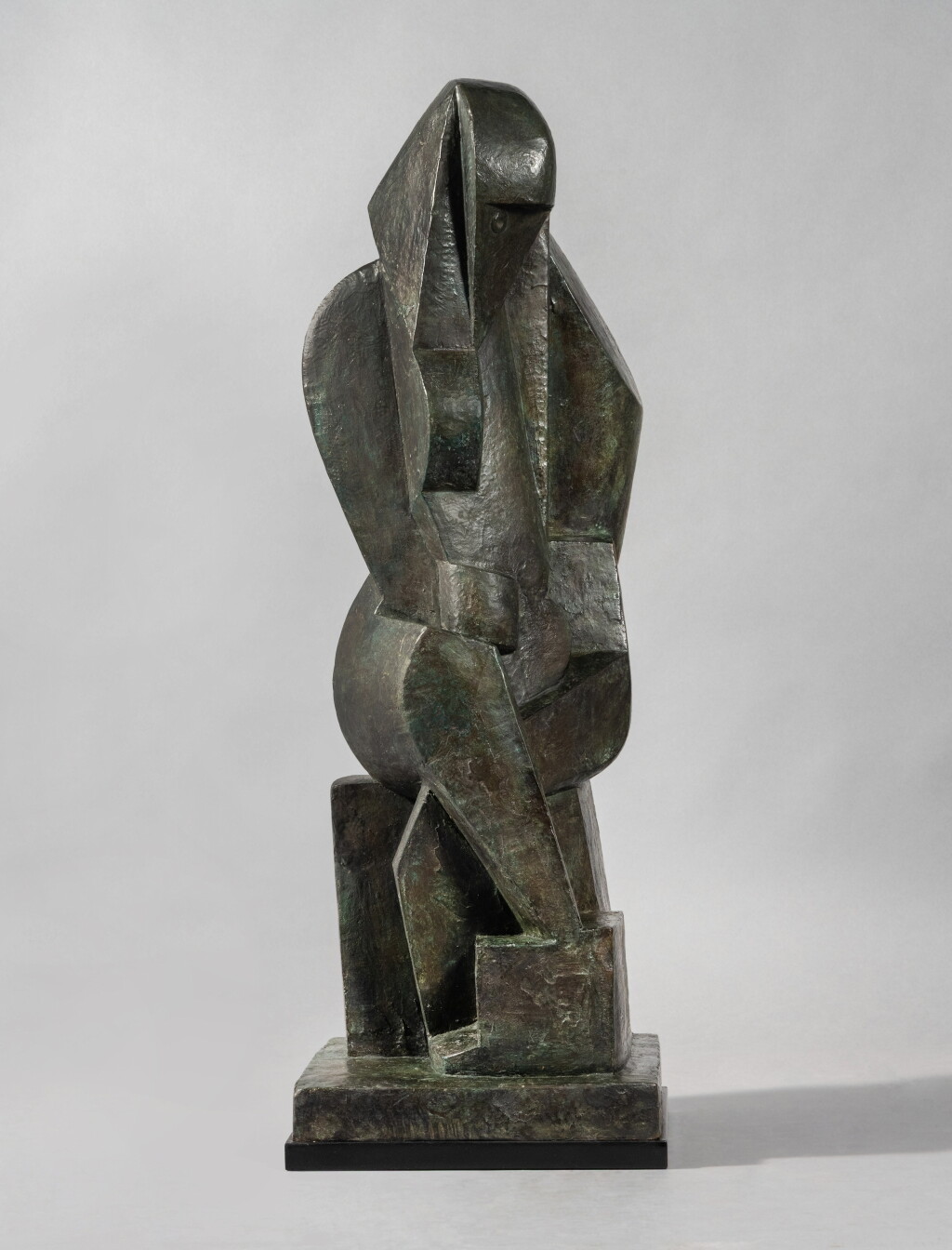
Baigneuse assise
Auction Closed
November 21, 01:55 AM GMT
Estimate
600,000 - 800,000 USD
Lot Details
Description
The Geri Brawerman Collection: A Tribute to Los Angeles and A Legacy of Giving
Jacques Lipchitz
(1891 - 1973)
Baigneuse assise
inscribed J Lipchitz, stamped with the artist’s thumbprint, numbered 7/7 and stamped with the foundry mark MODERN.ART.FDRY.N.Y.
bronze
height: 28 ⅛ in. 71.3 cm.
Conceived in 1916 and cast in the artist’s lifetime
Marlborough-Gerson Gallery Inc., New York
Lila Miley Walen, Fort Worth (acquired from the above on 5 November 1976)
Sotheby’s, New York, 12 May 1994, lot 212 (consigned by the above)
Acquired at the above sale by the present owner
Maurice Raynal, L’Art d’aujourd’hui Lipchitz, Paris, 1920, pl. 5, illustration of another cast
Exh. Cat., New York, Buchholz Gallery, Jacques Lipchitz—Early Stone Carvings and Recent Bronzes, 1948, no. 3, illustration of the stone version (dated 1917)
Exh. Cat., New York, Buchholz Gallery, Cubism, 1949, no. 29, illustration of the stone version (dated 1917)
Exh. Cat., New York, Curt Valentin Gallery, Closing Exhibition: Sculpture, Paintings and Drawings, 1955, no. 83, illustration of the stone version (dated 1917)
Robert Goldwater, Lipchitz, London, 1958, no. 3, illustration of the stone version (dated 1917)
Exh. Cat., New York, M. Knoedler & Co., Inc., The Colin Collection: Paintings, Watercolors, Drawings and Sculpture, 1960, no. 124, illustration of the stone version (dated 1917)
A.M. Hammacher, Jacques Lipchitz, His Sculpture, New York, 1960, no. 29, p. 30, illustration of the stone version (dated 1917); pp. 35-36 and 172
Exh. Cat., The Minneapolis Institute of Arts, Drawings, Paintings, and Sculpture from Three Private Collections, 1960, no. 96, illustration of another cast (titled Woman and dated 1917)
Elizabeth Payne, “Four Faces of Cubism,” Bulletin of the Detroit Institute of Arts, vol. 42, issue 1, Autumn 1962, p. 16, illustration of another cast; p. 17
Exh. Cat., New York, Marlborough-Gerson Gallery Inc., Lipchitz, The Cubist Period 1913-1930, 1968, no. 23, illustration of another cast
Tucson, University of Arizona Museum of Art, The Gallagher Memorial Collection: Paintings, Watercolors, Drawings and Sculpture, 1969, no. 16, p. 167, illustration of another cast (dated 1917)
Exh. Cat., Duisburg, Wilhelm-Lehmbruck-Museum der Stadt, Jacques Lipchitz, Skulpturen und Zeichnungen, 1911-1969, 1971, no. 13, p. 20, 22-23 and 37; p. 49, illustration of another cast
Exh. Cat., New York, The Metropolitan Museum of Art, Jacques Lipchitz: His Life in Sculpture, 1972, no. 18, another cast listed (dated 1917)
Jacques Lipchitz with H.H. Arnason, My Life in Sculpture,
New York, 1972, pp. 42 and 45; p. 43, illustration of another cast
Exh. Cat., New York, Marlborough Gallery, Jacques Lipchitz: Sculptures and Drawings from the Cubist Epoch, 1977, no. 18, p. 2, another cast listed
Deborah A. Stott, Jacques Lipchitz and Cubism, New York, 1978, no. 30, pp. 131-33 and 257; fig. 24, p. 283, illustration of another cast; fig. 25, p. 284, illustration of the stone version
Exh. Cat., Wellesley College Museum, One Century: Wellesley Families Collect, 1978, no. 57, illustration of another cast (dated 1917)
Exh. Cat., London, Tate Gallery, The Lipchitz Gift, Models for Sculpture, 1986-87, no. T03499, p. 34, illustration of the plaster (dated 1916-17)
Exh. Cat., Tokyo, Bunkamura Museum of Art; Kyoto Municipal Museum of Art and Ibaraki, The Museum of Modern Art, Masterpieces from the Detroit Institute of Arts, 1989-90, no. 116, p. 144, illustration of another cast; pp. 194, 238 and 243 (dated 1917)
Alan G. Wilkinson, The Sculpture of Jacques Lipchitz, A Catalogue Raisonné: The Paris Years 1910-1940, vol. I, New York, 1996, no. 57, p. 29 and 215; p. 46, illustration of another cast
Exh. Cat., Tucson, University of Arizona Museum of Art, Of Flesh, Form and Matter: Sculpture Selected from the UAMA Collections, 2008, illustration of another cast
Boldly geometric yet touchingly human, Baigneuse assise is a seminal work within Jacques Lipchitz’ oeuvre and a defining example of modernist sculpture. An artist at the forefront of inventing the Cubist visual language, this form sees Lipchitz at his finest—seamlessly merging the figural and abstract in a triumphant exploration of the very notion of reality itself.
Born in 1891, Lipchitz came of age at the dawn of a new epoch in human history. “The world has changed less since Jesus Christ than it has in the past thirty years,” wrote the poet Charles Péguy in 1913 (Roger Shattuck, The Banquet Years: The Origins of the Avant-Garde in France, 1885 to World War I, New York, 1968, p. xv). By 1916, rapid industrialization had irrevocably altered humans’ relationships with their labor, the natural environment and each other. The Great War was raging across Europe and the Middle East, leaving millions grappling with the casualties of modern warfare and questioning their own humanity. Rapid technological advancements sparked wonder and wreaked havoc indiscriminately. The world was spinning off its axis, and artists were scrambling for a way to capture the spirit of the age in a visual form.
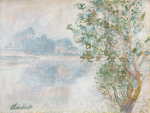
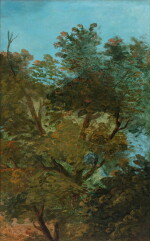
It is in this context that Lipchitz began his experimental Cubist forms, the present work marking the first in a series of depictions of bathers that would chart his development as a sculptor across the next decade. While Pablo Picasso, Georges Braque and the rest of the Cubist painters in Lipchitz’ milieu were borrowing and advancing the visual language of their post-Impressionist predecessors like Paul Cézanne (see figs. 1 and 2) and Georges Seurat, there were for Lipchitz no immediate sculptural precedents from which to derive inspiration. Sculpture, however, with its remarkable opportunity for physicality was a medium tailor-made for this pioneering abstract movement, allowing the artist to invent his own vocabulary for three-dimensional Cubism. This paved the way for Lipchitz' experimental period between 1916 and the early 1920s in which he approached questions about representation and perception, struggling to mold the reality of a brave new world with his bare hands. His series of bathers, along with his depictions of musicians, serve as the prime illustration of his development over the decade.
Lipchitz himself has described Baigneuse assise as a turning point in his development as a Cubist, marking a departure from the extreme verticality of his earlier sculptures, such as Personnage debout (see fig. 3). Here, he moves from the portrayal of static, directional figures to forms with incredible spatial complexity maneuvered into compact forms imbued with human presence. “In this work I think I clearly achieved the kind of poetry which I felt to be essential in the total impact,” he declared of Baigneuse assise in his 1972 autobiography (quoted in H.H. Arnason ed., My Life in Sculpture, New York, 1972, p. 45).
The first of his Cubist bathers, and the best example according to the scholar A.M. Hammacher, Baigneuse assise provides the visual basis for his next decade of engagement with the iconic motif (A.M. Hammacher, Jacques Lipchitz, His Sculpture, New York, 1960, pp. 35-36). This group of landmark works within his oeuvre sees him teetering on the tightrope between the figural and the abstract, occasionally diving into severe, rhythmic diagonals as in his 1917 Baigneuse (Nelson-Atkins Museum, Kansas City; see fig. 4), and other times leaning toward soft, undulating curves like the culmination of his series, the monumental Baigneuse of 1923-25 (St. Louis Art Museum; see fig. 5).
While the present Baigneuse assise depicts a seated figure, her pose is far from passive. The intersecting rectangular planes that form her limbs seem to move and collide into each other like tectonic plates. The longer one examines the sculpture, the more the eye begins to confuse reality. At first glance, it is a bashful, cross-legged bather, playfully dipping her head as she partially covers herself with drapery. A closer look leaves only the impression of a juxtaposition between soft curves and sharp angularity — solid geometric forms stacking and straining against each other in rhythmic harmony. Our eyes are fallible, Lipchitz warns the viewer, unable to distinguish between a human being and a collection of mechanical joints and planes. Time, too, is subjective as movement blurs together, the sculptor achieving the impossible act of condensing the natural dynamism of a human being in motion into one stagnant image.
Profoundly influenced by Egyptian sculpture, Lipchitz was closely emulating their ancient stone portraits when crafting the present work, evident in the bronze’s quiet solidity and resounding power. Her seated pose and draped hair are evocative of the stone depictions of pharaohs and deities that served as eternal vehicles for human spirits (see fig. 6).
Lipchitz, however, was not just seeking to convey the inert and the immortal. Keeping pace with a rapidly advancing society, he and his Cubist peers were primarily concerned with the fracturing of perspectives and reality as objects moved through space and time. To them, the self that sits down to rest is the same self that leisurely bathes in the water just moments earlier as well as the same self that will coyly cross her legs and tilt her head seconds later. To depict all these actions simultaneously, Lipchitz moved away from the full-frontal view of the ancient Egyptian portraits and toward a more dynamic circularity.
Gianlorenzo Bernini’s Baroque sculptures, such as the Rape of Proserpina, long ago expanded the possibilities of sculpture with three-dimensional spirals inviting the viewer to circle the work and watch its narrative unfold temporally (see fig. 7). In this tradition, Lipchitz’ Baigneuse assise incorporates a foundational curvilinear motion into his form, with both sinuous lines and sharp angles twisting around the central axis, capturing the viewer’s visual interest with its compelling movement.
Deeply engaged with the long history of great sculptors from the past, Lipchitz nevertheless primarily sought to create a new visual language centered around a machine aesthetic as a representation of his modern time, similar to the Italian Futurists that were his contemporaries. But while the Futurists’ championed a violent repudiation of the past in favor of the speed and power that modern technology could bring, Lipchitz’ embrace of mechanical and modernist forms were primarily born of a lifelong search for clarity and order within his art.
Umberto Boccioni’s Unique Forms of Continuity in Space aggressively strides into the future, the sheer pace of his progress morphing his body and the air around him into a war-like engine (see fig. 8). Lipchitz retains a pared-down form that subordinates movement into one unified composition in Baigneuse assise, less a rejection of humanity itself and more of an idealistic vision of the possibilities for melding man and machine. His sculptures, along with his peer Fernand Léger’s mechanical paintings, were partially a reaction to the soothing arabesque lines and natural inspirations of the Art Nouveau movement (see figs. 9 and 10). They simultaneously embrace a dialogue with his art historical predecessors as well as introduce a seismic rupture against the naturalism of the past in an attempt to visually marry the human and the mechanical.
“I remember a dream that I had; I had bitten into a ripe apple, and I woke up feeling extremely happy,” Lipchitz recalled in 1972. “The dream had some relationship to this moment of understanding that cubism was a triumph for the artist and for mankind, a new beginning, an emancipation from Mother Nature. My reaction was as acute as the one I felt recently when man first stepped on the moon … I felt it to be a moment when humanity had come out of the womb of nature to the beginning of a new independence” (ibid., p. 40)
The present work is one of an edition of 7 bronze casts in addition to a carved stone version. However, it is still wholly unique, distinguished by the remarkable details and finish done by the artist himself. Lipchitz collaborated closely with his foundry to cast each of his sculptures, entrusting them to cast the bronzes from his plaster model but carefully supervising during the lost wax casting process at the stages of preparing the waxes and patinating the bronzes. He himself would customize and retouch the waxes before the bronze was poured, a rarity amongst sculptors.
“Every time I retouch a wax, from day to day I am in a different mood. I see and want to express different textures and details,” he wrote. “Even though I make as many as seven casts of one sculpture, each issue will be different in small details. I don’t wish them to be identical” (Bert Van Bork, Jacques Lipchitz: The Artist at Work, New York, 1966, p. 31).
Held in the esteemed collection of Geri Brawerman for over 30 years, Baigneuse assise represents Lipchitz in his experimental prime. This is the first time this extraordinary form has come to auction in over 10 years, and two of the 6 other casts belong to the museum collections of the Detroit Institute of Arts and the University of Arizona Museum of Art.
You May Also Like