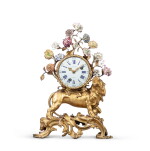
A Louis XV Porcelain-Mounted Gilt, Patinated and Polychrome Lacquered Bronze Mantel Clock, Circa 1750
Auction Closed
February 3, 09:38 PM GMT
Estimate
50,000 - 70,000 USD
Lot Details
Description
The dial signed ENE LENOIR A PARIS, the lacquered figures in the manner of the Frères Martin, decorated overall with soft paste porcelain flowerheads (some replacements), with circular enameled dial within a red and gilt-japanned case surmounted by a seated Chinese woman, supported by two crouching Chinese men and a tree in the center, on a naturalistically cast rockwork base, the movement signed Etienne Le Noir A Paris, with pierced backplate numbered 954.
height 13 in.; width 12 ½ in. depth 4½ in.
33 cm.; 32 cm.; 11.5 cm.
Possibly Prince Charles de Lorraine, Comte d'Armagnac (1684-1751), and thence by descent to the Prince de Mérode, his nephew by marriage
Messieurs Rheims Laurin, Palais Galliera, Paris, 6-7 December 1965, lot 176
With Kraemer, Paris
Monsieur et Madame Djahanguir Riahi, Paris
Christie's New York, Magnificent French Furniture, 2 November 2000, lot 8
Louis XV, Un moment de perfection de l'art Français, l'Hôtel de la Monnaie, Paris 1974, p.338, no.442
Elegance and Wonder: Masterpieces of European Art from the Jordan and Thomas A. Saunders III Collection, Virginia Museum of Fine Arts, Richmond, Virginia, May 2022 - October 2023
J.-D. Augarde, Les Ouvriers du Temps, Paris, 1996, p.180, fig.144
E. Niehüser, French Bronze Clocks, Munich, 1999, p.202, fig.141, Ref.4,180
F.M. Ricci, Quelques chefs-d'oeuvre de La Collection Djahanguir Riahi, Paris 2000, p.133-5
COMPARATIVE LITERATURE
Daniëlle Kisluk-Grosheide, 'The Reign of Magots and Pagods', Metropolitan Museum Journal, v. 37 (2002), p.177-197
This magnificent clock perfectly epitomises the engouement pour la Chine prevalent in French decorative arts that emerged in the 17th century and arguably reached its apogee in the Rococo period of the first half of the reign of Louis XV. Chinese and Japanese porcelain and earthenware figures were regularly exported to the West in the late 1600s and early 1700s and also copied by the newly founded European porcelain factories. Such figures, referred to as magots or pagodes, became extremely popular interior embellishments among fashionable collectors, so much so that in 1765 Diderot would write in the Encyclopédie that the era of Louis XV had become the ‘reign of the magots’.
Polychrome lacquered bronze figures like those seen here were first made in c.1725 and regularly used as decorative elements for gilt bronze objects including clocks, candelabra, inkstands, paperweights and potpourri vases, and references to such figures appear in inventories of numerous prominent art patrons the of period such as the Marquis de Bréteuil, the Maréchale d’Estrées and the Duchesse de Maine. In the majority of cases the magots are said to be in Vernis Martin, referring to the enterprise of the Martin brothers Guillaume (1689-1749), Etienne-Simon (1703-1770), Julien (d. 1765) and Robert (1706-1765), who ran a thriving workshop producing polychrome lacquered case furniture and boxes, small metal objects and carriage doors and received a Royal warrant in 1744. Although they were not the exclusive practitioners of this technique in mid-18th century Paris, their name became synonymous with high quality French lacquer work and given the frequent recurrence of their name in contemporary and later inventories and auction catalogues it is likely they were responsible for many of the magots that have survived today.
The Riahi-Saunders clock may well correspond to one described in the probate inventory of Prince Charles de Lorraine following his death in 1752 : Une pendule à tirage faite à Paris par Lenoir dans sa boîte de vernis rouge portée et surmontée de trois pagodes, la pendule sur son pied de bronze doré, ornée de feuillage émaillé, 400 livres. Six years later, a similar and possibly the same clock appears in an inventory of the possessions of his nephew by marriage the Prince de Mérode: Une petite pendule à tirage faite à Paris par Lenoir dans son cartel et supporté par deux magots, le tout de la Chine avec fleurs émaillés, 240 livres. Charles de Lorraine, Comte d’Argmagnac (1684-171) was the son of Louis de Lorraine, the Grand Ecuyer de France (royal equerry), one of the most important positions in the King’s Household and a hereditary title Charles inherited upon his father’s death in 1718. In 1717 he married Françoise Adélaide de Noailles, from whom he separated in 1721 and had no children. He is recorded as a client of the marchand-mercier Thomas Hébert and the great goldsmith, bronze artist and director of the Vincennes porcelain factory Jean-Claude Chambellan Duplessis. It is worth noting that the manufacturer of the movement of the present lot, Etienne II Lenoir (1699-1778; maître horloger in 1717) worked closely with another leading marchand-mercier Lazare-Duvaux to supply clocks to the Royal Household and Madame de Pompadour, and on 31 December 1751 delivered a similar clock to the Château de Choisy with lacquered magot figures described as in the invoice as 'trois enfants de cuivre bronzé'.
A gilt bronze and porcelain flower mantel clock incorporating three lacquered bronze figures of identical model to the Riahi-Saunders clock and also with a movement by Etienne Lenoir was formerly in the George Blumenthal Collection and sold Christie's New York, An American Dynasty: The Clark Family Treasures, 18 June 2014, lot 115. A mantel clock with two pagod figures in lacquered bronze and porcelain flowers and movement by Pierre Le Roy is in the Grog-Carven bequest at the Louvre (OA 10539), and two similar clocks, one with two figures and the other three and both with later movements by Vulliamy, are in the Royal Collection, formerly at Brighton Pavilion. Daniëlle Kisluk-Grosheide has identified thirteen other clocks with two lacquered bronze magots and nine with three or four magots that have appeared at auction, including:
- Baron Cassel van Doorn Collection, Parke-Bernet Galleries, New York, 6 December 1958, lot 131 (formerly Mrs Henry Walters Collection, Parke-Bernet Galleries, New York, 26 April 1941, lot 689)
- Mrs. Hamilton Rice Collection, Palais Galliera, Paris, 24 June 1965, lot 46
- Thelma Chrysler Foy Collection, Parke-Bernet Galleries, New York, 22-23 May 1959, lot 668
- Jaime Ortiz-Patiño Collection, Sotheby's New York, 20 May 1992, lot 7
- Giuseppe Rossi Collection, Sotheby's London, 11 March 1999, lot 755
- Alexander Collection, Christie's New York, 30 April 1999, lot 35
- Sotheby's Monaco, 18 June 1999, lot 84
You May Also Like